Why Can’t You Feel Glaucoma Until It’s Too Late?
Sarah, a 52-year-old accountant, came to my office for what she thought was a routine eye exam. She had no symptoms—no pain, no blurred vision, nothing that would suggest her eyes were in trouble. Yet when I measured her intraocular pressure, it was 28 mmHg, well above the normal range of 12 to 22 mmHg. Her optic nerve photos showed early cupping, the telltale sign of glaucoma. She’d been quietly losing peripheral vision for months without noticing it.
This is glaucoma’s cruel nature: it steals your sight in silence. Unlike other eye conditions that announce themselves with symptoms, glaucoma progresses without warning until significant vision loss occurs. The question patients ask me most is simple—why doesn’t it hurt? The answer reveals everything about how this disease works and why catching it early matters so much.
Key Facts About Glaucoma
- Glaucoma affects approximately 3.7 million Americans, but only half know they have it, according to CDC data
- Elevated intraocular pressure damages the optic nerve at different thresholds for different people—some tolerate 24 mmHg well while others develop damage at 18 mmHg
- African Americans are 6-8 times more likely to experience glaucoma-related blindness than Caucasians, with an earlier age of onset by 5-10 years
- Once optic nerve damage occurs, it is permanent and cannot be reversed; treatment only prevents further progression
- Open-angle glaucoma accounts for 90% of glaucoma cases in developed countries and typically shows no early symptoms
Understanding How Glaucoma Actually Damages Your Eyes
Your eye constantly produces a clear fluid called aqueous humor. Think of it like a faucet and drain system—fluid flows in at the front of your eye, and it should drain out through a network of tiny channels called the trabecular meshwork. When this drainage system malfunctions or becomes too narrow, pressure builds inside the eye, much like water backing up in a clogged sink.
This pressure—intraocular pressure or IOP—physically compresses the optic nerve, the bundle of 1.2 million nerve fibers that transmits images from your eye to your brain. The compression damages these fibers, and they die. Unlike skin cells that regenerate, nerve fibers don’t repair themselves. Each lost fiber represents a tiny blind spot, which is why peripheral vision goes first. You lose the edges before you notice anything is wrong.
Here’s the clinical insight that most articles gloss over: your eye has no pain receptors in the areas where pressure builds up. The nerve fibers being damaged don’t hurt because they’re not being stretched or torn acutely—they’re being slowly suffocated. This is why you can have dangerously high eye pressure and feel completely fine.
What Causes Glaucoma and Who’s Most at Risk
Most people think elevated eye pressure causes glaucoma. It’s more complicated. Elevated IOP is a major risk factor, but it’s not the only mechanism. Some people develop glaucoma with statistically normal pressures (called normal-tension glaucoma), while others have high pressures and never develop nerve damage. Your optic nerve’s individual susceptibility matters tremendously.
The established risk factors include age over 60, family history of glaucoma, African or Hispanic ancestry, prior eye trauma, and certain systemic conditions like diabetes and hypertension. Myopia (nearsightedness) also increases risk—the longer eyeball changes the angle where fluid drains.
One risk factor rarely discussed in popular health articles is sleep apnea. Research published in JAMA Ophthalmology found that untreated sleep apnea increases glaucoma risk through repeated episodes of low blood oxygen, which makes the optic nerve more vulnerable to pressure-related damage. If you have sleep apnea and haven’t mentioned it to your eye doctor, bring it up at your next visit.
Corticosteroid use also matters. If you’ve used prednisone, dexamethasone, or topical steroid eye drops regularly, your eye pressure can elevate as a medication side effect. This includes inhaled steroids for asthma and nasal steroid sprays.
What Glaucoma Actually Feels Like—Until It Doesn’t
Early glaucoma produces no symptoms at all. This is the problem. By the time patients notice something is wrong, they’ve usually lost 20-30% of their peripheral vision. They might mention to me that they’ve been bumping into things on one side, or they’re surprised by obstacles they didn’t see coming. Some people notice they need to turn their head more when driving or reading.
The “floaters” patients sometimes report—small dark spots drifting across vision—are not usually glaucoma. Progressive peripheral vision loss that develops slowly is the actual warning sign, but it’s subtle enough that most people rationalize it away or blame their aging eyes.
Acute angle-closure glaucoma is different. This is an emergency. Patients experience sudden severe eye pain, blurred vision, halos around lights, and sometimes nausea and vomiting. This happens when the drainage angle closes suddenly, pressure spikes rapidly to 40-50 mmHg or higher, and the optic nerve gets compressed acutely. If this happens, you need immediate treatment to prevent blindness.
How We Actually Diagnose Glaucoma
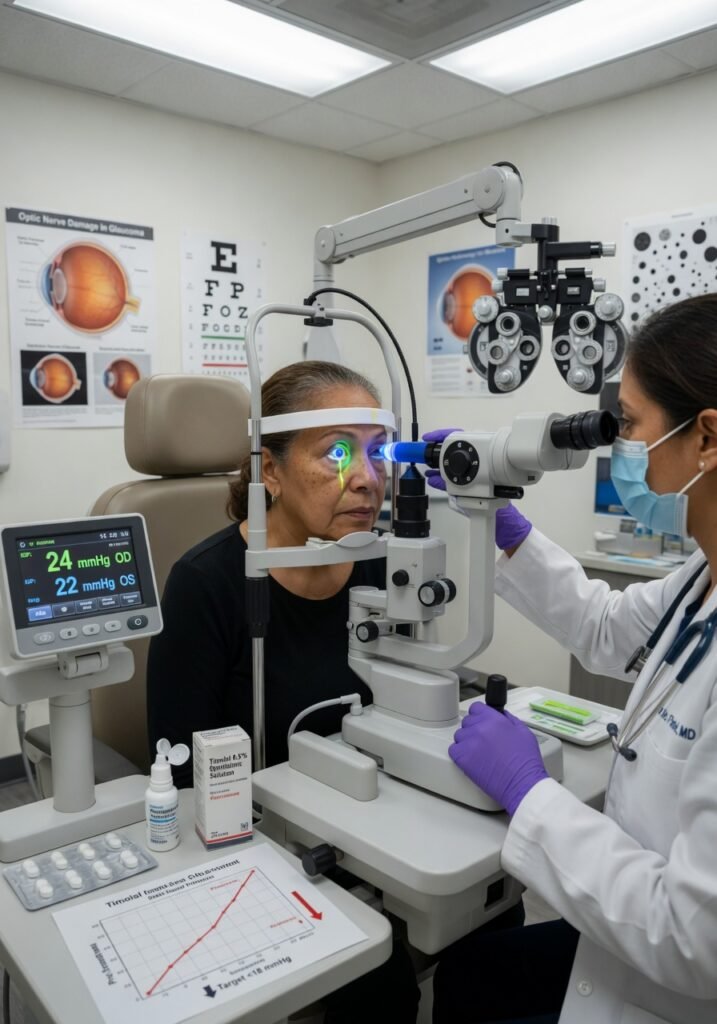
Diagnosis starts with intraocular pressure measurement, typically using applanation tonometry—a small instrument touches the front of your eye after anesthetic drops numb it. You’ll feel pressure but no pain. One reading alone doesn’t diagnose glaucoma; we look at patterns over time.
Visual field testing comes next. You sit at a machine and press a button whenever you see a light flash in your peripheral vision. The computer maps where you can and can’t see. This is the most direct way to detect vision loss from glaucoma.
Optical coherence tomography (OCT) of the optic nerve head shows the actual structure of your nerve. We look for cupping—thinning of the rim of tissue surrounding the optic nerve’s center. Significant cupping suggests glaucoma damage.
Fundoscopy—direct visualization of your optic nerve through a special lens—lets me examine the nerve head directly. We’re looking for vertical elongation, notching at the edges, or pale coloring compared to the rest of the disc.
I’ll also ask about family history and examine the angle of your eye with gonioscopy, a special lens that lets us see the drainage structures directly. Some people are born with narrow angles that predispose them to angle-closure glaucoma.
Treatment Options That Actually Work
Prostaglandin analogs are first-line medication. These include latanoprost, travoprost, and bimatoprost. They work by increasing outflow of aqueous humor through an alternate drainage pathway. You use them once daily, usually in the evening, and they lower pressure by 25-30% on average. Side effect: they can darken your iris and increase eyelash growth.
Beta-blockers like timolol reduce the amount of fluid your eye produces. They work reasonably well but are less potent than prostaglandin analogs. Topical carbonic anhydrase inhibitors like dorzolamide also decrease fluid production.
Alpha-2 agonists like brimonidine both reduce production and increase drainage. Rho kinase inhibitors like netarsudil are newer and work through multiple mechanisms.
Many patients need combination therapy—two or three different classes of drops to reach target pressure. Compliance is a huge issue; patients skip doses, mix up timing, and don’t follow instructions. I recommend using a pill organizer labeled with each eye or setting phone alarms.
Laser procedures include selective laser trabeculoplasty (SLT), which stimulates the drainage meshwork to work better. It’s less invasive than surgery but not permanent—effects wear off in 1-3 years. Some patients need the procedure repeated.
Surgical options like trabeculectomy create a new drainage pathway, bypassing the blocked trabecular meshwork. Tube shunt procedures place a small device to direct fluid drainage. These are reserved for cases that don’t respond adequately to medications and laser.
What You Actually Do Day-to-Day
If you’re on eye drops, proper technique matters. Tilt your head back, pull down your lower lid, and place the drop in the pocket formed. Close your eyes gently for 2-3 minutes—this prevents the drop from draining into your nasal passages. Use only one drop; a second drop just washes out the first. If you’re on multiple medications, wait 5 minutes between different drops.
Keep track of your intraocular pressure at each visit. Ask your doctor what your target pressure should be—it’s individualized. If your pressure is consistently above target, speak up. You might need medication adjustment or additional therapy.
Get your eyes examined at recommended intervals. Newly diagnosed glaucoma usually requires exams every 4-8 weeks initially to monitor pressure and adjust treatment. Once stable, annual or every-other-year visits are typical, but higher-risk patients need more frequent monitoring.
Avoid things that acutely elevate eye pressure. Straining to lift heavy weights, inverting your body in yoga positions, or performing Valsalva maneuvers (bearing down forcefully) can temporarily spike pressure. This shouldn’t stop you from exercising—aerobic activity actually helps lower baseline pressure—but avoid sustained straining.
Can Glaucoma Actually Be Prevented?
You can’t prevent glaucoma entirely if you have genetic predisposition. However, you can modify risk factors. Regular eye screening detects glaucoma early, before vision loss occurs. This is the most important preventive measure. If you’re over 40, have family history, or are African American, get screened at least every 1-2 years.
Cardiovascular health matters. Hypertension management is crucial—your optic nerve needs adequate blood flow, and high blood pressure paradoxically can contribute to glaucoma risk while also straining blood vessels. Work with your primary care doctor to optimize blood pressure control.
Sleep apnea treatment helps. If you use a CPAP machine, use it consistently. The improved oxygen levels protect your optic nerve.
Dietary nitrates may help slightly. Studies suggest that diets high in leafy greens (spinach, kale) containing nitrates are associated with lower glaucoma risk, possibly through effects on blood flow. This is not a strong effect, but it’s another reason to eat vegetables.
One misconception: drinking plenty of water does not prevent glaucoma. Excessive water intake won’t lower eye pressure meaningfully. Stay hydrated for general health, but don’t overdo it thinking it helps your glaucoma.
Frequently Asked Questions About Glaucoma
Can glaucoma be cured?
No. Once optic nerve damage occurs, it’s permanent and irreversible. Treatment’s goal is to lower eye pressure enough to prevent further damage and slow progression. With appropriate treatment, most people retain functional vision for life, but the goal is prevention of worsening, not cure.
If I have high eye pressure but no optic nerve damage, do I need treatment?
This depends on multiple factors including age, family history, central corneal thickness, and how high the pressure is. Some people with pressures of 24-28 mmHg never develop damage and don’t need treatment. Others do. Your eye doctor will risk-stratify you and may recommend observation with more frequent testing
Sources & Medical References
HealthTopics.com articles are based on peer-reviewed medical research and guidance from the NIH, CDC, and WHO. See our editorial policy for full sourcing standards.