Dementia vs Normal Aging: What Doctors Actually See That You Don’t
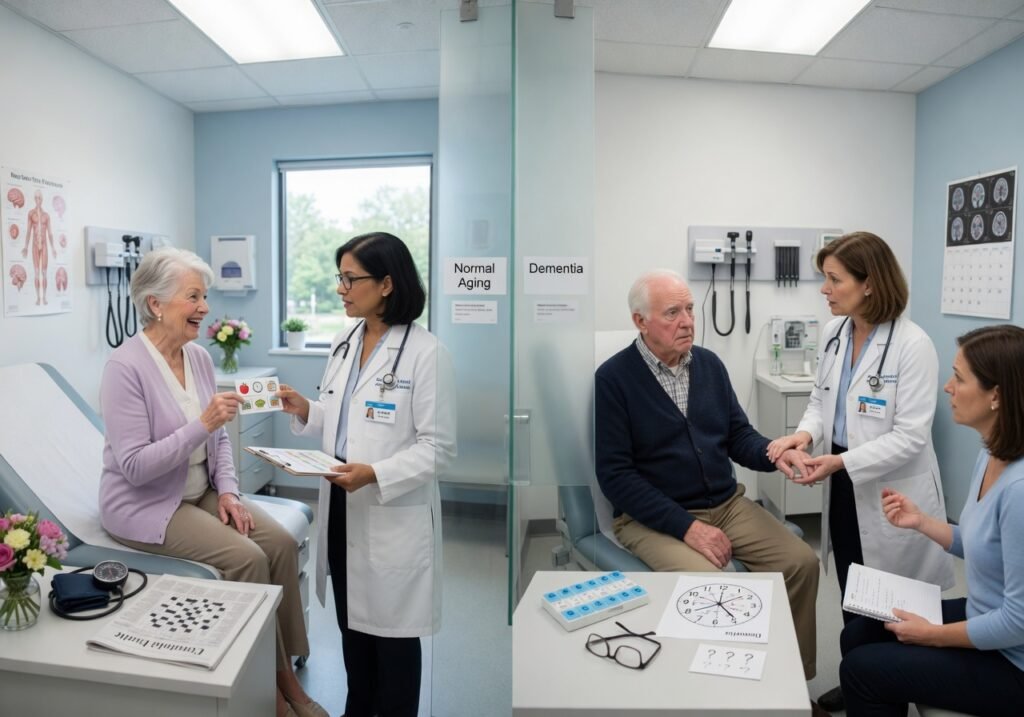
Most people think dementia is just forgetting where you put your keys or occasionally blanking on a person’s name at a party. That’s normal aging. But here’s what catches physicians off guard: patients with early dementia often don’t notice it themselves. Their spouse does. Their adult child does. The person with dementia frequently denies anything’s wrong, even as they’ve stopped managing their medications, started repeating the same story five times in one conversation, or gotten lost driving a familiar route. The difference isn’t subtle forgetfulness—it’s a breakdown in judgment, decision-making, and the ability to function in ways that matter. A 68-year-old woman came to my clinic because her daughter insisted something was wrong. She’d been working as an accountant for 30 years but suddenly couldn’t reconcile simple spreadsheets. She wasn’t “just getting older.” Something in her brain was changing at a cellular level, and we needed to find out what.
Key Facts About Dementia
- Prevalence: Approximately 6.7 million Americans aged 65 and older had dementia in 2023, according to the CDC, with Alzheimer’s disease accounting for 60–80% of all dementia cases
- Age factor: The risk of dementia doubles roughly every 5 years after age 65, but dementia is not a normal part of aging and should never be dismissed as such
- Gender disparity: Women account for approximately 65% of Alzheimer’s dementia cases, partly due to longer life expectancy and possibly hormonal factors still being researched
- Progression speed: Alzheimer’s disease typically progresses over 8–10 years from diagnosis to death, though some patients decline more rapidly while others progress more slowly
- Mortality impact: According to the NIH, dementia was the fifth leading cause of death in the United States in 2020, yet many cases go undiagnosed until moderate stages
Understanding Dementia: The Mechanism Behind the Memory Loss
Let’s talk about what’s actually happening inside the brain. Imagine your neurons—those billions of brain cells that communicate with each other—as a vast electrical grid. In dementia, that grid starts to deteriorate. In Alzheimer’s disease, two proteins called amyloid-beta and tau accumulate abnormally, forming sticky plaques and tangles that poison neurons from the inside out. The cells can’t talk to each other properly, then they die. When this happens in the hippocampus (the memory center) and the frontal and temporal lobes (responsible for judgment and executive function), you don’t just forget things—you lose your ability to plan, organize, problem-solve, and sometimes even regulate your behavior and emotions.
The brain shrinkage is real. We can see it on MRI scans. But here’s the clinical insight most health websites skip: the person with early dementia can still perform well on standard memory tests because they can often compensate cognitively in the moment. They might not recall a list of words you just read them, but with cues or multiple choice, they suddenly remember. This is why simple memory screening at home doesn’t catch early dementia. The deficit shows up in functional tasks—balancing the checkbook, following a complex recipe, managing appointments. By the time memory loss is obvious to everyone, significant brain damage has already occurred.
Causes and Risk Factors: Beyond Age and Genetics
Alzheimer’s disease is the most common form of dementia, but it’s not the only player. Vascular dementia results from strokes or small vessel disease. Lewy body dementia involves abnormal protein deposits and causes hallucinations alongside cognitive decline. Frontotemporal dementia strikes younger people and destroys personality and judgment first. Understanding which type matters because treatment and progression differ.
Age is the biggest risk factor—that’s not debatable. But genetics play a role. Having a parent or sibling with dementia increases your risk, especially if they developed it before age 65. The APOE4 gene variant, which you can test for, increases Alzheimer’s risk significantly. However, carrying the gene doesn’t guarantee dementia.
The modifiable risk factors matter more than people realize. High blood pressure in midlife, diabetes, obesity, hearing loss, and sedentary lifestyle all increase dementia risk substantially. Here’s what most articles miss: head trauma, especially repeated concussions, is an increasingly recognized dementia risk factor. Veterans, athletes in contact sports, and people with multiple head injuries show elevated dementia rates. This isn’t just anecdotal—neuroimaging shows chronic traumatic encephalopathy-related changes in vulnerable brains. Depression in late life is another flag that gets overlooked; persistent depression in your 60s and 70s can precede dementia diagnosis by years.
Signs and Symptoms: What Dementia Actually Looks Like Day-to-Day
Early dementia doesn’t announce itself dramatically. People notice small things first. Your dad asks the same question three times in an hour, though he’s always been sharp. Your mother forgets to pay bills or leaves the stove on. Someone who managed finances flawlessly suddenly struggles with basic math. These aren’t memory lapses—they’re changes in how the brain processes information and manages tasks.
As dementia progresses, you see behavioral changes. People become withdrawn or unusually irritable. They might accuse others of stealing (they can’t find things, so someone must have taken them). Judgment deteriorates—they buy things they can’t afford or make inappropriate comments. Sleep patterns change. They might wander at night or become agitated.
Early warning signs that clinicians take seriously but many people dismiss: difficulty following conversations, especially in noisy environments; trouble finding the right words; getting lost in familiar places; difficulty managing complex tasks like taxes or travel planning; and loss of interest in hobbies. The person might seem fine one moment and confused the next. This variability is actually characteristic of certain dementia types and helps us narrow the diagnosis.
Diagnosis: The Process and What to Expect
Diagnosis starts with a careful history. I ask about cognitive changes, when they started, how they’re progressing. I talk to family members separately because they often report symptoms the patient doesn’t acknowledge. Then come the cognitive tests. The Montreal Cognitive Assessment (MoCA) and the Mini-Cog are quick screening tools we use in clinic. A low score doesn’t confirm dementia—it flags the need for more testing.
Brain imaging follows. An MRI shows brain structure and rules out strokes or tumors. Some patients need PET scans to detect amyloid or tau accumulation, though insurance coverage for these is limited outside specialty centers. Blood biomarkers are changing the game now. Tests measuring phosphorylated tau and amyloid-beta in blood plasma can detect Alzheimer’s pathology with reasonable accuracy, sometimes before symptoms appear.
Neuropsychological testing—a battery of tests administered by a psychologist over several hours—gives the clearest picture of what’s impaired and what’s preserved. This matters because it guides management and helps distinguish dementia from depression or delirium, which can mimic dementia but are treatable.
Treatment Options: What Actually Works
Here’s the uncomfortable truth: we can slow dementia but not stop or reverse it. Yet “slow” matters. Losing function two years more gradually means two extra years of independence.
For Alzheimer’s disease, cholinesterase inhibitors like donepezil (Aricept) and rivastigmine (Exelon) help preserve acetylcholine, a neurotransmitter crucial for memory. Memantine (Namenda) works differently, blocking excess glutamate that damages neurons. These medications work best in mild to moderate stages and help about 30–40% of patients measurably. Side effects—nausea, dizziness, bradycardia—limit use in some patients.
Newer monoclonal antibodies targeting amyloid, like aducanumab (Aduhelm) and lecanemab (Leqembi), represent a shift toward treating the underlying pathology rather than just symptoms. Lecanemab shows promise in early Alzheimer’s, slowing cognitive decline by about 35% over 18 months, but requires regular IV infusions and amyloid PET imaging to confirm amyloid pathology. It’s expensive and not suitable for everyone.
Non-pharmacologic treatments matter enormously. Cognitive stimulation therapy, physical exercise, social engagement, and cognitive rehabilitation all slow functional decline. Antidepressants help if mood disturbance accompanies dementia. Antipsychotics are used cautiously because they increase stroke risk in elderly patients, but low doses sometimes manage severe behavioral symptoms when nothing else works.
Practical Daily Management: Strategies That Actually Help
Living with dementia—whether you have it or care for someone who does—requires concrete systems. Simplify the environment. Remove clutter, lock dangerous items like medications and power tools, install motion-sensor lighting in hallways. Use labels on drawers and cabinets with pictures, not just words.
Create routines. Eating, bathing, and activities at the same time each day reduce confusion and anxiety. Use written schedules and large calendars. Set alarms for medications on a pill organizer.
Communication changes. Use short, simple sentences. Speak slowly but not condescendingly. If someone with dementia is agitated, don’t argue about factual accuracy—redirect. If they think it’s 1985 and they need to pick up their children from school, arguing won’t help. Validating their emotional reality and gently redirecting works better.
Physical activity—30 minutes of walking most days—improves mood, sleep, and slows cognitive decline. It’s not optional. Music and art programs reduce agitation more reliably than medications sometimes do. Reminiscence therapy, where people review old photos and memories, engages remaining cognitive abilities and reduces depression.
Prevention: What the Evidence Actually Shows
You can’t prevent dementia with certainty, but you can reduce your risk meaningfully. The JAMA Psychiatry meta-analysis shows that cardiovascular health is foundational—managing blood pressure, cholesterol, and diabetes in midlife reduces dementia risk by up to 40% by your 80s. That’s substantial.
Cognitive engagement matters. Learning something new—a language, an instrument, complex hobbies—keeps neural networks active. Passive TV watching doesn’t; challenging mental activities do. Social engagement is equally important. Loneliness accelerates cognitive decline. Maintaining close relationships and social involvement is protective.
Sleep quality is underrated. Chronic sleep deprivation allows amyloid buildup. Aim for 7–8 hours. Sleep apnea, if present, needs treatment because intermittent oxygen drops damage brain tissue.
Mediterranean-style diet—vegetables, fish, olive oil, nuts, limited red meat—shows the most consistent evidence for slowing cognitive decline. Alcohol in moderation (one drink daily for women, two for men) might be protective; heavy drinking accelerates dementia.
Hearing correction matters more than people think. Hearing aids don’t just help you hear—they maintain social engagement and reduce cognitive load, both protective against dementia. Untreated hearing loss nearly doubles dementia risk, according to recent studies.
Frequently Asked Questions
No. Occasional forgetfulness is normal. You might forget where you parked your car or why you walked into a room. With dementia, you forget you own a car or don’t remember driving at all. The key difference is functional impact—does the memory loss interfere with your ability to live independently and manage daily tasks? Normal aging doesn’t; dementia does.
Yes, though it’s rare. Early-onset dem
Sources & Medical References
HealthTopics.com articles are based on peer-reviewed medical research and guidance from the NIH, CDC, and WHO. See our editorial policy for full sourcing standards.