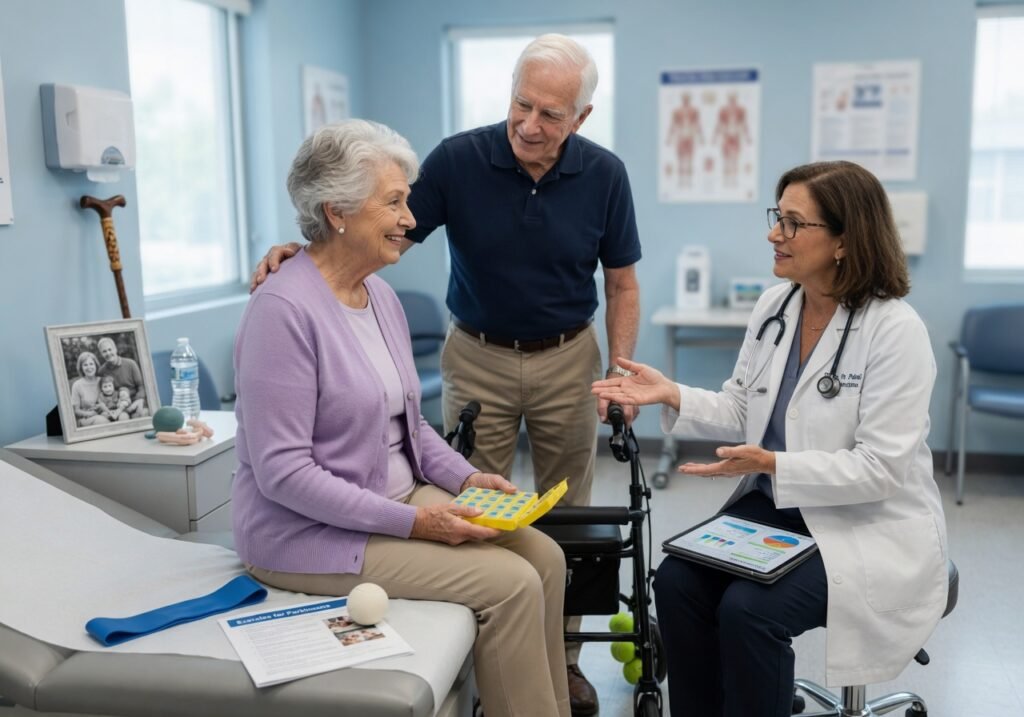
Margaret, 62, noticed something odd last month. Her right hand trembled slightly when she reached for her coffee mug, and her husband mentioned she wasn’t swinging that arm as much when she walked. The tremor disappeared at rest, came back with purposeful movement, and she felt frustrated that her neurologist wanted to schedule advanced imaging—surely this was just anxiety. Two weeks later, her walking felt stiff, her face seemed less expressive in the mirror, and she finally understood this wasn’t stress.
Parkinsons disease affects approximately 1 million Americans today, though many don’t recognize the initial warning signs because they assume tremor means anxiety or caffeine sensitivity. Understanding what’s actually happening in your brain, recognizing subtle early symptoms, and knowing your treatment options can make the difference between years of unnecessary uncertainty and getting proper support when you need it most.
Key Facts About Parkinsons Disease
- Approximately 60,000 Americans are newly diagnosed with Parkinsons each year, with median age at diagnosis around 60 years old, according to the NIH Neurological Institute
- Men are 1.5 times more likely to develop Parkinsons than women across all age groups
- Parkinsons involves loss of dopamine-producing neurons in the substantia nigra region of the brain, with about 60% of these neurons already damaged before motor symptoms appear
- The disease progresses at highly variable rates—some patients experience symptom changes over decades while others progress more rapidly within 5-10 years
- Lewy bodies (alpha-synuclein protein deposits) are present in approximately 85% of Parkinsons cases and are central to neuropathology
Understanding Parkinsons: What Happens Inside Your Brain
Think of your basal ganglia—the brain structures controlling movement—as a sophisticated messaging system. Dopamine acts like the postal worker, delivering critical signals between different neighborhoods of your brain that coordinate smooth, controlled movement. In Parkinsons, these dopamine-producing postal workers gradually retire or disappear. Without enough dopamine circulating, movement commands get stuck in traffic. Your brain sends the signal to walk, but without sufficient dopamine facilitating communication between the substantia nigra and striatum, your muscles receive a sluggish, incomplete version of that instruction.
What makes Parkinsons unique isn’t simply low dopamine—depression also involves dopamine dysregulation. The real culprit is accumulation of a misfolded protein called alpha-synuclein, which clumps into structures called Lewy bodies. These protein tangles damage and kill the very neurons that manufacture dopamine, creating a progressive spiral. As more neurons die, the brain cannot compensate anymore, and symptoms emerge. By the time someone experiences noticeable tremor or rigidity, the damage is already substantial. This is why early recognition matters—we can’t reverse the cellular damage yet, but we can support the remaining neurons and manage symptoms before they compromise quality of life.
Causes and Risk Factors
Parkinsons results from complex interactions between genetics and environment. Neither genes nor environment alone typically causes the disease—you need the wrong combination. The CDC has identified several risk factors with varying strength of evidence.
Age remains the strongest risk factor. Your risk roughly doubles every five years after age 60. Family history matters too—having a parent or sibling with Parkinsons increases your risk 3-4 fold, though most cases aren’t inherited in a straightforward pattern.
Environmental exposures that research now supports include pesticide exposure, particularly herbicides like paraquat and fungicides, especially in agricultural workers and gardeners. Traumatic brain injury, particularly repeated head trauma, shows associations in several studies. Drinking well water—potentially contaminated with agricultural chemicals—correlates with increased risk in some regions.
Here’s what most articles overlook: rural living itself appears protective against Parkinsons. People living in rural areas show lower Parkinsons rates than urban dwellers in several large studies. Researchers speculate this might relate to less air pollution exposure, different dietary patterns, or different occupational exposures, but the mechanism remains unclear. The point? Living in a city doesn’t doom you, but environmental toxins matter more than people realize.
Genetic mutations in genes like LRRK2, GBA, and SNCA account for about 15% of cases. Remarkably, some people carry disease-causing mutations but never develop symptoms—suggesting protective factors we don’t fully understand yet.
Signs and Symptoms: What Patients Actually Experience
Motor symptoms get all the attention, but the full Parkinsons experience extends far beyond shaking hands.
Early motor warning signs often missed: Decreased arm swing on one side during walking, reduced facial expression, softer voice volume, and cramped or smaller handwriting. Many people attribute these to aging. Loss of sense of smell—years before tremor appears—is now recognized as an early marker. Your neurologist might ask about this specifically.
Classic motor symptoms include resting tremor (shaking at rest that improves with purposeful movement), rigidity (muscle stiffness and resistance to movement), bradykinesia (slowness of movement that makes simple tasks exhausting), and postural instability (increased fall risk, especially later). Not every patient has tremor—”akinetic-rigid” presentations with bradykinesia and stiffness but no tremor are equally valid and sometimes harder to diagnose.
Non-motor symptoms often cause more suffering than tremor itself. Constipation precedes motor symptoms in many patients. Sleep disturbances—REM sleep behavior disorder where people act out dreams—can occur years early. Depression, anxiety, and cognitive changes affect up to 50% of patients. Freezing of gait—the sudden, temporary inability to initiate walking despite wanting to move—develops in about 30% of patients and causes terrifying falls. Autonomic dysfunction produces orthostatic hypotension (dizziness on standing), excessive sweating, and urinary urgency.
Progression looks different for everyone. Some patients plateau for years at a particular stage. Others notice monthly changes. The variability itself is characteristic.
Getting a Diagnosis
There’s no blood test for Parkinsons. Diagnosis depends on clinical evaluation by a neurologist, usually movement disorders specialist. Your doctor will assess for the cardinal motor features—at least two of the four (tremor, rigidity, bradykinesia, postural instability) are typically required. The response to dopaminergic medication supports diagnosis—if symptoms improve significantly with levodopa, that’s consistent with Parkinsons.
Advanced imaging like DAT scans (dopamine transporter imaging) can show decreased dopamine uptake in the basal ganglia, supporting diagnosis. MRI rules out other conditions mimicking Parkinsons—stroke, subdural hematoma, normal pressure hydrocephalus. The neurologist will ask detailed questions about symptom onset, progression timeline, medication history, and whether relatives have Parkinsons.
Expect the diagnostic process to feel uncertain initially. Parkinsons can resemble essential tremor, atypical parkinsonism syndromes, or medication side effects. Your neurologist might say “probable Parkinsons” initially, as definitive diagnosis technically requires autopsy. But with careful evaluation and often time—watching how symptoms evolve and respond to treatment—diagnosis becomes clear.
Treatment Options
Treatment aims to replace or supplement dopamine function while preserving remaining dopamine neurons.
Levodopa with carbidopa remains the gold standard. Levodopa crosses the blood-brain barrier and converts to dopamine. Carbidopa prevents conversion outside the brain, reducing side effects. Typical starting dose is 25/100 mg three times daily, gradually increased. Levodopa works powerfully but develops wearing-off effects and motor complications (involuntary movements called dyskinesia) with years of use—reasons why doctors sometimes delay starting it in younger patients, though recent evidence questions this conservative approach.
Dopamine agonists like pramipexole, ropinirole, and rotigotine (patch) directly stimulate dopamine receptors. They’re weaker than levodopa but valuable earlier in disease when used as monotherapy, potentially delaying levodopa need. Risk of impulse control issues (gambling, hypersexuality) runs higher with dopamine agonists than levodopa.
MAO-B inhibitors (selegiline, rasagiline) slow dopamine breakdown, providing modest symptom benefit. Rasagiline at 1 mg daily shows disease-modifying potential in some studies—possibly slowing neurodegeneration, though evidence remains debated.
COMT inhibitors like entacapone extend levodopa duration by blocking catechol-O-methyltransferase, an enzyme that breaks down dopamine. Useful when wearing-off occurs.
Anticholinergics like trihexyphenidyl help tremor specifically but cause cognitive and urinary side effects—largely avoided now.
Deep brain stimulation (DBS) involves surgically implanting electrodes in the subthalamic nucleus or globus pallidus. It’s transformative for appropriate candidates—tremor can become nearly invisible, medication doses decrease, quality of life improves substantially. Candidacy depends on levodopa responsiveness, disease duration (usually several years), and cognitive preservation. Not suitable for patients with dementia or significant psychiatric disease.
Physical and occupational therapy targets gait disturbance, balance, freezing episodes, and activities of daily living. Speech therapy addresses voice volume and intelligibility. These interventions show real functional benefit, not just psychological support.
Practical Daily Management Strategies
Medication timing matters intensely. Take levodopa 30-60 minutes before meals on an empty stomach for optimal absorption. Protein competes for absorption, so spacing meals from medications helps. Keep a detailed log of symptom patterns—”off” times when medication effectiveness wanes versus “on” times. Show this to your neurologist to guide dose adjustments.
For freezing episodes: Use external cues. Marching to an imagined beat, stepping over lines on the floor, or using a laser-based cane (Rhythmic Auditory Cueing devices) often unlock frozen gait suddenly. This works because different motor pathways activate—you bypass the damaged basal ganglia circuit temporarily.
Exercise is genuinely neuroprotective, not just mood-boosting. Cardiovascular exercise (walking, swimming, cycling) for 150 minutes weekly correlates with slower cognitive decline. Progressive resistance training maintains muscle mass against rigidity. Dance specifically engages the motor cortex differently than routine exercise—several studies show dance slows Parkinsons progression compared to standard exercise.
Sleep quality deteriorates in Parkinsons. Use melatonin 3-5 mg for REM sleep behavior disorder. Avoid sedating medications if possible—benzodiazepines increase fall risk catastrophically. Sleep apnea testing is worthwhile as untreated sleep apnea accelerates cognitive decline.
Constipation requires proactive management. Increase fiber gradually (sudden increases cause gas and bloating), drink 2-3 liters water daily, and use stool softeners or osmotic laxatives like miralax regularly, not just when desperate. Parkinsons doesn’t self-correct constipation—it worsens.
Swallow safety matters. Early dysphagia (difficulty swallowing) is silent—you might aspirate without realizing. Video fluoroscopic swallow studies identify aspiration risk. Speech therapy teaches compensatory swallowing techniques. Don’t ignore persistent throat clearing or wet voice quality.
Prevention: What Evidence Actually Shows
Parkinsons prevention remains limited territory because we can’t prevent something we don’t fully understand. However, some modifications show promise.
Caffeine consumption associates with lower Parkinsons risk in multiple observational studies—the effect is modest but consistent. Coffee drinkers show 40% reduced risk compared to non-drinkers in some studies, though whether caffeine itself