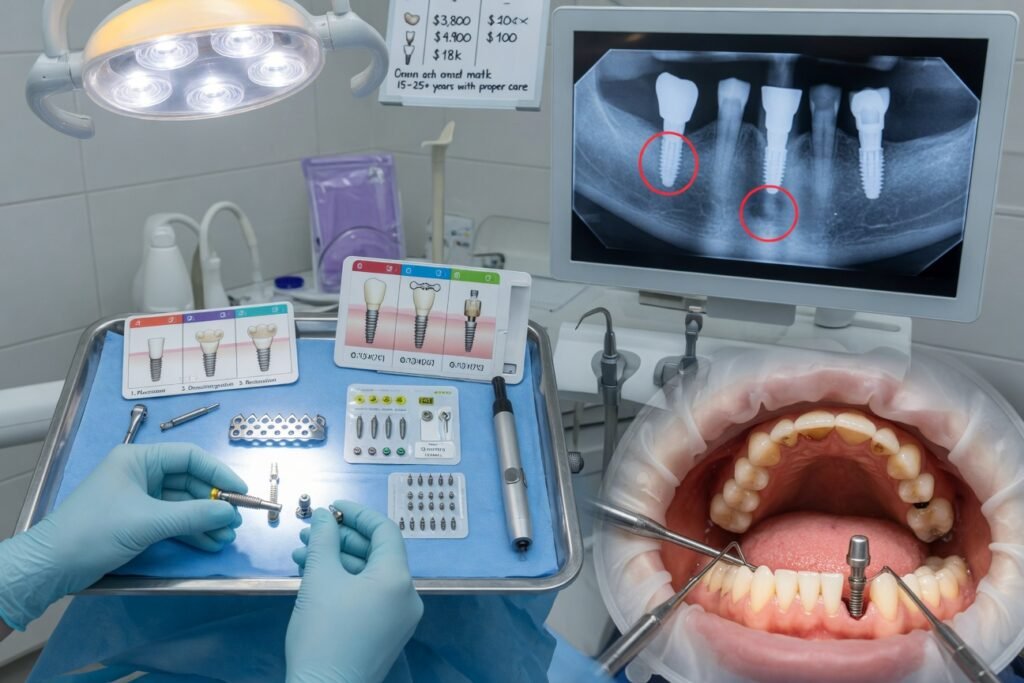
Dental Implants: What Actually Happens After You Get Them, and Why Some Last While Others Don’t
Sarah, a 52-year-old accountant, sat in my chair asking the question I hear several times each month: “I lost a molar to decay five years ago and just got an implant. Will it actually last, or am I throwing $6,000 away?” Research shows that approximately 10-15% of dental implants fail within the first five years, yet most patients aren’t told why—or what they can do to prevent becoming part of that statistic. The difference between an implant that functions perfectly at 20 years and one that fails at year three often comes down to factors nobody discusses before the surgery happens.
Key Facts About Dental Implants
- Success rates for dental implants range from 94-98% at the one-year mark, according to data published in the Journal of Dental Research, but this drops to 90-95% by five years in patients with poor oral hygiene.
- The average cost of a single tooth implant in the United States ranges from $4,500 to $9,000 when including the implant body, abutment, and crown, with geographic variation of up to 40% between regions.
- Osseointegration—the process where bone fuses to the implant—typically requires 4 to 6 months in the lower jaw and 6 to 12 months in the upper jaw, though individual variation is significant.
- Peri-implantitis, a bacterial infection around the implant that destroys supporting bone, affects approximately 22-43% of implant patients at some point, making post-implant oral hygiene as critical as pre-implant selection.
- Implants placed in patients with uncontrolled diabetes have failure rates three to four times higher than in patients with normal glucose levels, a risk factor often underestimated during initial consultations.
Understanding How Dental Implants Actually Work in Your Jaw
A dental implant isn’t simply a screw you twist into bone and then stick a tooth on. Think of it more like planting a tree: you’re not just driving a stake into the ground, you’re creating conditions where living tissue integrates with an artificial material. When a titanium implant post is placed into your jawbone, your body’s cells don’t recognize it as foreign—they recognize it as a scaffold. Over months, osteoblasts (bone-building cells) migrate toward the implant surface and begin laying down new bone matrix directly on the titanium. This process, called osseointegration, creates a biological seal that’s often stronger than the bond between your natural tooth root and bone.
What most patients don’t realize is that this isn’t passive. Your immune system is actively deciding whether to accept or reject the implant based on signals from the titanium’s surface. The microscopic texture, the biocompatibility of the alloy (pure titanium is superior to titanium alloys with vanadium), and even the implant’s design all influence whether osseointegration proceeds smoothly or stalls. This is why implants from different manufacturers placed by equally skilled surgeons can have subtly different success trajectories.
Causes and Risk Factors That Determine Implant Success
Your bone quality matters more than people realize. Dental surgeons classify bone density on a scale from Type 1 (dense cortical bone, excellent) to Type 4 (soft, low-density bone). A patient with Type 1 bone in their posterior mandible might achieve full osseointegration in 10-12 weeks, while someone with Type 3 or 4 bone might need 6 months or longer—or might never achieve it completely. Smokers have bone resorption rates 40% higher than non-smokers, meaning they lose more jawbone both before and after implant placement. But here’s what most articles miss: the timing of your smoking matters. If you quit smoking six weeks before surgery and stay quit for at least six weeks after, you reduce implant failure risk significantly. Smoking on the surgery date itself? That’s the critical window.
Uncontrolled diabetes doesn’t just increase infection risk—it literally impairs osteoblast function. Patients with HbA1c levels above 7% have compromised bone healing. But patients whose diabetes is well-controlled (HbA1c below 6.5%) have success rates nearly identical to non-diabetics. Autoimmune conditions like rheumatoid arthritis and lupus increase peri-implantitis risk through immune dysregulation. Medications matter too: bisphosphonates (used for osteoporosis) can rarely cause osteonecrosis around implants, particularly if dosing was high or duration long, though this risk is still uncommon. Immunosuppressants for transplant recipients increase bacterial infection risk.
Signs That Indicate You Need an Implant or That Your Implant Is in Trouble
Before implant placement, you might notice a gap between teeth that shifts your bite, or you’re avoiding chewing on one side because the remaining roots ache. Some patients describe a “floating” sensation when biting, because opposing teeth have drifted into space. Once you have an implant, early warning signs of failure include pain beyond the first three weeks, increasing swelling rather than decreasing swelling, or a clicking sensation when you bite. These aren’t normal post-operative symptoms.
Later problems—around months 3-6—include bleeding when you brush around the implant, even with gentle technique. Gum recession around the implant crown is another red flag; healthy implants shouldn’t show recession beyond what you’d see around natural teeth. Some patients describe a “sour” taste or slight drainage near the implant site, which suggests low-grade bacterial infiltration. Implant mobility—actually feeling the crown move slightly when you press on it—means osseointegration has failed, and the implant needs removal. This doesn’t always cause pain, which is why some patients discover late-stage problems only at their hygiene appointment.
How Implant Failure Gets Diagnosed
Your dentist will take a cone-beam CT scan (CBCT), which provides 3D imaging of bone density and structure around the implant. This shows bone loss quantitatively—your dentist can measure how many millimeters of bone height you’ve lost. Probing with a periodontal probe reveals pocket depth; pockets deeper than 5mm around implants suggest pathology. Radiographs taken annually show whether bone level is stable or declining. Some surgeons use resonance frequency analysis, a device that vibrates the implant and measures how much it moves; less movement indicates better integration, and you get a numerical score (ISQ values above 70 are excellent, below 60 are concerning).
The patient experience of diagnosis is often delayed because pain isn’t always present. You might go in for a routine cleaning and hear, “I’m seeing some bone loss here.” By the time it’s discovered, the infection has sometimes become established enough that antibiotics are unlikely to resolve it—extraction becomes the only option.
Treatment Options and Current Evidence
If you’re a candidate for implants, the surgical technique matters. Flapless surgery (where the dentist doesn’t cut the gum to expose bone) has equivalent success rates to traditional flapped surgery in patients with adequate bone, but causes less post-operative pain and swelling. Immediate implant placement (putting the implant in the same appointment as extraction) has success rates of 94-97% in skilled hands, versus 96-98% for delayed placement where you wait 3-6 months. Immediate placement saves time but requires excellent bone volume at the extraction site.
Bone grafting before implant placement becomes necessary when your existing bone is insufficient. Autografts (bone harvested from your own chin or posterior mandible) integrate most reliably, but xenografts (processed bovine bone) and allografts (cadaveric bone) work well with success rates of 90%+ when the implant is placed 6 months after grafting. Some surgeons use guided bone regeneration with barrier membranes, which guides your body’s own bone-forming cells into the deficient area.
If you already have a failing implant, treatment depends on timing. Early infection (month 1-2) might respond to aggressive decontamination, specialized mouthwashes with chlorhexidine, and systemic antibiotics like amoxicillin-clavulanate or azithromycin. Late-stage infections (peri-implantitis beyond 6 months) are rarely cured with antibiotics alone and usually require explantation (removal) followed by bone healing and potential re-implantation 3-6 months later. Some surgeons attempt implant surface decontamination using air-abrasive polishing or laser therapy, but the evidence for salvaging severely infected implants is weak.
Daily Management: What You Actually Need to Do
Standard flossing doesn’t work around implants—the floss can’t reach the critical junction between gum and crown. Use a water flosser or, better yet, implant-specific floss with a stiffened section that you guide under the gum edge. Electric toothbrushes with pressure sensors (like Oral-B models with Bluetooth feedback) reduce over-brushing, which contributes to gum recession. Avoid ultrasonic scalers at home; only your hygienist should use professional-grade ultrasound near implants because improper technique can damage bone.
Your bite matters more than you’d think. If your implant crown is even slightly high (making contact before other teeth when you close), your body interprets that as persistent microtrauma. Request that your dentist use articulating paper during crown insertion to verify your bite is even. After three months, return for a bite check because some settling occurs.
Professional cleanings should happen every four months instead of six, particularly in the first year. Regular two-month intervals are standard for patients with history of periodontitis.
Prevention: What Evidence Actually Shows Works
Smoking cessation is non-negotiable—quit before surgery if possible. The six-week window before and after surgery is critical. Optimizing diabetes control before implant placement (getting your HbA1c below 6.5%) statistically predicts success. If you’re on bisphosphonates, discuss with your implant surgeon; they may want records of your dosing history.
Preventing bone loss in the first place means saving your natural teeth. A molar you’ve had for 20 years, even if it’s requiring root canal treatment, might be preferable to an implant because your natural tooth root maintains bone density through mechanoreceptor signaling. Implants don’t transmit proprioceptive information the way natural roots do, so they can’t prevent the subtle bone loss that occurs over decades.
Frequently Asked Questions
Sources & Medical References
HealthTopics.com articles are based on peer-reviewed medical research and guidance from the NIH, CDC, and WHO. See our editorial policy for full sourcing standards.