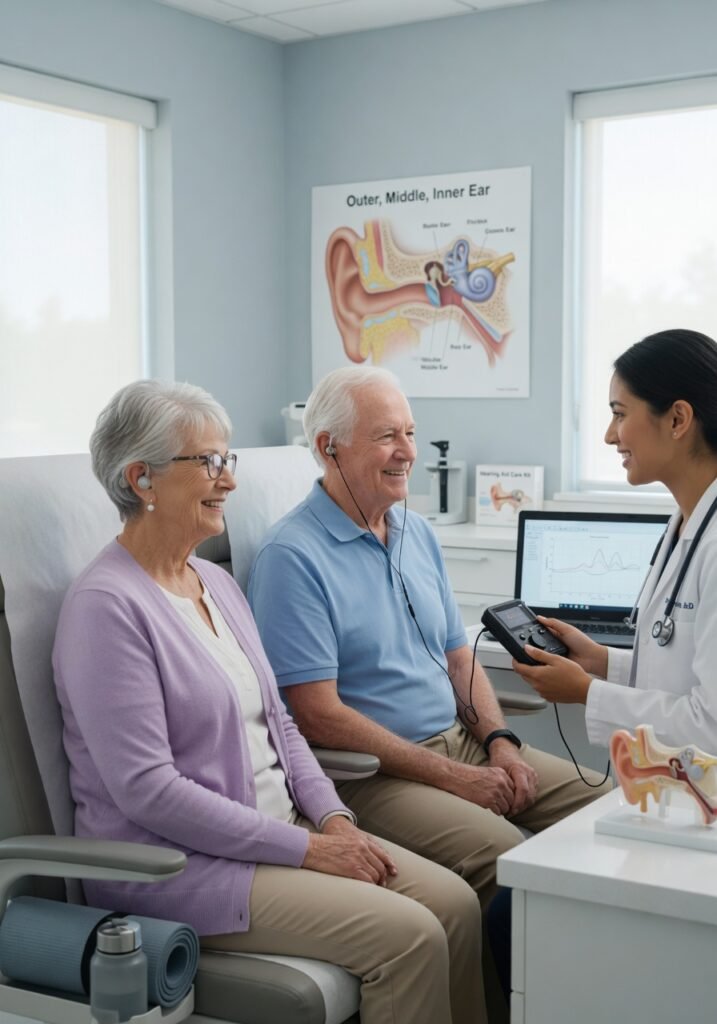
Most people assume hearing loss in older adults is simply about the volume of sound getting through—as if your ears are just receiving less input, like turning down a radio. That’s not quite right. What’s actually happening is far more complex: your inner ear’s sensory cells are literally dying off, and your brain’s ability to process and make sense of sound is degrading simultaneously. I see this constantly in my geriatric patients. Margaret, a 72-year-old former elementary school teacher, came in saying she could “hear” people talking but couldn’t understand the words. Her husband would repeat himself three times. She wasn’t deaf. Her hearing aid settings were already maxed out. The real problem? Her cochlea was damaged in a way that made speech discrimination—the brain’s job of separating signal from noise—nearly impossible. This distinction matters because it changes everything about how we treat her.
Key Facts About Hearing Loss in Elderly Adults
- One in three Americans aged 65 to 74 has hearing loss, rising to one in two for those 75 and older, according to the National Institute on Deafness and Other Communication Disorders (NIDCD)
- Age-related hearing loss (presbycusis) typically begins with loss of high-frequency sounds, meaning seniors often miss consonants like “s,” “f,” and “th” before they notice volume problems
- The CDC reports that untreated hearing loss is associated with increased risk of falls, cognitive decline, and depression in older adults—not because of the hearing loss itself, but because of the social isolation it causes
- Approximately 15% of Americans aged 18 and over report some trouble hearing; this jumps to 65% in those 70 and older, per data from the National Health and Nutrition Examination Survey (NHANES)
- Hearing aids are used by only about 30% of older adults who could benefit from them, despite being available for decades with improving technology
Understanding How Hearing Actually Breaks Down With Age
Think of your ear like a concert hall with a sound engineer. The outer ear is the lobby where sound arrives. The middle ear is the amplification system. But the inner ear—that’s where the magic happens and also where age wreaks havoc. Inside your cochlea, there are about 16,000 hair cells, each tuned to a specific frequency. These cells are like musicians in an orchestra. Once they die, they don’t come back. Unlike skin cells or even most nerve cells, you don’t replace cochlear hair cells.
In young people, those hair cells vibrate and send electrical signals to the auditory nerve, which shoots straight to your brain. Your brain then does something remarkable: it filters out background noise, recognizes speech patterns, and predicts what words are coming based on context. With age, two things happen simultaneously. First, the high-frequency hair cells start dying—those handle the crisp, consonant sounds that make speech intelligible. Second, your brain’s processing speed for auditory information slows. So even when sound reaches the inner ear, the translation to meaning gets muddier. This is why turning up the volume doesn’t always help. You’re still missing the consonants, and your aging brain struggles to fill in the gaps as quickly as it used to.
What Actually Causes Hearing Loss in Older Adults
Age itself is the primary culprit, but that’s not the whole story. Genetics determines about 50% of your baseline hearing capacity. If your parents had good hearing into their 80s, you probably will too. That said, decades of noise exposure compounds everything. Even moderate noise—lawn mowers, leaf blowers, heavy traffic—adds up over a lifetime.
Cardiovascular disease is a risk factor most articles skim past. Your inner ear relies on excellent blood flow, specifically through small capillaries that feed those hair cells. When you have hypertension, atherosclerosis, or diabetes, those tiny vessels get damaged first. I’ve noticed that seniors with poorly controlled hypertension lose hearing faster than those with well-managed blood pressure. Diabetes accelerates this process by about two-fold according to studies in the Journal of the American Medical Association.
Certain medications actively damage the cochlea. Aminoglycoside antibiotics (like gentamicin), some chemotherapy agents (cisplatin particularly), and even high-dose aspirin taken long-term can cause irreversible hearing loss. Ototoxic drugs, we call them. If you’re taking these, your prescriber should know about your hearing baseline.
Vitamin B12 deficiency rarely gets mentioned but does matter. B12 supports nerve health throughout your body, including the auditory nerve. Seniors with pernicious anemia or those on metformin long-term sometimes develop B12 deficiency, which can worsen hearing. It’s worth checking.
Head trauma, even mild repeated head injuries, can damage the vestibular system and cochlea. And here’s something that surprises patients: extreme stress and lack of sleep genuinely affect hearing. Your auditory system relies on the parasympathetic nervous system to process sound correctly. Chronic activation of your stress response literally shifts your hearing function.
The Early Warning Signs You Shouldn’t Ignore
Most people wait until someone tells them “you never listen,” but earlier indicators exist. Do you find yourself turning up the television while others in the room find it loud enough? Do phone conversations feel harder than in-person conversations—even when the person is speaking clearly? That’s your clue that speech discrimination is becoming an issue.
High-pitched sounds might suddenly feel annoying or piercing. Your granddaughter’s voice but not your grandson’s. Smoke alarms or microwave beeps make you wince. These indicate loss of high-frequency acuity specifically.
Tinnitus—ringing, buzzing, or hissing in your ears—often accompanies hearing loss. It’s not always loud. Sometimes it’s just noticeable, a background presence you notice in quiet rooms. That’s worth investigating because the earlier you address underlying hearing loss, the better your brain’s auditory processing stays intact.
Social withdrawal is the symptom that concerns me most clinically. If you’ve stopped attending dinner with friends because “I can’t follow the conversation anyway,” or you’re avoiding group settings, that’s advanced enough that you should be evaluated. The depression and isolation that follow are harder to treat than the hearing loss itself.
Getting Your Hearing Tested: What the Process Actually Involves
Start with your primary care physician or a referral to an audiologist. Many seniors expect they need an ear, nose, and throat doctor, but audiologists—who specialize specifically in hearing—usually handle this work.
The core test is called pure-tone audiometry. You sit in a soundproof booth wearing headphones while the audiologist plays tones at different pitches and volumes. You raise your hand each time you hear something. It takes 10 to 15 minutes and shows exactly which frequencies you’re missing. The results get plotted on an audiogram—a graph showing your hearing threshold at each frequency compared to normal hearing for your age.
Speech discrimination testing comes next. The audiologist plays recorded words at various volumes, and you repeat back what you hear. This matters enormously because two people can have identical pure-tone audiograms but very different speech understanding. It guides treatment decisions.
Tympanometry tests your eardrum and middle ear function, ruling out conductive problems like earwax impaction or middle ear fluid. This takes seconds. Then there’s a physical exam where the audiologist visualizes your ear canal and checks for cerumen impaction—earwax buildup—which affects about 26% of older adults and is completely reversible.
The whole appointment takes 45 minutes to an hour. Bring someone with you if possible. They’ll hear recommendations you might miss, and they’ll be your accountability partner for follow-up.
Treatment Options That Actually Work
No medication reverses age-related hearing loss. That’s the clear truth. There’s no pill. Several drugs in clinical trials show promise in animals, but nothing has reached FDA approval for human presbycusis. If someone tells you otherwise, they’re selling you something ineffective.
Hearing aids are the evidence-based first line. Modern digital hearing aids process sound thousands of times per second, adjusting amplification in real time based on your environment. Brands like Phonak, Oticon, Signia, Widex, and Starkey all have devices specifically programmed for age-related hearing loss. Prescription hearing aids cost $3,000 to $7,000 per pair, but over-the-counter options like Lexie, Nuheara, and Jabra have entered the market with prices from $500 to $2,000. The FDA approval of over-the-counter hearing aids in 2022 genuinely changed access.
Cochlear implants are considered when hearing aids don’t provide adequate benefit. If your speech discrimination is severely compromised despite properly fitted hearing aids, you might be a candidate. This is a surgical procedure where electrodes are implanted in your cochlea, bypassing damaged hair cells. It requires surgery, rehabilitation, and commitment to device maintenance, but for the right patient—someone willing to do the work—outcomes are remarkable. Most of my patients implanted after age 70 report that speech understanding improved dramatically within six months.
Direct-to-ear amplification systems and personal sound amplification products exist as intermediate options, though they’re less targeted than hearing aids. Apps on smartphones can provide supplemental benefit—not a replacement, but helpful in noisy restaurants when combined with hearing aids.
Auditory training—working with an audiologist on techniques to maximize speech understanding—genuinely helps, especially in the first three months after getting hearing aids. Your brain needs to relearn how to process amplified sound. It’s neuroplasticity in action. Skip this and you’ll abandon your aids within months. Do it properly and you’ll wonder why you waited so long.
Daily Strategies That Make a Real Difference
Positioning matters in conversation. Face the person speaking. Watch their lips and facial expressions. This isn’t “cheating”—it’s how your brain was designed to process speech. Lipreading accounts for about 30% of normal speech understanding anyway.
Control your environment aggressively. In restaurants, request corner tables with your back to a wall. Sit where there’s adequate lighting on the speaker’s face. Meet in quiet venues when possible. If someone suggests a loud bar, decline and suggest coffee instead. You’re not being difficult; you’re making communication possible.
With family, establish conversation rules. Ask people to get your attention before speaking—face you, reduce background noise, speak clearly but not slowly or unnaturally. People shout because it feels like it should help; it usually just makes clarity worse and strains your hearing aid microphones.
Use captions on the television and phone calls. Most phones let you enable real-time captioning. It’s not a crutch; it’s accommodating your physiology, like glasses for vision.
Keep your ears clear. Earwax impaction is reversible and common. If it’s the culprit, a simple cleaning restores hearing instantly. Don’t assume you have permanent hearing loss without cerumen impaction being ruled out.
Manage chronic conditions aggressively. Controlling blood pressure, blood sugar, and cholesterol slows hearing decline. A meta-analysis in JAMA Otolaryngology found that people who maintained ideal cardiovascular health had measurably better hearing preservation over a decade than those with multiple cardiovascular risk factors.
What Prevention Actually Shows in the Evidence
You can’t prevent age-related hearing loss entirely—genetics and time work against you. But you can slow the rate of decline.
Noise avoidance matters most. Anything above 85 decibels for extended periods accelerates hair cell death. A typical lawnmower is 90 decibels. A leaf blower is 96. Rock concerts are 110. If you enjoy loud activities, hearing protection—actual earplugs or earmuffs rated for the decibel level you’re exposed to—works. This seems obvious, but studies show most older adults who’ve already lost some hearing don’t bother protecting what remains.
Cardiovascular fitness correlates with hearing preservation. People who exercise regularly and maintain healthy weight show slower hearing decline than sedentary peers. The mechanism likely involves blood flow and inflammation reduction.