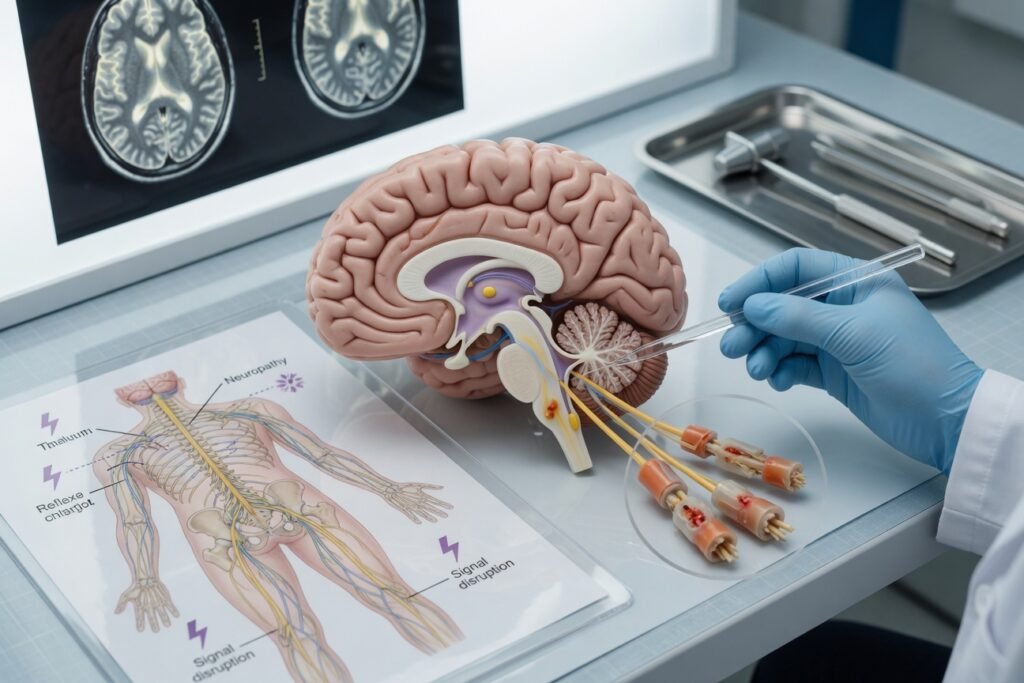

Most people believe neuropathy is simply “worn nerves” that develop slowly over decades, but that’s backwards. Nerve damage can start silently at the cellular level right now—in your feet, hands, or organs—before you feel a single symptom. By the time you notice tingling or burning, the damage is already established. What’s actually true: neuropathy is your nervous system’s wiring short-circuiting, and catching it early matters because some types can be reversed or stopped, while others progress irreversibly if left untreated.
Sarah, a 52-year-old accountant, came to my clinic complaining of what she called “restless feet” at night. She’d been attributing it to stress for two years. But her feet had also been gradually growing numb—she’d stopped noticing when her socks had holes in them. Testing revealed small-fiber neuropathy from uncontrolled diabetes. She’d had elevated blood sugar for longer than she realized. We started her on tight glucose control and gabapentin, and after six months, the burning stopped advancing. The numbness didn’t reverse, but we prevented progression. That’s the window we’re working in with neuropathy—early detection and intervention matter enormously.
Key Facts About Neuropathy
- Approximately 20 million Americans have some form of peripheral neuropathy, according to CDC estimates, yet fewer than half have been formally diagnosed.
- Diabetes accounts for roughly 30% of neuropathy cases in developed countries, but accounts for nearly 60% of cases in patients under age 40.
- Small-fiber neuropathy—affecting the thinnest nerve fibers—can develop 10-15 years before conventional nerve conduction studies detect large-fiber involvement.
- Chemotherapy-induced peripheral neuropathy (CIPN) occurs in 30-60% of cancer patients receiving taxanes or platinum agents, making it one of the leading treatment side effects that forces medication dose reductions.
- Idiopathic neuropathy—neuropathy with no identifiable cause—accounts for 25-30% of all peripheral neuropathy cases, despite extensive testing.
Understanding Neuropathy: What’s Actually Happening
Think of your nerves as underground cables carrying electrical signals from your brain and spinal cord to every part of your body. Neuropathy happens when those cables get damaged—the outer insulation (myelin) gets stripped away, or the core wires (axons) themselves get injured. Either way, the signal gets scrambled or stops moving altogether.
Here’s what most articles miss: your body doesn’t just lose sensation passively. Instead, the damaged nerves start firing randomly and sending false signals. That’s why neuropathy pain often feels nothing like a typical injury. It’s not a sharp pain from touching something—it’s a burning, tingling, or electric sensation your brain is receiving from nerves that are basically malfunctioning. This distinction matters because it tells us how to treat it differently than pain from inflammation or torn tissue.
The damage can be focal (affecting one nerve) or diffuse (affecting many nerves). Peripheral neuropathy usually spreads from the feet upward, starting in the longest nerves—the ones running down to your toes—because they’re metabolically demanding and vulnerable.
Causes and Risk Factors: The Overlooked Culprits
Diabetes and chemotherapy dominate the headlines, but they’re not your only risks. Here’s what actually drives neuropathy development:
- Metabolic causes: Uncontrolled diabetes, vitamin B12 deficiency (especially if you’re on metformin or take proton pump inhibitors), low thyroid hormone, and kidney disease all damage nerves through different mechanisms.
- Infections: HIV, hepatitis C, and Lyme disease cause direct nerve inflammation. People assume Lyme disease only causes acute joint pain, but if untreated, it can trigger chronic neuropathy months or years later.
- Toxins: Alcohol damages nerves through both nutritional deficiency and direct toxicity. Heavy alcohol use causes neuropathy in 25-60% of people with alcohol use disorder.
- Medications: Beyond chemotherapy, fluoroquinolone antibiotics (like ciprofloxacin), antiretrovirals for HIV, and some anti-seizure drugs can trigger neuropathy.
- The overlooked factor—hereditary small-fiber neuropathy: Many patients have genetic mutations in sodium channels or other nerve proteins that don’t cause symptoms until triggered by a secondary stressor like infection or metabolic stress. This is why two people exposed to the same chemotherapy drug can have completely different outcomes.
Autoimmune conditions like lupus and vasculitis directly attack nerve tissue. And there’s one category doctors sometimes miss: occupational exposure. Chronic exposure to industrial solvents or pesticides can accumulate in nerve tissue over years, silently damaging the myelin.
Signs and Symptoms: What Neuropathy Actually Feels Like
The earliest warning sign isn’t always tingling—it’s temperature sensation loss. Patients tell me they suddenly don’t notice hot water or cold ice the way they used to. They might dip their foot in water and misjudge the temperature, causing minor burns. That’s small-fiber neuropathy in its infancy.
As damage progresses, you get the classic symptoms: burning feet, especially at night; pins-and-needles sensations; numbness that makes walking feel like you’re walking on cotton; or sharp, lightning-like pains shooting through your legs. Your balance gets worse because your feet can’t sense the ground properly. Some people describe it as “wearing thick socks” even when barefoot.
What most websites gloss over: autonomic neuropathy also happens. Your autonomic nerves control heart rate, digestion, and sweating. So neuropathy can cause dizziness when standing, constipation that won’t respond to fiber, and feet that never sweat or sweat excessively. These symptoms often appear years before sensory symptoms develop.
Pain patterns vary wildly. Some experience constant dull aching. Others get sharp, lancinating pains that strike without warning. A few describe allodynia—pain from light touch, where even soft fabric becomes unbearable. Duration matters too: acute neuropathy (sudden onset) often has treatable causes, while insidious onset over months usually signals metabolic or toxic causes.
Diagnosis: The Testing Process
There’s no single “neuropathy test” despite what patients hope. Here’s how we actually diagnose it:
First comes clinical evaluation. I ask about your pain pattern, which areas started first, whether you have risk factors, and what medications you’re on. Then comes the physical exam: checking your reflexes (which often disappear early), testing whether you can feel light touch and vibration, and assessing proprioception—your sense of where your body parts are in space.
Nerve conduction studies and electromyography (EMG) measure how fast electrical signals travel down your nerves. These tests work well for large-fiber neuropathy but can be normal in early small-fiber disease. That’s frustrating for patients: you’re having clear symptoms, but the standard test says “normal.”
Small-fiber neuropathy requires specialized testing: quantitative sensory testing (QST), which uses temperature and vibration thresholds, or corneal confocal microscopy, which actually visualizes nerve fibers in the eye’s surface. Not all clinics have this technology.
We also order labs: fasting glucose, hemoglobin A1C, complete metabolic panel, thyroid function, and B12 levels. If you have risk factors, we might check for hepatitis C, HIV, or Lyme disease antibodies. Skin biopsy—taking a tiny sample from your leg to count actual nerve fibers—is becoming more common for small-fiber confirmation.
The process takes time because we’re essentially working backwards: finding the cause requires excluding mimics first. Spinal stenosis causes foot pain. Plantar fasciitis causes foot pain. A herniated disc causes leg pain. We have to differentiate.
Treatment Options: What Actually Works
Treatment depends entirely on cause and type. Let me be direct about what helps and what’s oversold:
For pain management: Gabapentin and pregabalin (Lyrica) are first-line. Gabapentin works by modulating calcium channels in damaged nerves, reducing abnormal firing. Start low (300mg daily) and increase gradually—most people need 1800-3600mg daily divided into three doses to see benefit. Pregabalin works similarly but has more predictable pharmacokinetics, so some doctors prefer it despite higher cost.
Topical capsaicin cream or lidocaine patches work for localized pain and have minimal systemic side effects. Apply capsaicin five times daily for 4-8 weeks before deciding if it helps—the initial burning sensation discourages many patients too early.
Duloxetine (Cymbalta), an SNRI antidepressant, helps certain patients, particularly those with diabetic neuropathy. It increases norepinephrine and serotonin, which modulate pain perception. Give it 6-8 weeks at 60mg daily before deciding it’s not working.
Opioids reduce neuropathic pain but carry addiction risks. I reserve them for patients with severe pain not responding to other options and who don’t have substance use disorder history.
For cause-specific treatment: If diabetes is driving it, tight glucose control prevents progression—this is proven. If B12 deficiency is the cause, B12 supplementation (injections work faster than oral) can halt or sometimes reverse early neuropathy. Infection-related neuropathy requires treating the infection first. Chemotherapy-induced neuropathy is trickier—there’s no specific reversal, but duloxetine and gabapentin reduce symptoms while you recover.
Physical therapy helps, particularly for balance and proprioception retraining. If you’re falling or losing coordination, working with a PT who understands neuropathy matters more than generic therapy.
Practical Daily Management: Concrete Strategies
Beyond medication, here’s what actually changes people’s lives with neuropathy:
- Foot care becomes obsessive: Check your feet daily with a mirror, looking for cuts or blisters you can’t feel. Wear well-fitting shoes with thick soles—numbness means you miss pressure points until they become wounds. Temperature matters: avoid very hot baths because you can’t feel when water is dangerously hot.
- Sleep positioning: Neuropathic pain often peaks at night. Prop your legs on a pillow to reduce pressure. Wear loose, soft pajamas. Some people tolerate a lightweight blanket tent that prevents fabric from touching painful skin.
- Compression socks: They improve circulation and proprioceptive feedback, helping balance. Wear them during the day, not at night.
- Temperature management: Alternating warm and cool therapy—not extreme heat or cold—can reduce pain. A heated pad for 15 minutes followed by 15 minutes without helps more than sustained heat.
- Balance training: Practice standing on one foot daily. Hold a counter and do heel-to-toe walking. Neuropathy-related falls are serious in older adults, and proprioceptive training prevents them.
Prevention: What the Evidence Actually Shows
True prevention (stopping neuropathy before it starts) only works for some causes. If you have diabetes, tight glucose control prevents neuropathy development—this is proven in landmark studies. Keep your A1C below 7% and you substantially reduce your risk.
For chemotherapy patients: there’s no proven prevention that works across all drug types. Cooling the hands and feet during infusion (cryotherapy) shows modest benefit for some agents like taxanes, but it doesn’t work for everyone.
For alcohol-related neuropathy: