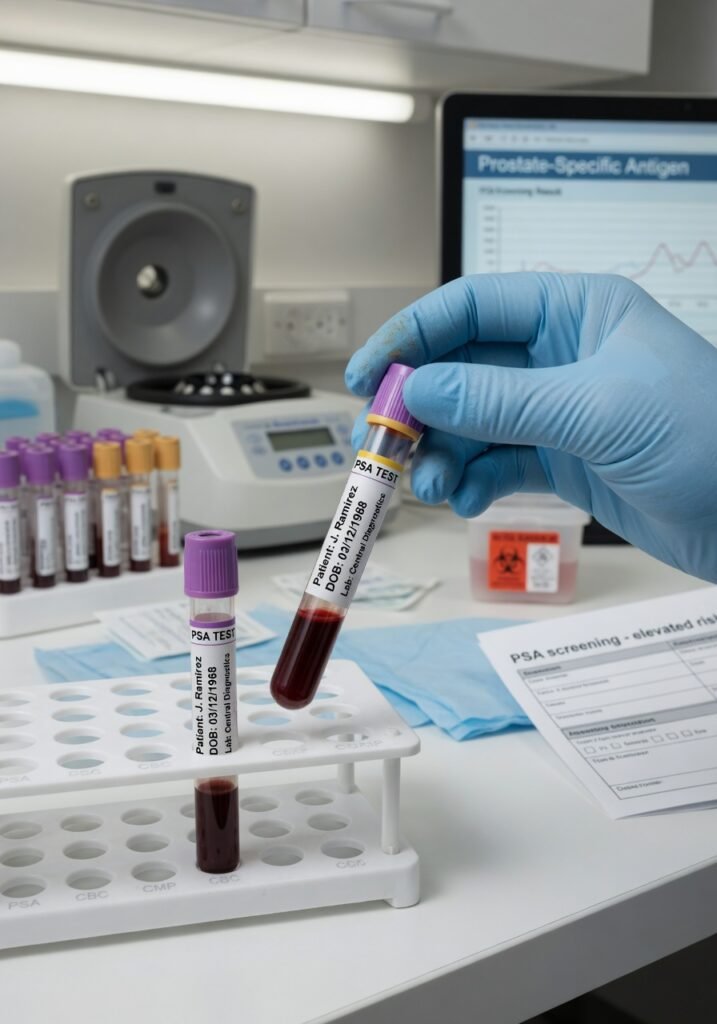

Tom, a 52-year-old accountant, sat in my office holding his lab results. His PSA came back at 6.2 ng/mL, and he’d already convinced himself he had cancer based on something he read online. His hands were shaking as he asked, “Does this mean I’m going to die?” The truth? His number wasn’t even clearly abnormal, and we had several thoughtful options ahead of us, not a diagnosis.
The PSA test remains one of the most misunderstood lab tests in medicine. Men see a single number and panic, or they ignore it entirely because they heard conflicting information from their neighbor. The reality sits in the middle—this blood test can provide useful information, but only if you understand what the number actually represents and what it doesn’t.
Key Facts About PSA Testing
- PSA (prostate-specific antigen) is a protein produced by the prostate gland, and elevated levels can indicate prostate cancer, benign prostatic hyperplasia, or prostatitis—but elevated PSA alone is not a cancer diagnosis
- According to the CDC, approximately 1 in 8 men will be diagnosed with prostate cancer during their lifetime, and PSA testing remains one of the primary screening tools despite ongoing debate about its value
- A PSA level below 4.0 ng/mL was historically considered “normal,” but this threshold varies by age; men in their 40s may have different baselines than men in their 70s
- The JAMA study published findings showing that PSA screening in men aged 55-69 reduced prostate cancer mortality by approximately 1 death per 1,000 men screened over 13 years, but increased detection of non-lethal cancers
- PSA velocity (how quickly the number rises over time) and PSA density (PSA level relative to prostate size) are often more clinically useful than a single PSA measurement in isolation
What PSA Actually Measures
Think of PSA as a smoke detector for your prostate. When there’s activity in the gland—whether that’s cancer, inflammation, benign enlargement, or even a urinary tract infection—PSA can seep into the bloodstream in detectable amounts. The blood test captures that signal.
Here’s the critical part that most patients miss: a smoke detector going off doesn’t tell you what kind of fire is happening. It just tells you something is happening. Your prostate produces PSA naturally as part of its normal function; we find trace amounts in every man’s blood. The question becomes: how much is too much, and does it warrant further investigation?
The gland itself sits right below your bladder, wrapping around the urethra like a donut around a hole. It secretes fluid that becomes part of semen. When you turn 40, your prostate often starts enlarging—this is almost universal in older men and usually causes no problems. But this enlargement can release PSA into the bloodstream, which is why age matters so much in interpreting your number.
Risk Factors That Actually Move the Needle
Age is the overwhelming risk factor for elevated PSA and prostate cancer. A man at 70 is exponentially more likely to have prostate cancer than a man at 45. Family history matters too—if your father or brother had prostate cancer, your risk roughly doubles.
Race is another factor that doesn’t get discussed enough in casual conversations. Black men have higher incidence and mortality from prostate cancer compared to white men, even when controlling for access to care. This isn’t because of genetics alone; it involves socioeconomic factors, healthcare disparities, and biological differences we’re still working to understand. If you’re a Black man over 40, the screening conversation with your doctor becomes more nuanced and potentially more important.
Here’s the overlooked risk factor: obesity. Excess adipose tissue—particularly visceral fat around your organs—increases inflammation throughout your body, including in the prostate. Men with BMI over 30 tend to have higher PSA levels and worse prostate cancer outcomes. Yet you won’t see this emphasized in most patient education materials.
Infection matters acutely. Prostatitis (bacterial or nonbacterial inflammation of the prostate) can spike your PSA temporarily. Urinary tract infections, recent ejaculation, or even aggressive digital rectal exams can elevate your number. If your PSA is up, your doctor should ask: when was your last prostate exam? When did you last have sexual activity? Any UTI symptoms recently?
What You Actually Feel (or Don’t)
Here’s something crucial: elevated PSA typically produces no symptoms whatsoever. The blood test finds something before you feel anything. This is why it’s called screening—we’re looking for disease in asymptomatic people.
If your prostate is genuinely enlarged (benign prostatic hyperplasia), you might notice difficulty starting urination, a weak urinary stream, needing to urinate more frequently especially at night, or incomplete emptying of the bladder. But these symptoms don’t correlate well with PSA levels. Some men with high PSA feel completely normal, while others with low PSA experience significant urinary symptoms.
Prostatitis (inflammation or infection) does cause symptoms: pain with urination, frequency, urgency, pelvic discomfort, or sometimes fever if it’s acute bacterial infection. But again, the PSA elevation is secondary to the inflammation, not the other way around.
Getting the Test and Interpreting Results
The actual PSA test is straightforward—a simple blood draw, usually at a lab. Your doctor should ideally draw it in the morning before 10 AM, at least 48 hours after your last ejaculation (which artificially elevates PSA), and when you’re free from urinary symptoms or infections.
Your result comes back as a single number: ng/mL (nanograms per milliliter). The interpretation depends heavily on context. A PSA of 5.5 ng/mL in a 45-year-old man warrants more investigation. The same number in a 78-year-old with multiple health conditions might not change management at all.
This is where your doctor’s clinical judgment matters more than the test itself. A single PSA tells you less than the trajectory over time. If your PSA was 2.5 five years ago and is now 3.2, that’s a 28% rise in five years—the velocity is what flags concern. But if it’s been stable at 3.5 for ten years, you’re probably fine.
If your PSA is elevated, your doctor might order additional testing: repeat PSA to confirm the finding, a test for PSA variants (like free PSA percentage), a digital rectal exam to assess prostate size and texture, or imaging like MRI. The MRI approach has become more common because it can identify whether the prostate has suspicious lesions before biopsies.
Treatment Depends on What You Actually Have
Here’s the fundamental confusion: elevated PSA isn’t a diagnosis. It’s a finding that might lead to further investigation. If biopsy confirms prostate cancer, then treatment depends on how aggressive the cancer is (Gleason score), how much of the prostate is involved, whether it’s spread, and your age and health status.
Active surveillance is now a legitimate first-line option for low-risk prostate cancer. You don’t automatically get surgery or radiation. Instead, you get regular PSA tests, periodic imaging, and possibly repeat biopsies to confirm the cancer isn’t advancing. Many low-grade prostate cancers grow so slowly that they never cause death.
If treatment is warranted, options include radical prostatectomy (surgical removal), external beam radiation therapy, brachytherapy (radioactive seed implants), and androgen deprivation therapy (hormonal treatment with drugs like goserelin or leuprolide) for more advanced cases. Each has different side effect profiles—surgery and radiation can cause erectile dysfunction and urinary issues; hormonal therapy causes hot flashes and fatigue.
For benign prostatic hyperplasia without cancer, medications like tamsulosin (Flomax) or finasteride (Proscar) can help by relaxing smooth muscle or shrinking the gland. For prostatitis, antibiotics like ciprofloxacin or doxycycline address infection, while anti-inflammatory medication helps with pain.
Practical Management After Your PSA Test
If your PSA is normal: get retested in one year if you’re under 40 with no risk factors and want to establish a baseline. Then consider testing every two to four years depending on risk factors and your preference.
If your PSA is mildly elevated: avoid the urge to panic-research online. Instead, schedule a follow-up test in four to six weeks. Many elevated PSAs drop back to normal, especially if caused by recent infection, ejaculation, or instrumentation.
Keep a simple log of your PSA results with dates. This velocity information is worth more than any single number. Show this to your doctor at every visit.
Discuss your personal risk tolerance. Some men want aggressive screening; others prefer watchful waiting. Neither is wrong. Your preference matters and should guide the testing strategy.
What Evidence Shows Actually Works for Prevention
Can you prevent an elevated PSA or prostate cancer? The evidence is mixed and often oversold. Large studies show that a Mediterranean-style diet rich in fish, vegetables, and olive oil may reduce prostate cancer risk modestly. Regular physical activity (150 minutes per week of moderate exercise) correlates with better prostate health, though it’s unclear whether this prevents cancer or just improves outcomes.
Finasteride (Proscar), a 5-alpha reductase inhibitor, can reduce PSA levels and lower the risk of prostate cancer diagnosis. The catch? It reduces PSA by about 25%, which makes interpretation trickier. It doesn’t prevent all cancers, and some evidence suggests it might slightly increase risk of high-grade cancers, though this remains debated.
Limiting red meat, reducing dairy, and maintaining a healthy weight are all associated with better prostate health, but none of these interventions guarantee protection. Your genetics and age still trump these factors.
Frequently Asked Questions
Sources & Medical References
HealthTopics.com articles are based on peer-reviewed medical research and guidance from the NIH, CDC, and WHO. See our editorial policy for full sourcing standards.