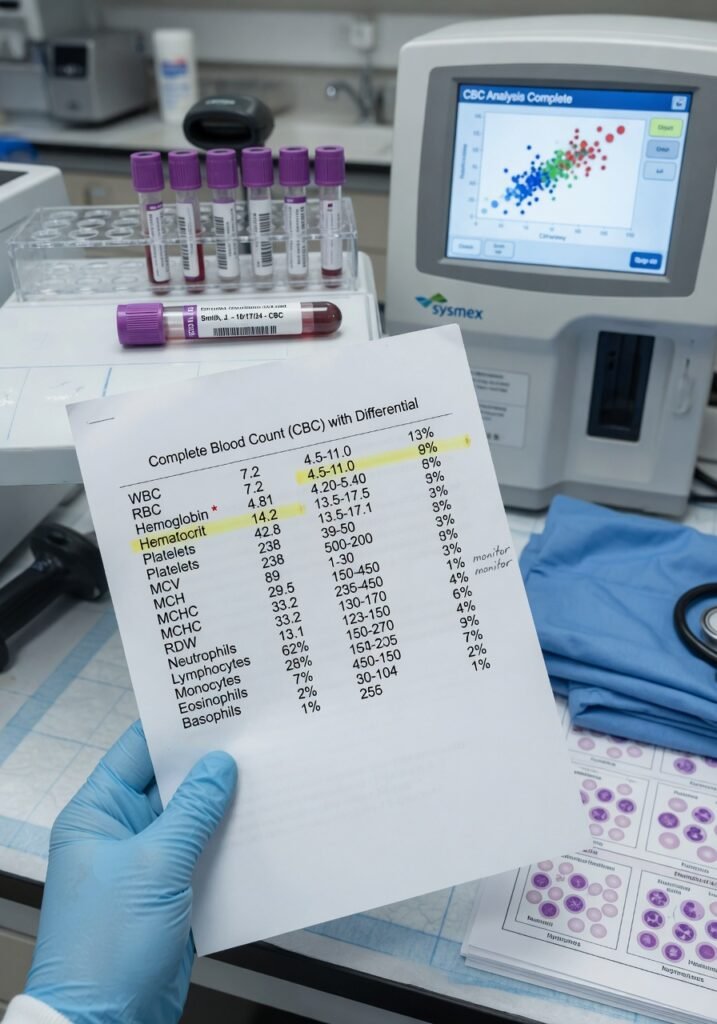
Last year, a 34-year-old accountant came to my office complaining of fatigue and recurring infections. Her employer’s annual health screening had flagged something unusual on her complete blood count, and she wanted to know what it meant. The truth? She had no idea that the three main categories on that single test—the red cells, white cells, and platelets—paint a surprisingly accurate picture of what’s happening inside her body right now. Research shows that abnormalities detected on a CBC lead to a diagnosis in roughly 22% of patients with non-specific symptoms, yet most people never understand what those numbers actually represent.
What You Need to Know About Your CBC Results
Key Facts About Complete Blood Count
- A normal red blood cell count ranges from 4.5 to 5.9 million cells per microliter in men and 4.1 to 5.1 million in women, and even small decreases can signal iron deficiency or chronic disease
- White blood cell counts between 4,500 and 11,000 cells per microliter indicate immune function; above 11,000 often suggests infection, leukemia, or inflammation
- Platelets normally measure 150,000 to 400,000 per microliter, and dropping below 50,000 significantly increases bleeding risk during minor injuries
- The CBC takes less than 5 minutes to run on modern analyzers yet can detect approximately 15 different types of blood cell abnormalities
- Hemoglobin levels must stay above 13.5 g/dL in men and 12.0 g/dL in women to maintain proper oxygen delivery; dropping 1 g/dL below these thresholds noticeably worsens fatigue
Understanding How Your CBC Actually Works
Think of your blood as a delivery system with three main job categories. Your red blood cells are the delivery trucks—they pick up oxygen from your lungs and carry it throughout your body. Your white blood cells are the security team patrolling those trucks, looking for infections and foreign invaders. Your platelets are the repair crew, ready to patch up any leaks or damage in the blood vessel walls. The CBC simply counts how many workers you have in each category and whether they look healthy.
When your doctor orders a CBC, the lab draws one small tube of blood and runs it through an automated analyzer that literally counts cells. The machine also measures hemoglobin, which is the iron-containing protein inside red cells that actually grabs oxygen molecules. It measures hematocrit, which is the percentage of your blood that’s actually made up of red cells versus liquid plasma. None of this requires any special preparation from you—no fasting, no medication adjustment. The test is so routine that most labs can have results back within hours.
What most patients don’t realize is that each number tells you something different about your health timeline. Low red cells might mean a chronic problem that developed slowly, like iron deficiency. High white cells might mean an acute problem that just started, like a bacterial infection. The “differential” part of the CBC breaks down white cells into five subtypes—neutrophils, lymphocytes, monocytes, eosinophils, and basophils—and each elevation pattern points to different culprits. Elevated neutrophils suggest bacterial infection. Elevated lymphocytes suggest viral infection or leukemia. That’s the real power of the CBC.
What Causes Abnormal CBC Results and Who’s at Risk
The most common culprit is iron deficiency anemia. Women of childbearing age lose blood monthly, and if they don’t consume enough iron through their diet, their red cell production eventually falls behind. Men rarely get iron deficiency anemia unless they’re bleeding internally—which could mean ulcers, colon polyps, or something more serious. That’s why screening men for anemia should trigger investigation into the GI tract.
Chronic kidney disease is the overlooked risk factor that most general articles skip. Your kidneys produce erythropoietin, a hormone that tells your bone marrow to make red blood cells. When kidney function declines, erythropoietin production drops, and suddenly you’re anemic without any bleeding at all. I see this constantly in diabetic patients whose kidney disease develops silently over years.
Infections—whether viral, bacterial, or fungal—show up as elevated white cell counts. Your body mobilizes white blood cell production when it senses a threat. Severe infections might elevate white cells to 20,000 or 30,000. Leukemias show even more dramatic elevations, sometimes exceeding 100,000.
Medications cause surprisingly frequent CBC changes. Chemotherapy drugs intentionally suppress white cell production. Antibiotics can occasionally cause agranulocytosis, a dangerous drop in neutrophils. Even NSAIDs like ibuprofen can rarely affect platelet function. If you’re on long-term medications, periodic CBC monitoring isn’t paranoia—it’s standard care.
Bone marrow disorders—including myelodysplastic syndromes and myeloproliferative neoplasms—directly damage the cells that produce blood cells. These typically affect older adults and cause simultaneous abnormalities across multiple cell lines rather than isolated changes.
What Symptoms Drive Patients to Get a CBC
Fatigue is the most common reason someone requests a CBC, and rightfully so. When your hemoglobin drops from 14 to 11 g/dL, your tissues receive genuinely less oxygen. You don’t imagine feeling tired—you are objectively more tired. Patients often describe it as heaviness rather than sleepiness. They can nap for two hours and still feel exhausted. Their workouts become sluggish.
Shortness of breath with normal activity is another classic presentation. Walking up one flight of stairs shouldn’t leave you gasping if your hemoglobin is normal. Dizziness, especially when standing up quickly, reflects the same problem—your cardiovascular system struggles to deliver adequate oxygen when red cell counts are low.
Recurrent infections—getting a cold or flu every few weeks rather than once yearly—should prompt white cell assessment. Your immune system isn’t working properly when your white cells are depleted or dysfunctional. Some patients develop oral thrush, fungal infections, or persistent sinus infections that hint at immune compromise.
Unexplained bruising or bleeding gums suggest low platelet counts. Normal platelet function stops bleeding within minutes. When platelets drop to critical levels, even minor bumps leave dark bruises that take weeks to fade. Bleeding that won’t stop after dental work or minor cuts is a red flag.
Fever combined with sore throat and extreme fatigue might represent infectious mononucleosis, which causes characteristic lymphocytosis on CBC. The combination of symptoms plus the CBC pattern makes diagnosis straightforward.
How CBC Testing Actually Happens
The process is genuinely simple. You arrive at a lab, sit in a chair, and a phlebotomist applies a tourniquet around your upper arm to make veins more visible. They clean the inside of your elbow with alcohol, insert a needle into a vein, and fill one or two small tubes with blood. The whole procedure takes 30 seconds. Some patients worry about the tourniquet cutting off circulation—it doesn’t. The pressure is just enough to temporarily slow venous return, making blood pool in forearm veins.
Your blood tube contains a special anticoagulant that prevents clotting so the automated analyzer can count cells accurately. Within an hour, the analyzer produces a report with roughly 20 different values. Your doctor reviews this and either reassures you that everything is normal or recommends follow-up testing.
Understanding your specific CBC values requires context. A white cell count of 12,000 in someone with fever and productive cough makes sense as a response to pneumonia. The same count in an asymptomatic person might warrant repeat testing to see if it’s a transient blip or something persistent. A hemoglobin of 10.5 g/dL in a woman with heavy menstrual bleeding points toward iron deficiency. The same hemoglobin in an elderly man with no obvious bleeding source triggers investigation for malignancy or chronic disease.
Treatment Depends on Finding the Underlying Cause
Iron deficiency anemia treatment starts with identifying the source of blood loss and fixing it, plus iron supplementation. Ferrous sulfate 325 mg daily is standard first-line therapy. It works, but many patients struggle with GI side effects—nausea, constipation, or dark stools. Some tolerate ferrous gluconate better. If oral iron fails, IV iron infusions like ferric carboxymaltose work faster and bypass GI absorption issues entirely.
Anemia from chronic kidney disease requires erythropoietin-stimulating agents like epoetin alfa or darbepoetin alfa, which artificially stimulate red cell production. These medications cost substantially more but address the actual mechanism rather than just treating symptoms.
Elevated white cells from infection resolve when you treat the infection—antibiotics for bacterial infections, antivirals for some viral infections. Your body will gradually normalize white cell production once the infection clears. Sometimes that takes weeks even after the infection itself is gone.
Low platelets from medication side effects improve after you stop the offending drug, though sometimes platelet recovery lags by days or weeks. Severe thrombocytopenia might require platelet transfusions to prevent spontaneous bleeding.
Leukemia and other bone marrow malignancies require hematology-oncology specialist care and might involve chemotherapy regimens like cytarabine or venetoclax depending on the specific diagnosis.
Practical Day-to-Day Management of CBC Abnormalities
If you have low red blood cells, prioritize rest and modify activity expectations. You genuinely cannot exercise at your normal intensity until hemoglobin improves. This isn’t laziness—this is physiology. Your muscles demand oxygen, and your blood cannot deliver it. Trying to maintain your usual routine will only exhaust you further. Gradually increase activity as your numbers improve.
Dietary adjustments matter specifically. Iron from red meat (heme iron) absorbs much more efficiently than iron from plants (non-heme iron). If you’re taking oral iron supplements, take them on an empty stomach with orange juice—vitamin C enhances iron absorption. Avoid taking iron with calcium, which blocks absorption. That morning coffee with milk? Drink it separately from your iron supplement.
If your white cells are low, avoid crowded public spaces during cold season. Wash your hands frequently. Your immune system literally cannot mount a normal defense against pathogens. Even minor infections could become serious. This isn’t paranoia—this is risk mitigation.
Low platelets mean avoiding contact sports, taking precautions against falls, and using soft toothbrushes. NSAIDs worsen platelet dysfunction, so stick to acetaminophen for pain. Avoid blood thinners unless specifically prescribed. These restrictions might feel excessive until you’ve seen the bruising that accompanies thrombocytopenia.
Prevention: What Actually Reduces Abnormal CBC Results
Most CBC abnormalities aren’t truly preventable in the traditional sense—you cannot will away leukemia or kidney disease. However, you can prevent iron deficiency anemia if you’re at risk. Adequate dietary iron intake prevents decline. Vegetarians need roughly 1.8 times more iron than meat-eaters because plant-based iron absorbs poorly. Women with heavy periods benefit from discussing hormonal birth control options that might reduce menstrual bleeding.
Preventing medication-induced CBC changes means regular monitoring if you take drugs known to affect blood cells. If you take methotrexate, azathioprine, or carbamazepine, routine CBC checks catch problems early.
Preventing chronic kidney disease—the most common cause of anemia I see—means managing diabetes and blood pressure aggressively. Losartan and lisinopril don’t just control blood pressure; they actually slow kidney disease progression. This matters because controlling hypertension prevents the anemia that follows.
Frequently Asked Questions About CBC
Can I
Sources & Medical References
HealthTopics.com articles are based on peer-reviewed medical research and guidance from the NIH, CDC, and WHO. See our editorial policy for full sourcing standards.