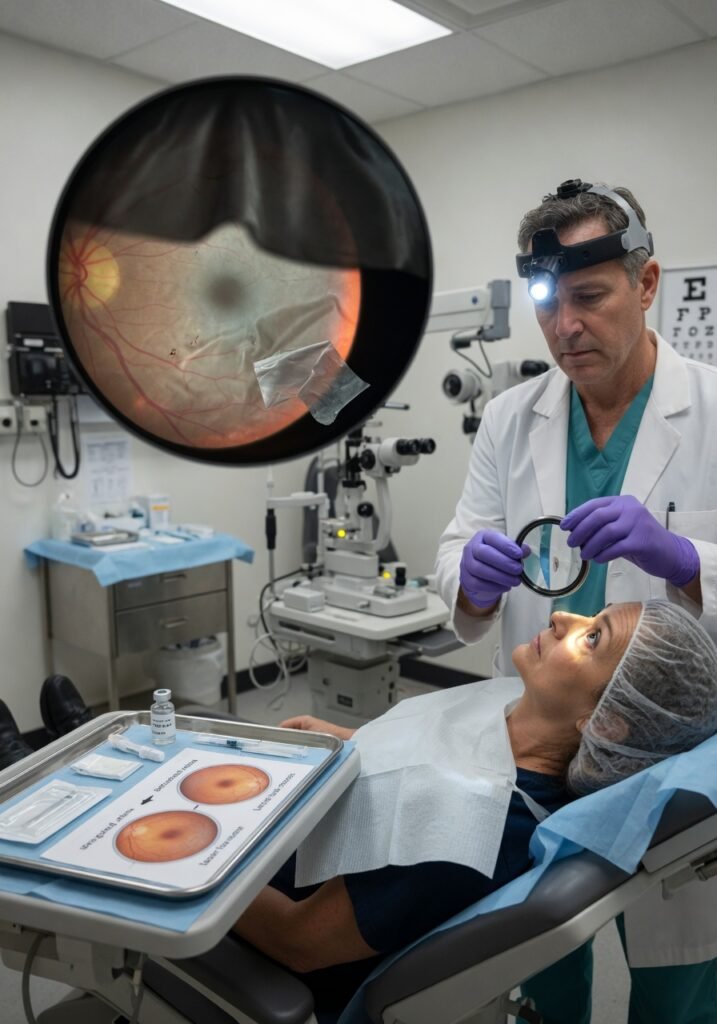
Most people think retinal detachment is something that happens gradually, like a slow leak in a tire. They imagine they’ll notice it building over weeks and have time to schedule an appointment. Here’s what actually happens: your retina can peel away from the back of your eye in hours, and by the time you realize something’s wrong, you may have already lost permanent vision. I’ve seen patients come in thinking they have floaters, only to discover their photoreceptors are dying because the blood supply was cut off eight hours ago. This isn’t a condition where “let’s monitor it” is an acceptable strategy.
Key Facts About Retinal Detachment
- Retinal detachment occurs in approximately 1 in 10,000 people per year in developed countries, according to the National Eye Institute, but this rate doubles in people with high myopia (over -6 diopters)
- Without treatment, 90% of detached retinas will progress to total vision loss within 4-6 weeks
- Pneumatic retinopexy (using an air bubble) succeeds in 85% of cases when the detachment involves only the upper retina, compared to 65% success for lower detachments
- The macula—your central vision area—detaches in roughly 35% of cases, and surgery within 7 days of macular detachment preserves significantly better vision than delayed treatment
- Diabetic patients with retinal detachment face 3-4 times higher reattachment failure rates due to proliferative vitreoretinopathy
Understanding How Retinal Detachment Actually Works
Think of your retina as the film in a camera. But here’s where the analogy breaks down in a way that matters: your retinal film isn’t just sitting there passively. It’s actively connected to the pigment epithelium beneath it through hundreds of millions of photoreceptors that require constant oxygen and nutrient delivery. When the retina detaches, those connections snap. The photoreceptors essentially suffocate because they can no longer reach their blood supply.
There are actually three different mechanisms at play. In rhegmatogenous detachment—the most common type—a small tear or hole forms in the retina, and vitreous fluid seeps underneath, peeling the retina away like wallpaper curling off a damp wall. This accounts for about 90% of cases. Tractional detachment happens when scar tissue physically pulls the retina off, often in advanced diabetes. Exudative detachment occurs when fluid accumulates beneath the retina without any tear, usually from inflammation or leaking blood vessels. Each type demands different treatment because the underlying problem is fundamentally different.
What Actually Causes Retinal Detachment
High myopia remains the single strongest risk factor. People with severe nearsightedness have elongated eyeballs, and that physical stretching makes the retina thinner and more prone to tearing. I regularly see detachments in patients with -10 or -12 prescriptions who had LASIK years earlier—the refractive surgery itself doesn’t cause detachment, but it changes the biomechanics enough that some high myopes develop problems they wouldn’t have otherwise.
Previous eye trauma is obvious, but here’s what most articles don’t explain: the trauma doesn’t need to be recent. A serious eye injury from twenty years ago can weaken a localized area of retina, and it may suddenly tear decades later with minimal provocation. Family history matters more than people realize—if your parent had detachment, your risk increases roughly tenfold.
Posterior vitreous detachment accelerates the process. As you age, the vitreous gel that fills your eye naturally shrinks and pulls away from the retina. This happens to almost everyone over 80, but it’s increasingly common in your 50s and 60s. When the vitreous tugs hard enough, it can rip the retina right then.
Here’s the risk factor I see overlooked constantly: a previous detachment in your other eye. If you’ve had retinal detachment in one eye, your risk in the fellow eye is about 15-20% over your lifetime. Yet so many patients don’t know this and don’t get the necessary screening.
What Retinal Detachment Actually Feels Like
The classic warning sign is a sudden shower of floaters—not the occasional one you’ve had for years, but dozens appearing overnight. Patients describe it as “pepper in my vision” or “black specks floating around.” These are actually blood cells and inflammatory debris released when the retina tears. Within hours or days, many patients notice a shadow creeping across their visual field, usually starting from the periphery. This shadow represents the detached area no longer processing light.
Some people experience photopsia—flashes of light at the periphery of their vision, often described as lightning streaks. This happens because the pulling on the retina stimulates the photoreceptors electrically. One patient told me it felt like “someone’s taking pictures of my eye from inside my head.”
Here’s what catches people off guard: early detachment causes almost no pain because your retina has no pain receptors. Pain means something else is wrong—perhaps angle closure glaucoma or acute uveitis. If your eye hurts, don’t assume it’s “just” detachment. But also don’t assume floaters and flashes are harmless. They’re not.
The timing matters desperately. Vision loss from macula-off detachment—where the central retina is already detached—is genuinely an emergency. If your central vision is already blurry or distorted, you need surgery that same day if possible, not tomorrow morning. Central retina cells start dying within 24-48 hours of oxygen deprivation.
How Retinal Detachment Gets Diagnosed
When you come to my clinic with these symptoms, I’m doing indirect ophthalmoscopy—essentially looking at your retina with special lenses and a bright light. But I also need optical coherence tomography (OCT) to measure exactly how much of the retina is detached and whether the macula is involved. For most detachments, B-scan ultrasound helps when I can’t see the retina clearly, particularly if there’s significant bleeding clouding the view.
What happens next depends on the exam findings. If the detachment hasn’t reached the macula and you’re a good candidate for office procedures, you might get pneumatic retinopexy in an outpatient setting. This involves injecting a gas bubble into your eye that floats to push the detached retina back while laser or cryotherapy seals the tear. The catch? You’ll need to hold your head in a specific position for days or weeks so gravity keeps the bubble in the right place.
More complex detachments require vitrectomy—surgery where we remove the vitreous gel, peel off any scar tissue, repair the retinal break, and then fill the eye with either silicone oil or a gas bubble. Vitrectomy has higher reattachment rates overall, roughly 90-95% with modern techniques, but it’s genuinely major surgery requiring general anesthesia.
Treatment Options That Actually Work
The choice between pneumatic retinopexy and vitrectomy depends on detachment location, complexity, and your ability to cooperate with positioning requirements. Pneumatic retinopexy works beautifully for superior detachments—those in the upper half of the retina—because gravity helps. For inferior or complex detachments, vitrectomy becomes necessary.
During vitrectomy, we use endolaser photocoagulation around the retinal break to create permanent scarring that helps reattach the retina. Cryotherapy, where we freeze the area around the break from outside the eye, serves as an alternative. Both essentially scar the retina and underlying tissue together, creating a permanent seal. Silicone oil tamponade—leaving oil inside your eye instead of letting it refill with fluid—provides superior tamponade for complex cases but eventually requires removal.
Success rates improve dramatically with appropriate timing. Operating within one week of macula-off detachment preserves significantly better central vision than waiting. I’ve seen patients regain 20/40 vision when surgery happened within days, versus 20/200 or worse when delayed a month.
Bevacizumab and aflibercept—anti-VEGF injections—may reduce the risk of proliferative vitreoretinopathy, that scarring process that can cause redetachment. We don’t routinely inject these at surgery yet, but emerging evidence suggests they could improve outcomes in high-risk patients.
Managing Life After Detachment Surgery
If you had pneumatic retinopexy with a gas bubble, your head positioning is critical. You’ll receive specific instructions—perhaps “bubble down” meaning keeping your face pointing downward, or “bubble superior” for upper positioning. This isn’t optional. You can’t fly, and you may not be able to drive. High altitude is forbidden because atmospheric pressure changes expand the bubble dangerously. This positioning typically lasts 10-14 days.
After vitrectomy, if silicone oil was placed, you’ll need another surgery to remove it within 3-6 months. If gas was used, it gradually absorbs over 4-8 weeks depending on the gas type. During both periods, flying and altitude travel remain restricted.
Expect temporary vision fluctuations. Gas bubbles create a visible line across your vision as they shrink. This bothers some people more than others. Your vision will progressively clear over weeks to months, but final visual recovery may take 6 months or longer.
Physical activity restrictions vary. Most surgeons recommend avoiding heavy lifting, straining, or jarring activities for 2-4 weeks. Contact sports should be discussed individually—if you had detachment once, you’re at higher risk for recurrence, so protective eyewear becomes essential.
Prevention Strategies With Real Evidence
If you have high myopia, regular dilated eye exams—annually or every other year—matter genuinely. Your ophthalmologist can identify lattice degeneration or other thinned areas before they tear. You won’t see these changes yourself.
Avoiding eye trauma is obvious but underappreciated. Wearing protective eyewear during risky activities—not just in obvious industrial settings but also during certain sports—reduces injury-related detachment risk substantially.
If your family has retinal detachment, inform your eye doctor explicitly. Genetic predisposition through refractive error or connective tissue variations runs in families. This knowledge changes your screening frequency and may affect decisions about procedures like LASIK.
One caveat: there’s no solid evidence that limiting strenuous exercise prevents detachment in asymptomatic people. The restrictions we give are because detachment has already occurred, not as primary prevention. Living normally—within reason—is appropriate for someone at higher risk.
Frequently Asked Questions About Retinal Detachment
Sources & Medical References
HealthTopics.com articles are based on peer-reviewed medical research and guidance from the NIH, CDC, and WHO. See our editorial policy for full sourcing standards.