
Age-Related Macular Degeneration: What Your Eye Doctor Actually Knows That Changes Everything
Sarah, 67, noticed that the straight edge of her kitchen cabinet looked wavy one Tuesday morning. By Thursday she couldn’t read her medication bottles. She assumed she just needed new glasses. Her optometrist didn’t find a new prescription that helped—because glasses can’t fix what was really happening: the central portion of her retina was breaking down at the cellular level, and she had intermediate age-related macular degeneration (AMD) that might progress to vision-threatening disease.
Most people think AMD is simply about blurry vision that gets worse with age, like presbyopia or cataracts. That’s wrong. AMD is fundamentally different. It’s not a focusing problem—it’s tissue degeneration. And here’s what makes the difference between maintaining functional vision and losing it: not all AMD is the same disease, treatment works only when started before irreversible damage occurs, and the progression timeline is utterly unpredictable. Some patients stay stable for decades. Others deteriorate in months. Knowing which category you’re in, and catching it early, determines whether you’ll be able to read, drive, and recognize faces five years from now.
Key Facts About Macular Degeneration
- AMD affects approximately 11 million Americans, making it the leading cause of irreversible vision loss in adults over 50, according to data from the National Eye Institute
- The wet form accounts for only 10-15% of cases but causes roughly 90% of severe vision loss, compared to the dry form which progresses more slowly
- Antivascular endothelial growth factor (anti-VEGF) injections like ranibizumab and aflibercept can stabilize vision in 95% of wet AMD patients when treatment begins within the first month of symptom onset, versus only 50-60% stabilization if delayed beyond 3 months
- Genetic factors account for 46-71% of AMD risk, with the CFH gene polymorphism being present in roughly 43% of the population
- Smoking accelerates dry AMD progression by approximately 3-4 years compared to never-smokers, making it the single most modifiable risk factor outside of nutritional intervention
Understanding Macular Degeneration: What’s Actually Breaking Down
The macula is a tiny region at the back of your eye—about the size of a pencil eraser—but it contains more than half of the retina’s light-sensing cells. Think of it this way: if your retina is a camera sensor, the macula is the center of that sensor where all the detailed, color vision happens. Everything else on the retina is peripheral sensing.
In AMD, the retinal pigment epithelium (RPE)—a single layer of cells that acts like the support crew for your photoreceptors—starts malfunctioning. Waste products accumulate faster than they can be cleared away. These clumpy deposits, called drusen, form between the RPE and the underlying blood vessel layer. In dry AMD, this process happens slowly. The drusen pile up, the RPE withers, and central photoreceptors gradually die. In wet AMD, abnormal blood vessels grow underneath the retina in response to inflammatory signals, leaking fluid and blood that scar the macula acutely.
The critical insight most sources miss: it’s not the drusen themselves that matter most—it’s what they tell you about the underlying inflammatory and metabolic dysfunction. Two patients can have identical-looking drusen on imaging but follow completely different disease trajectories. What happens inside those drusen at the molecular level—the inflammatory cascade, the oxidative stress, the complement cascade activation—that’s what drives progression. This is why simply waiting and watching doesn’t work. The disease is actively advancing before you notice any vision change.
Causes and Risk Factors: Why Some People Develop AMD and Others Don’t
Age is the most obvious risk factor—roughly 1 in 3 people over 75 have some form of AMD—but that tells you almost nothing useful. What actually matters more is genetics combined with lifestyle.
Here are the evidence-backed culprits:
- Smoking: Current or former smokers have 3-4 times higher risk than never-smokers, and the damage doesn’t reverse quickly after quitting
- Hypertension: Chronic high blood pressure damages the retinal vasculature and accelerates RPE cell death
- Dietary patterns: Low intake of lutein, zeaxanthin, and omega-3 fatty acids specifically increases dry AMD risk
- Obesity: BMI over 30 is associated with a 1.5x increased risk, possibly through chronic systemic inflammation
- Genetic variations: The CFH, ARMS2, and C3 genes account for most heritable risk
- The overlooked factor—circadian disruption: Recent research in the Proceedings of the National Academy of Sciences suggests chronic sleep disruption accelerates retinal aging and increases AMD progression risk by interfering with the retinal circadian clock that coordinates photoreceptor outer segment renewal. Most articles completely ignore this.
Sunlight exposure? Controversial. The evidence is genuinely mixed, and I tell patients not to obsess over it. But smoking? That’s non-negotiable to address.
Signs and Symptoms: What AMD Actually Feels Like
Early AMD often produces no symptoms at all. That’s the trap. You go to your routine eye exam expecting nothing special and the ophthalmologist says, “You have drusen. Let’s watch it.” Meanwhile, the disease is advancing silently.
When symptoms do appear, they’re specific to macular involvement:
- Straight lines appear wavy or bent—called metamorphopsia; this is a classic early warning sign that many people attribute to needing new glasses
- A blurry or dark spot in the center of your visual field that doesn’t go away, sometimes described as a hole or scotoma
- Colors look duller or less vibrant, particularly reds and blues
- Words on a page seem to shift or jump when reading, or letters appear missing from the middle of sentences
- Difficulty recognizing faces even though you know who the person is (prosopagnosia secondary to macular dysfunction)
- Struggling with activities requiring fine detail: threading a needle, reading medication labels, identifying denominations of currency
One crucial distinction: peripheral vision stays intact in AMD. You’ll always see things at the edges. This is why someone with advanced AMD can still navigate a room but can’t read a newspaper. That’s actually diagnostically helpful information.
How AMD Gets Diagnosed: The Real Process
A standard eye chart test won’t catch early AMD. You need imaging. Your ophthalmologist will likely perform:
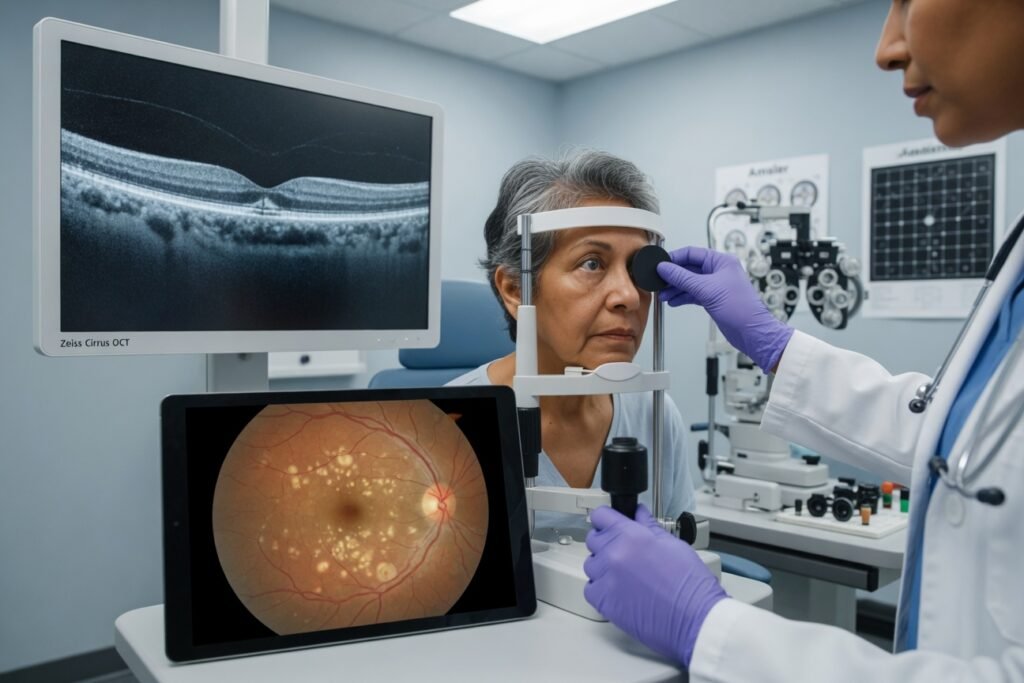
- Optical coherence tomography (OCT): This is the gold standard. It’s a non-invasive scan that shows the retinal layers in cross-section—you can literally see drusen, RPE changes, and fluid accumulation. Takes about 5 minutes.
- Fundus photography: Colored photos of the back of your eye that document drusen size and location; these create a baseline for comparison at future visits
- Fluorescein angiography (FA) or indocyanine green (ICG) angiography: Used when wet AMD is suspected; dye is injected into your arm and photos track blood vessel leakage patterns to confirm neovascularization
- Amsler grid testing: You stare at a simple grid of lines at home and watch for waviness, breaks, or missing sections; this is genuinely useful for detecting wet AMD early if you check it weekly
The diagnosis itself follows the Age-Related Eye Disease Study (AREDS) classification system: early AMD (small drusen or pigmentary changes), intermediate AMD (intermediate-sized drusen or geographic atrophy), and advanced AMD (geographic atrophy or wet disease). Your stage determines how aggressively you need monitoring—early stage every 1-2 years, intermediate every 3-6 months, advanced every 4 weeks or more frequently.
Treatment Options: What Actually Works and For Whom
Dry AMD (85% of cases): Here’s the honest truth—we don’t have any medication that reverses drusen. But we can slow progression. The AREDS2 study showed that a specific combination slows intermediate dry AMD progression: zinc oxide 80 mg, cupric oxide 2 mg, vitamin C 500 mg, vitamin E 400 IU, lutein 10 mg, and zeaxanthin 2 mg daily. This reduces the risk of progression to advanced disease by 25% over 5 years. The brand name is commonly AREDS2 formulation supplements. It’s not magic, but it’s real benefit.
For advanced dry AMD with geographic atrophy, pegcetacoplan (Foresee) is the first complement inhibitor approved by the FDA (2021) that slows the progression of atrophy. It’s delivered as monthly intravitreal injections and reduces the growth rate of geographic atrophy by roughly 30% over 12 months. It doesn’t restore vision—it slows loss.
Wet AMD (10-15% of cases): This is where treatment really works. Anti-VEGF medications block vascular endothelial growth factor, the signal that triggers abnormal vessel growth. The main options are:
- Ranibizumab (Lucentis): Given as intravitreal injections every 4 weeks initially; roughly 95% of patients with treatment stabilize their vision
- Aflibercept (Eylea): Similar effectiveness; can be dosed every 8 weeks after initial loading phase, meaning fewer injections per year
- Bevacizumab (Avastin): Off-label use in wet AMD; less expensive than approved anti-VEGFs but requires compounding; comparable efficacy when dosed appropriately
- Brolucizumab (Beovu): Newer option; some data suggests faster visual improvement but slightly higher inflammation risk
The critical timing issue: vision improvement is greatest when treatment starts within 1 month of symptom onset. Wait 3 months? You’ve already lost photoreceptors that won’t come back. This is why the wavy lines warrant immediate ophthalmology referral, not watching and waiting.
Practical Daily Management: Concrete Strategies That Actually Help
- Check the Amsler grid weekly—print it from your ophthalmologist’s office and look at it under consistent lighting the same time each week; any change warrants immediate examination
- Use specialized magnification tools for specific tasks—a handheld magnifier for medication labels, a video magnifier for reading mail, not generic reading glasses
- Optimize lighting in your home—increase brightness on reading surfaces by 50-100% compared to ambient lighting; use halogen or LED bulbs with higher color temperature
- Practice eccentric viewing if you’ve lost central vision—train your eyes to use intact peripheral retina by looking slightly off to the side of what you want to see; occupational therapists can teach this technique formally
- Use reading software and devices—text-to-speech apps, screen readers (JAWS, NVDA), or dedicated devices like eSight glasses can compensate for lost detail vision
- Adjust your home for safety—remove tripping hazards, improve st