
Sarah, a 54-year-old accountant with type 2 diabetes for eight years, noticed her vision becoming slightly blurry while reading spreadsheets at work. She assumed her glasses prescription needed updating, so she scheduled an appointment with her optometrist. During the eye exam, the optometrist found microaneurysms and small hemorrhages in her retina—signs of diabetic retinopathy she’d never suspected—and immediately referred her to a retina specialist. Sarah hadn’t experienced any pain or dramatic vision loss, yet her eyes were already being damaged by the high blood sugar that had been well-controlled by her medications on paper.
This is the frustrating reality of diabetic retinopathy: it progresses silently in many cases, detected only during a dilated eye exam when damage has already begun. Understanding what happens in your eyes when blood sugar runs high, and knowing what to watch for, can make the difference between maintaining your vision and living with preventable sight loss.
Key Facts About Diabetic Retinopathy
- Diabetic retinopathy affects approximately 1 in 3 adults with diabetes according to CDC data, representing roughly 7.7 million Americans with the condition.
- High blood pressure (hypertension) in patients with diabetes increases the risk of diabetic retinopathy by 60-80% compared to normotensive diabetic patients.
- The Wisconsin Epidemiologic Study of Diabetic Retinopathy found that after 20 years of diabetes, nearly all patients with type 1 diabetes and 60% of patients with type 2 diabetes develop some degree of retinopathy.
- Vision-threatening retinopathy can develop without any symptoms; many patients don’t notice changes until significant damage has occurred.
- Tight glycemic control reduces the risk of retinopathy development or progression by approximately 25-30% according to landmark studies like the Diabetes Control and Complications Trial.
Understanding Diabetic Retinopathy: What Actually Happens Inside Your Eyes
Think of your retina as the film in a camera, and the tiny blood vessels that nourish it as delicate irrigation lines supplying water to a garden. When blood sugar stays elevated over months and years, those blood vessels thicken and weaken. High glucose damages the inner lining of these capillaries, making them leaky and fragile. Fluid seeps into the retina, creating swelling and deposits. In some cases, the vessels become so damaged they close off completely, starving parts of your retina of oxygen. Your eye then attempts to compensate by growing new, abnormal blood vessels—a process called neovascularization—but these new vessels are even more fragile and prone to bleeding into the vitreous gel that fills your eye.
The process typically unfolds in stages. Early nonproliferative diabetic retinopathy is when those microaneurysms and small hemorrhages first appear—the stage Sarah was diagnosed with. If blood sugar remains uncontrolled, it progresses to more severe nonproliferative disease with larger hemorrhages and more widespread vessel damage. Advanced cases develop proliferative diabetic retinopathy, where abnormal new vessel growth occurs. At this point, the risk of sudden vision loss from vitreous hemorrhage or retinal detachment becomes real and urgent.
Causes and Risk Factors: Beyond Just High Blood Sugar
Duration of diabetes matters tremendously. Someone newly diagnosed with diabetes has minimal retinopathy risk, but that risk climbs steeply the longer you’ve had the condition. The longer your pancreas has been struggling, the more cumulative damage your blood vessels have endured.
Glycemic control—how consistently your blood sugar stays near target—is the primary modifiable risk factor. An A1C above 8% significantly increases retinopathy risk. But here’s where it gets nuanced: rapid drops in A1C can paradoxically worsen retinopathy temporarily. This phenomenon, called transient worsening of diabetic retinopathy, occurs because quickly lowering blood sugar can cause sudden changes in retinal blood flow. Gradual improvement over months is safer than aggressive drops over weeks.
High blood pressure is often overlooked in discussions of diabetic retinopathy. Hypertension accelerates damage to these fragile retinal vessels. A patient with both diabetes and uncontrolled hypertension faces compounded vascular risk. Systolic blood pressure above 140 mmHg substantially increases retinopathy severity.
Pregnancy with diabetes deserves specific mention. Diabetic retinopathy can worsen during pregnancy due to hormonal and metabolic changes, even in women whose diabetes has been well-controlled. Any woman with diabetes considering pregnancy needs comprehensive eye screening beforehand.
One factor many articles skip: chronic kidney disease frequently coexists with diabetic retinopathy because both conditions stem from similar vascular damage. If you have both, your retinal prognosis requires even more aggressive management. The kidneys and eyes share a common vulnerability to diabetes.
Signs and Symptoms: What Patients Actually Experience
Early-stage diabetic retinopathy produces no symptoms whatsoever. You could have microhemorrhages and microaneurysms without noticing anything different about your vision. This is why annual dilated eye exams are non-negotiable for anyone with diabetes.
As disease progresses, patients report floaters—small dark spots or cobweb-like shapes drifting across vision. These represent blood in the vitreous from leaking vessels. Some people notice blurred vision that fluctuates throughout the day, correlating with blood sugar swings and resulting retinal swelling.
An overlooked early sign is difficulty with dark adaptation. You walk from bright sunlight into a restaurant and notice you need longer than usual to see clearly in the dimmer light. This happens because retinal damage impairs the rods that handle low-light vision.
Advanced symptoms include sudden floaters (suggesting fresh vitreous hemorrhage), flashing lights at the edges of vision, or a shadow or veil obscuring part of your visual field. These warrant same-day evaluation by an eye care specialist, as they may signal proliferative disease or retinal detachment.
Diagnosis: How Retinal Damage Gets Detected
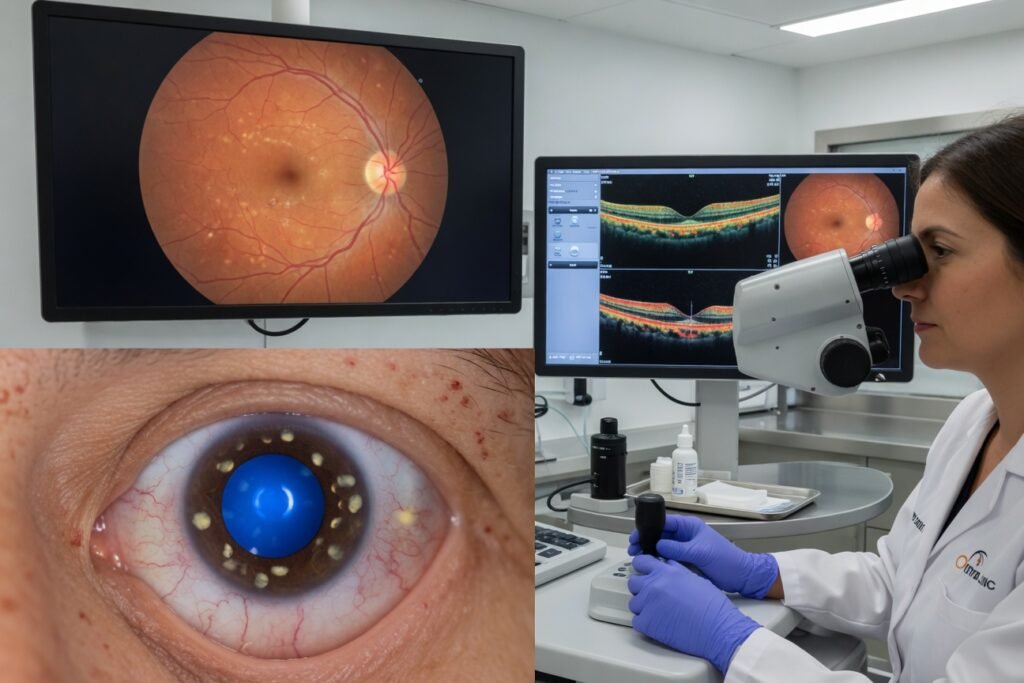
The dilated eye exam remains the gold standard. Your eye care provider instills dilating drops, which take 20-30 minutes to fully work, then uses a specialized lens to examine the retina in detail. They’re looking for microaneurysms (tiny bulges in capillaries), retinal hemorrhages, hard exudates (yellow lipid deposits), cotton-wool spots (nerve fiber layer infarcts), and new vessel growth.
Optical coherence tomography (OCT) has revolutionized how we detect and monitor diabetic macular edema—swelling in the macula, the central retina responsible for detailed vision. OCT provides cross-sectional images of the retina with micrometers of precision, revealing fluid accumulation within retinal layers that aren’t visible during a standard exam. This often changes management because macular edema requires more aggressive treatment even in nonproliferative disease.
Fundus photography documents the appearance of your retina at each visit, allowing comparison over time to track progression. Fluorescein angiography, where dye is injected intravenously and photographed as it flows through retinal blood vessels, shows exactly which vessels are leaking and which areas lack blood flow. This guides treatment planning for advanced disease.
Most people find the dilated exam uncomfortable but not painful. The drops sting briefly, and you’ll experience blurred vision and light sensitivity for 4-6 hours afterward—plan for someone else to drive if you wear contact lenses.
Treatment Options: Actual Medications and Procedures That Work
For nonproliferative retinopathy without macular edema, observation with close follow-up is often appropriate. Tight glucose and blood pressure control become your primary treatments. But once macular edema develops or proliferative disease appears, intervention is necessary.
Intravitreal anti-VEGF injections—specifically ranibizumab (Lucentis), aflibercept (Eylea), and bevacizumab (Avastin)—have become first-line therapy for diabetic macular edema. VEGF, or vascular endothelial growth factor, drives abnormal vessel growth and vascular leakiness. These monoclonal antibodies suppress VEGF signaling. Injections are performed in the office, directly into the vitreous cavity, usually monthly initially, then adjusted based on response. Most patients tolerate them reasonably well, though some discomfort during injection is typical.
Corticosteroid implants, particularly dexamethasone (Ozurdex), reduce inflammation and edema. These work differently than anti-VEGF agents and are sometimes used in combination or when anti-VEGF monotherapy hasn’t achieved adequate drying.
Laser photocoagulation, while less frequently used since anti-VEGF became available, remains important for certain scenarios. Focal laser targets leaking microaneurysms directly, and panretinal photocoagulation treats broad areas of retinal ischemia to halt new vessel growth. It’s still the standard for many cases of proliferative disease.
Vitrectomy—surgical removal of the vitreous gel—becomes necessary when vitreous hemorrhage is severe or when fibrous proliferation threatens retinal detachment. This is reserved for advanced disease because it’s more invasive, though modern small-gauge vitrectomy causes less postoperative inflammation than older techniques.
Practical Daily Management: Concrete Strategies That Actually Help
Check your blood sugar logically, not emotionally. Many diabetics with retinopathy obsess over daily fluctuations while missing the bigger picture. Ask your doctor what your target A1C should be (often 6.5-7% for patients with retinopathy, though individualization is important), then focus on that quarterly target rather than white-knuckling individual readings.
Establish a blood pressure routine. Check your BP weekly at home or at a pharmacy. Keep a log. If readings consistently run above 130/80 mmHg, discuss adjustment with your doctor. Retinal disease demands aggressive hypertension management.
Understand your medications fully. If you take an ACE inhibitor or angiotensin II receptor blocker for blood pressure, these agents protect retinal vessels specifically. Don’t skip doses because you “feel fine.” Similarly, statin therapy reduces retinopathy risk independent of cholesterol levels—they decrease inflammation in retinal vessels.
Schedule annual dilated exams religiously and bring written records of your recent A1C values and blood pressure readings. This information helps your eye doctor assess your risk trajectory. If you notice any sudden vision changes, floating spots, or flashing lights, don’t wait for your scheduled appointment; call that day.
Manage other cardiovascular risk factors aggressively. Smoking accelerates retinal vessel damage. Obesity worsens insulin resistance and glycemic control. Physical activity, even 30 minutes of walking most days, improves insulin sensitivity and can lower A1C by 1-2 percentage points.
Prevention: What Evidence Actually Shows Works
The Diabetes Control and Complications Trial conclusively demonstrated that lowering A1C from ~9% to ~7% reduces retinopathy risk by approximately 76% in type 1 diabetes patients. The United Kingdom Prospective Diabetes Study replicated similar findings in type 2 diabetes. This is the bedrock evidence: glycemic control prevents diabetic retinopathy.
Blood pressure control matters nearly as much. Tight BP management reduces retinopathy progression by 35% according to multiple prospective trials. The combination of controlled glucose and controlled blood pressure offers additive protection.
ACE inhibitors and angiotensin II receptor blockers (ARBs) provide retinal vascular protection beyond their blood pressure-lowering effects. Some trials suggest they may slow retinopathy progression even in normotensive patients with diabetes, though the effect is modest.
Aspirin for primary prevention—taking aspirin just to prevent diabetic complications in asymptomatic patients—has limited evidence. Most major organizations recommend against routine aspirin for diabetic retinopathy prevention specifically, though it may have value for cardiovascular prevention in certain patients.</p