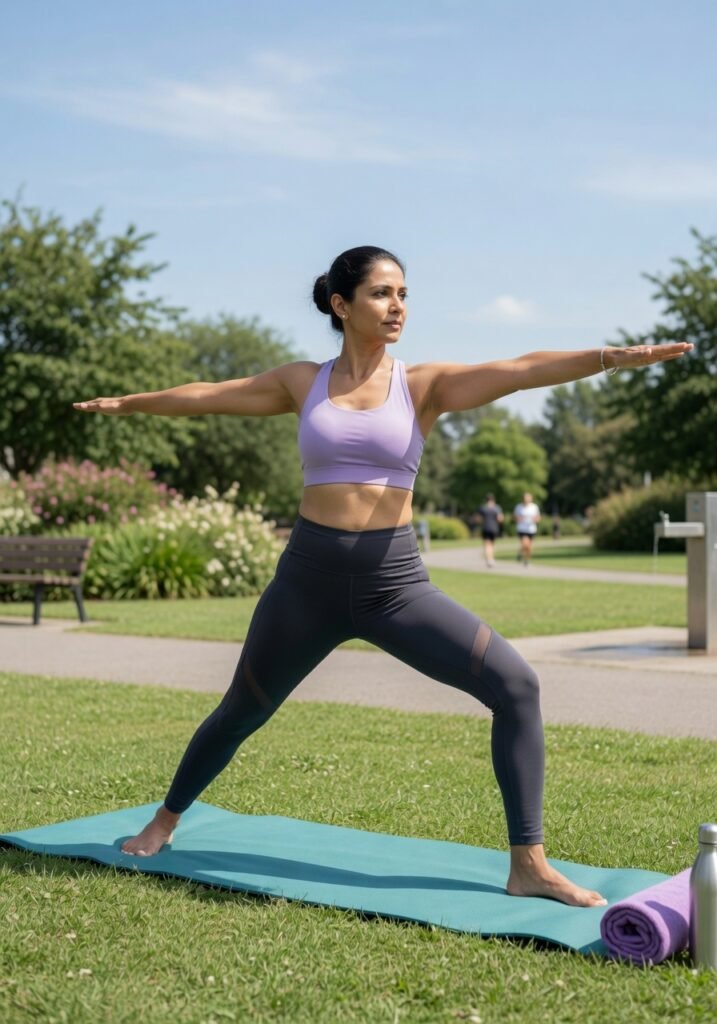
Sarah, a 42-year-old accountant with chronic lower back pain, spent two years taking ibuprofen daily and avoiding exercise. When her doctor suggested yoga, she dismissed it as stretching for people in expensive activewear. Six months into a regular Hatha practice, her pain medication dropped from 1200mg daily to occasional doses. But here’s what surprised her: the real change wasn’t flexibility. It was her nervous system finally downshifting from constant fight-or-flight mode.
The misconception: Yoga is primarily about becoming more flexible, like a gymnast bending into pretzel shapes. The reality: Yoga’s documented benefits come from systematically training your parasympathetic nervous system—the biological brake pedal most of us never learned to use. Flexibility is a side effect, not the mechanism.
Key Facts About Yoga
- According to the National Institutes of Health, 10% of American adults practice yoga regularly, yet only 23% began primarily for physical fitness—59% started for mental health or stress management.
- A 2021 JAMA study found that adults with chronic lower back pain who practiced yoga twice weekly for 12 weeks experienced pain reduction comparable to physical therapy, with effects persisting 6 months after the intervention ended.
- Heart rate variability (a marker of parasympathetic nervous system tone) increases measurably within 8 weeks of consistent yoga practice, detectable through simple wearable devices.
- The CDC recognizes yoga as a low-impact physical activity meeting aerobic exercise recommendations only when practiced at moderate intensity; gentle restorative yoga does not satisfy cardiovascular guidelines alone.
- Brain imaging shows that regular yoga practitioners have increased gray matter density in the hippocampus and prefrontal cortex, regions associated with emotional regulation and memory consolidation.
Understanding What Actually Happens When You Practice Yoga
Think of your nervous system like a car with a stuck accelerator. Modern life—emails, notifications, financial stress—keeps your sympathetic nervous system firing constantly. Your body releases cortisol and adrenaline. Your muscles tense. Your digestion slows. Most people never experience the “off” switch.
Yoga works like this: specific breath patterns (pranayama) and sustained postures activate your vagus nerve, the main cable connecting your brain to your body’s parasympathetic system. When you hold downward dog for 8 breaths while consciously slowing your exhale, you’re literally sending a safety signal to your brainstem. Your heart rate drops. Your pupils constrict. Your body shifts into “rest and digest” mode. This isn’t mystical—it’s measurable physiology.
The physical positions matter too, but differently than most articles suggest. Holding a warrior pose doesn’t primarily build strength (though it does). It teaches your body to maintain stability under mild stress without recruiting every muscle fiber. You learn to contract only what’s necessary. This pattern transfers to daily life: you eventually stop clenching your jaw during meetings or gripping your shoulders while typing.
Why Some People Benefit More Than Others: Risk Factors That Matter
Your starting nervous system state determines your timeline. Someone with diagnosed generalized anxiety disorder or PTSD typically sees measurable changes within 3 weeks of regular practice. Someone already calm? They might notice subtle shifts in mood stability after 2 months.
Age is less relevant than people think. The larger factor is what we call “system rigidity”—how fixed your movement patterns have become. A 58-year-old office worker with 25 years of desk posture might progress faster than a 32-year-old athlete, because the athlete’s body is already somewhat mobile and reactive. Yoga’s biggest advantage goes to people whose nervous systems have been stuck in overdrive.
Here’s what most articles skip: your yoga style choice determines which benefits you’ll access. Vigorous Vinyasa or Power yoga elevates heart rate and builds strength but provides minimal parasympathetic activation. Restorative or Yin yoga deeply engages the parasympathetic system but won’t improve cardiovascular fitness. A person with high blood pressure needs different yoga than someone with depression, yet they often get the same generic recommendation.
Sleep quality matters. People who sleep poorly have higher baseline cortisol, which blunts yoga’s effects. The physiology still works, but the nervous system is too depleted to respond quickly. Starting sleep hygiene improvements alongside yoga accelerates results.
What You Actually Experience: The Signs Yoga Practitioners Notice
The first observable change typically isn’t strength or flexibility—it’s breathing. Within 1-2 weeks, people notice they naturally breathe more slowly during stress. They catch themselves midway through the day and realize their shoulders dropped from their ears.
Around week 3-4, sleep quality often shifts. Not necessarily longer sleep, but deeper, more restorative sleep. Practitioners wake less frequently and report fewer racing thoughts at 3 AM.
By week 6-8, emotional changes emerge that patients frequently attribute to something else (new medication, therapy, better circumstances). In reality, the improved vagal tone means you recover faster from frustration. You respond rather than react. You tolerate difficult conversations without your nervous system hijacking your behavior.
Physical changes lag behind these internal shifts. Flexibility improvements become noticeable around week 4-6. Strength and muscle definition take 8-12 weeks. This matters because most people quit after 3 weeks when they’re experiencing nervous system benefits but haven’t yet seen the physical changes they expected.
An overlooked warning sign: muscle soreness that doesn’t resolve. Unlike gym soreness, which peaks at 48 hours then improves, persistent yoga soreness (especially in joints rather than muscle bellies) suggests form issues. This requires correction before building a regular practice.
How to Know Yoga Will Help You: Assessment and Testing
There’s no blood test for “yoga responsiveness,” but clinicians now use measurable markers. Before starting, a baseline measurement of resting heart rate and heart rate variability (captured through devices like an Oura Ring or simple wearable chest strap) gives you a starting point. A functional movement screen—essentially observing how you squat, lunge, and reach—identifies movement restrictions or compensation patterns your yoga practice will address.
The honest process: you’ll do a trial. Start with two weeks of consistent practice (even just 15 minutes daily of beginner-level poses like Child’s Pose, Cat-Cow stretches, and Legs-Up-The-Wall). Notice what shifts. Do you sleep better? Is your jaw less clenched? Can you complete a stressful work task without your heart rate spiking? These subjective measures matter more than official testing.
If you have existing conditions—rotator cuff injury, knee arthritis, herniated discs—a single consultation with a yoga therapist (distinct from a regular yoga instructor, with additional training in therapeutic applications) prevents aggravation. They’ll identify which poses to modify or avoid entirely.
Treatment and Management: What Actually Works and For Whom
The evidence strongest supports yoga for five specific conditions: chronic lower back pain, generalized anxiety disorder, depression (as adjunctive therapy alongside antidepressants like sertraline or fluoxetine, not as replacement), hypertension, and type 2 diabetes blood sugar control.
For back pain specifically, a 2019 study in JAMA found that 12 weeks of Iyengar yoga (which emphasizes precise alignment) reduced pain equivalent to physical therapy, with improvements maintained one year later. Frequency matters: twice weekly outperforms once weekly.
For anxiety, the mechanism works through vagal activation, but you cannot outthink anxiety during practice. Trying to “be mindful” or “let thoughts go” paradoxically increases tension. The benefit comes from the physical practice itself—your vagus nerve responds to the sustained breathing and gentle stretching regardless of your mental state. Over time, your baseline anxiety naturally decreases.
For depression, research published in the Journal of Affective Disorders shows yoga increases BDNF (brain-derived neurotrophic factor) similarly to exercise, but the social component matters. Group yoga classes show better depression outcomes than home practice, likely because isolation itself worsens depression. If you’re severely depressed, begin with fluoxetine or similar SSRI medication alongside yoga rather than instead of it—the combination outperforms either alone.
Type 2 diabetes management: consistent yoga practice improves insulin sensitivity markers and HbA1c levels modestly (typically 0.5-1.0 point reduction) in 8-12 weeks. It’s not replacement for metformin or lifestyle diet changes, but an excellent adjunct, particularly for people who dislike running or cycling.
Your Practical Daily Yoga Strategy
Pick a specific time and duration first. “I’ll do yoga sometime” fails. “15 minutes before breakfast on Mondays, Wednesdays, and Fridays” succeeds. Consistency matters more than duration.
Choose one style and stick with it for 8 weeks. Mixing styles—Vinyasa on Monday, restorative Wednesday, hot yoga Friday—confuses your nervous system’s adaptation. Pick one. Learn its logic. Then layer in variation.
Progress slowly with difficulty. Your ego will suggest advanced poses. Resist. Build your foundation in basic poses (Mountain Pose, Downward Dog, Warrior I, Child’s Pose) for weeks. These basics retrain your entire movement pattern. Fancy poses just look cooler.
Track one specific metric you care about. For anxiety sufferers: resting heart rate or count of “racing mind” nights weekly. For back pain: pain intensity on mornings you practiced versus didn’t. For sleep issues: minutes awake after sleep onset. Measure something. Numbers motivate compliance.
Use a mirror or recording yourself. You cannot feel your alignment. You can only see it. Record one practice weekly and watch for compensation patterns—excessive arching, one side hiked higher, shoulders creeping up during breathing.
Prevention: Building Resilience Before Crisis Hits
The strongest evidence for yoga’s preventive power addresses stress-related conditions before they become clinical diagnoses. Someone practicing yoga regularly demonstrates measurably lower baseline cortisol, meaning they start from a position of greater resilience when life stressors arrive.
Does yoga prevent heart disease? The data suggests it reduces risk factors (blood pressure, inflammation markers, improved lipid profiles in some studies), but no randomized trial proves it prevents cardiac events compared to other exercise. It’s part of a broader healthy pattern, not a standalone prevention tool.
One caveat: irregular practice provides minimal prevention benefit. Practicing intensely for two months then quitting for six months doesn’t build lasting nervous system retraining. Your vagus nerve is like any other physiological system—it needs consistent input to maintain adaptation.