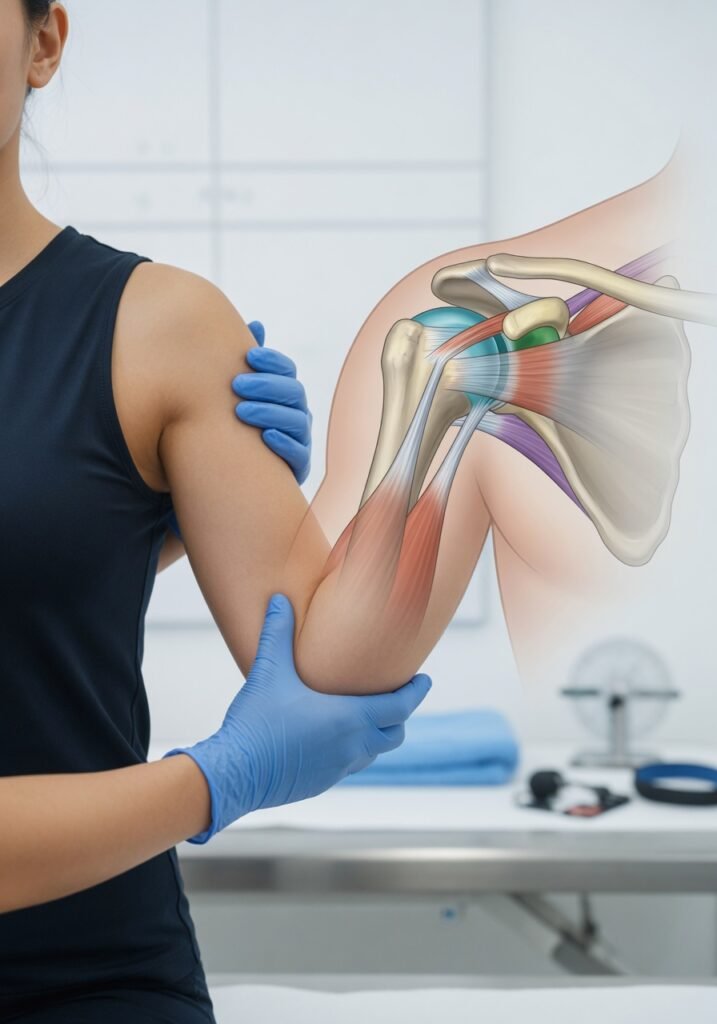

Rotator Cuff Injury: What You Actually Need to Know About Your Shoulder Pain
Sarah, a 52-year-old accountant, spent three months convinced her shoulder pain meant a complete rotator cuff tear. She’d read online that she’d likely need surgery, so she stopped reaching for things, started compensating with her left arm, and actually made her shoulder weaker. When her MRI finally came back, it showed a small partial tear in her supraspinatus tendon—something that would likely heal without an operating room if she stopped babying it and did the right exercises.
Here’s the misconception most people get wrong: A rotator cuff injury doesn’t automatically mean you’re looking at surgery or permanent damage. The truth is harder to swallow—it requires patience, specific rehabilitation, and sometimes months of consistent effort rather than a quick fix. But that same truth means most rotator cuff injuries can resolve completely without surgical intervention.
Key Facts About Rotator Cuff Injuries
- Rotator cuff tears affect approximately 20% of adults by age 60, yet not all cause pain or functional problems, according to research published in JAMA Orthopaedic Surgery
- Partial thickness tears account for roughly 60% of all rotator cuff pathology, while full-thickness tears comprise about 40%
- The supraspinatus tendon is injured in 90% of rotator cuff cases because it carries the most mechanical load during overhead activities
- Approximately 80-90% of rotator cuff tears in patients under 60 can be managed non-operatively with proper physical therapy
- Re-tear rates after surgical repair range from 20-47% depending on tear size, with larger tears (>3cm) showing significantly higher re-rupture risk
Understanding Your Rotator Cuff: The Mechanics Behind the Pain
Your rotator cuff isn’t a single structure—it’s four small but crucial muscles and their tendons that work as a dynamic stabilizer for your shoulder joint. Think of them as the shoulder’s internal bracing system. The four muscles are the supraspinatus, infraspinatus, teres minor, and subscapularis. They don’t create the big movements (that’s your deltoid and pectoralis); instead, they keep the ball of your shoulder socket centered in the cup while other muscles do the heavy lifting.
Here’s where most articles get it wrong: people think of the rotator cuff as static support, like a rope holding something in place. It’s actually dynamic—constantly firing, adjusting, and stabilizing based on what you’re asking your arm to do. When you reach overhead, your rotator cuff muscles must work harder to prevent the humeral head from jamming upward into the acromion. That’s why repetitive overhead activities damage it, but also why rest alone rarely fixes it. The muscles need to relearn how to stabilize properly under load.
What Causes Rotator Cuff Injuries: Risk Factors Beyond Age
Most people blame age, and yes—collagen in tendons becomes less elastic after 40. But age explains only part of the story. The CDC and sports medicine literature identify several modifiable risk factors that most health websites bury or ignore entirely.
Repetitive overhead activities remain the primary culprit. Painters, swimmers, baseball players, and construction workers face genuine elevated risk. But here’s what gets overlooked: the intensity threshold matters more than the volume. Someone throwing a baseball at competitive speeds once weekly faces more rotator cuff stress than someone painting casually for hours.
Scapular dyskinesis is the less-discussed risk factor. If your shoulder blade doesn’t move smoothly and symmetrically, your rotator cuff compensates and fatigues. This often comes from weak serratus anterior muscles or tight pectoralis minor—correctable problems through targeted strengthening.
Other established risk factors include smoking (which impairs tendon healing through reduced blood flow), diabetes (affects collagen quality), and previous shoulder injury. One often-missed factor: cervical spine pathology. Nerve compression in your neck can cause referred pain that feels like a rotator cuff problem, or it can genuinely weaken rotator cuff muscles through neurologic compromise.
Traumatic causes—like falling on an outstretched arm—account for maybe 10-15% of cases. Most rotator cuff injuries develop gradually from cumulative microtrauma.
Recognizing the Symptoms: What Rotator Cuff Injury Actually Feels Like
Patients typically describe a dull ache in the lateral shoulder—the side facing away from your body—that worsens with specific movements. Reaching overhead, throwing, or even sleeping on the affected shoulder generates pain. Some people report weakness, though this can be misleading because often the weakness exists due to pain avoidance rather than true muscular failure.
Early warning signs get missed constantly. The first hint might be subtle: you can’t reach behind your back as comfortably, or you notice your arm tires faster during repetitive activities. You might feel clicking or catching, though not always—some people have silent rotator cuff tears on imaging despite zero symptoms.
Night pain is particularly common and frustrating. Rolling onto the affected side compresses the supraspinatus tendon further under the acromion, triggering pain that wakes you at 2 AM. This sleep disruption actually slows healing because your body repairs tissues during sleep.
The pain typically worsens over weeks to months if untreated. Some people experience sudden, severe pain from an acute tear, while others describe gradually intensifying discomfort that finally forces them to seek help when it interferes with work or daily activities.
Getting an Accurate Diagnosis: Tests and What They Actually Tell You
Your doctor should start with a clinical examination, not imaging. Specific tests like the Supraspinatus (empty can) test, the Infraspinatus test, and the Lift-off test can identify which rotator cuff muscle is involved. A positive finding doesn’t confirm a tear—it suggests weakness or pain, which might indicate a tear, inflammation, or a neurologic issue.
Ultrasound is the first imaging choice for rotator cuff evaluation. It’s cheaper than MRI, has real-time dynamic capability (your radiologist can watch the tendon move), and doesn’t involve radiation. High-frequency probes can detect tears with 85-90% sensitivity when performed by experienced sonographers.
MRI provides superior soft tissue resolution and can characterize tear size, location, and whether retraction occurred. If surgery is being considered, MRI helps surgeons plan the repair. But here’s the critical insight: MRI findings don’t always correlate with symptoms. You can have a tear on MRI with zero pain, or severe pain with a normal-appearing tendon. The clinical picture matters more than the imaging finding alone.
X-rays usually appear normal in rotator cuff tears but help rule out arthritis, calcification, or bony injuries. CT rarely adds useful information unless you’re evaluating complex fractures or preparing for revision surgery.
Treatment Options: From Conservative Care to Surgery
Non-operative management remains the first-line approach for most rotator cuff injuries. Physical therapy specifically targeting rotator cuff strengthening and scapular stabilization produces good outcomes in 80-90% of cases when patients actually do the work.
NSAIDs like ibuprofen or naproxen reduce inflammation short-term, though evidence for long-term healing benefit is modest. Acetaminophen offers an alternative for those who can’t tolerate NSAIDs. Topical NSAIDs applied directly over the shoulder provide some benefit while avoiding systemic absorption.
Corticosteroid injections deserve nuance here. A single subacromial corticosteroid injection can reduce pain enough to allow meaningful physical therapy participation. However, repeated injections (more than three in a year) may impair tendon healing and should be avoided. The evidence, particularly from studies in the American Journal of Sports Medicine, shows injections work best when combined with structured rehabilitation.
Physical therapy is genuinely non-negotiable. Effective programs include scapular stabilization exercises (like serratus anterior strengthening and lower trapezius activation), rotator cuff isometric exercises initially, then progressive resistance training as pain allows. Therapists typically recommend 2-3 sessions weekly for 6-12 weeks.
Surgical repair becomes relevant when conservative treatment fails after 3-6 months of dedicated therapy, or when you have a large acute tear with significant functional loss. Arthroscopic rotator cuff repair involves small incisions, visualization with a camera, and anchoring the torn tendon back to bone. Open repair through a larger incision is rarely used now except for massive tears or revision cases. Outcomes are generally good—about 85-90% pain relief—though re-tearing occurs in 20-47% of cases depending on tear size and patient factors.
Practical Daily Management Strategies That Actually Work
Sleep positioning matters. Side-sleeping on the opposite shoulder, or sleeping on your back with a pillow under the affected arm to prevent shoulder compression, significantly reduces night pain. This isn’t minor—better sleep accelerates healing.
Activity modification beats complete rest. Stop overhead reaching and throwing temporarily, but maintain gentle movement. Total immobilization weakens muscles further and stiffens joints. After the acute phase (usually 1-2 weeks), progressive movement under controlled conditions promotes healing.
Ice in the first 2-3 weeks, heat after that. Initial inflammation responds to cold. Once acute inflammation settles, heat increases blood flow and tissue extensibility before stretching or exercise.
Specific strengthening progression works like this: Start with isometric rotator cuff contractions (hold without moving), progress to resistance band exercises with light resistance, then advance to heavier bands or light weights only when pain-free. Never push through significant pain during exercise—mild discomfort is acceptable; sharp pain means you’re overdoing it.
Scapular control exercises deserve priority. Wall slides, prone Y-T-W exercises, and dead bug variations with resistance bands train your scapula to move properly, reducing compensatory stress on your rotator cuff.
Prevention: What Evidence Actually Shows Works
If you engage in repetitive overhead activities, preseason rotator cuff strengthening reduces injury risk by roughly 50%, according to studies in throwing athletes. This means rotator cuff exercises during off-season and maintenance during competition matter.
Proper technique during overhead activities prevents many injuries. Baseball pitchers, for example, generate force from their legs and trunk—not just their shoulder. Poor mechanics overload the rotator cuff. If your activity involves overhead movement, coaching or instruction in proper form provides genuine benefit.
Addressing scapular dyskinesis before injury develops is preventive medicine. If you notice your shoulder blade winging or moving asymmetrically during arm raises, targeted strengthening prevents future problems.
Smoking cessation improves tendon healing and microvascular supply. If you smoke and have shoulder problems, quitting accelerates recovery beyond the general health benefits.
Maintaining cervical spine health matters. Posture exercises, neck stretching, and ergonomic positioning at work prevent nerve compression that can weaken rotator cuff muscles preventively.
Frequently Asked Questions About Rotator Cuff Injuries
Can a rotator cuff tear heal on its own?
Small partial-thickness tears often heal without surgery, especially in younger patients with good overall health. Full-thickness tears rarely heal on their own because the tendon ends retract and don’t re-approximate naturally. However, even full-thickness tears can improve functionally with physical therapy and proper strength compensation, which is why surgery isn’t always necessary.</p
Sources & Medical References
HealthTopics.com articles are based on peer-reviewed medical research and guidance from the NIH, CDC, and WHO. See our editorial policy for full sourcing standards.