Cardiac Arrest vs Heart Attack: Why They’re Not the Same Thing (And Why That Matters)
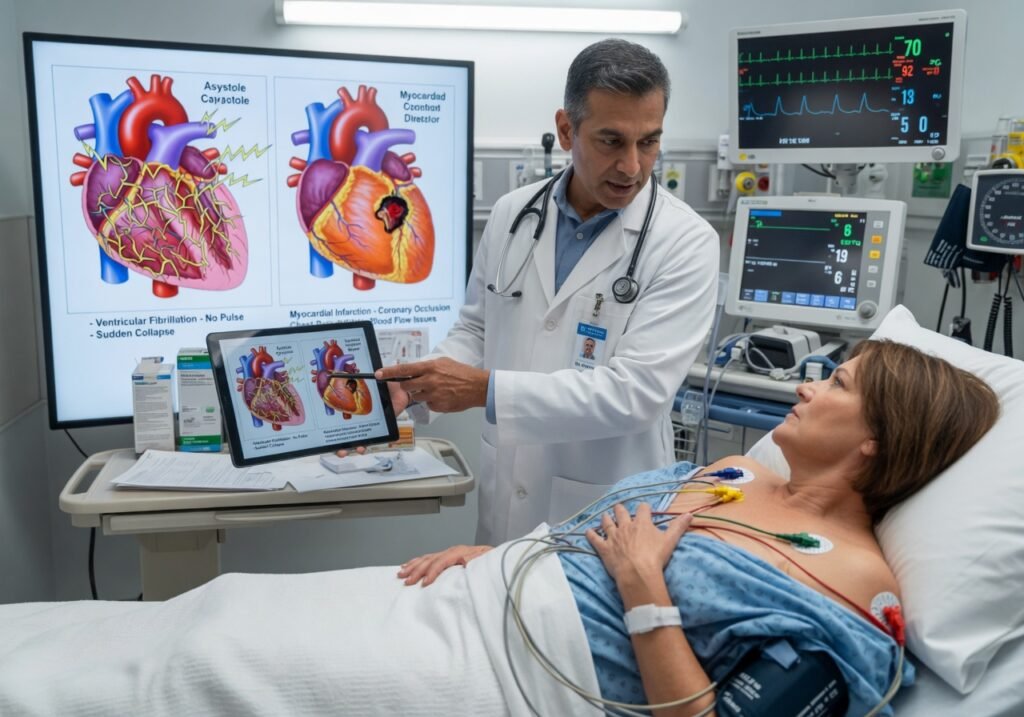
I had a patient named Robert come into clinic last month convinced he’d had cardiac arrest after experiencing crushing chest pain while mowing his lawn. His wife had called 911, he’d been rushed to the hospital, and he’d spent three days in our cardiac unit. The truth? He’d suffered a massive myocardial infarction—a heart attack. He was alive and conscious the entire time, which meant by definition he hadn’t experienced cardiac arrest. But here’s what people get wrong: they use these terms interchangeably, as if they describe the same catastrophic event. They don’t. A heart attack is about blood flow. Cardiac arrest is about electrical chaos. One destroys heart muscle. The other stops the heart from beating at all. Understanding the difference could literally save your life or help you recognize when someone around you needs CPR in the next thirty seconds.
Key Facts About Cardiac Arrest
- Sudden collapse happens in seconds. Cardiac arrest causes loss of consciousness and unresponsiveness within 10-20 seconds because the brain stops receiving oxygenated blood. A heart attack victim remains conscious and alert unless complications develop.
- Out-of-hospital cardiac arrest survival is roughly 10-12% according to the CDC, though this varies dramatically by region and response time. In-hospital survival reaches 25-40% depending on the underlying rhythm and patient age.
- Ventricular fibrillation requires immediate defibrillation. If cardiac arrest stems from a shockable rhythm (VF or pulseless VT), survival rates double or triple with defibrillation within the first minute compared to waiting for paramedics.
- Most cardiac arrests occur outside hospitals. Approximately 70% of witnessed out-of-hospital cardiac arrests happen in residential settings, not in public spaces where automated external defibrillators (AEDs) are typically located.
- Post-arrest brain injury is common and serious. Even successfully resuscitated patients face anoxic brain injury in 20-40% of cases, leading to cognitive deficits, memory problems, and personality changes that may not appear immediately.
Understanding Cardiac Arrest: The Electrical System Fails
Let me explain what’s actually happening when someone goes into cardiac arrest, because the physiology matters for understanding why this is so different from a heart attack.
Your heart is essentially an electrical-mechanical pump. The electrical system sends out organized signals that tell the atria and ventricles when to contract. Think of it like a precisely timed orchestra where every instrument knows exactly when to play. Cardiac arrest occurs when that electrical system becomes chaotic—or stops entirely. The rhythm deteriorates into ventricular fibrillation (the ventricles quivering uselessly instead of contracting), pulseless ventricular tachycardia (dangerously fast, uncoordinated beats), asystole (flatline—total electrical silence), or pulseless electrical activity (organized electrical signals on the monitor but no actual pumping action).
When the heart stops beating effectively, blood flow to your brain ceases. Within 4-6 minutes without oxygenated blood, permanent brain damage begins. Within 8-10 minutes, death becomes nearly inevitable without intervention. This is why the time between collapse and CPR or defibrillation is literally the difference between walking away and permanent disability or death.
A heart attack, by contrast, is a plumbing problem. A coronary artery becomes blocked by a blood clot, starving a section of heart muscle of oxygen. That muscle begins to die. The heart keeps beating (unless complications develop), but it’s damaged. You’re conscious. You’re aware. You’re probably in severe pain.
What Causes Cardiac Arrest? Look Beyond the Obvious
Most people assume cardiac arrest only happens to older folks with severe heart disease. Wrong. While age and previous MI (myocardial infarction) do increase risk, cardiac arrest can strike seemingly healthy younger people, which is why this matters to you even if you think you’re low-risk.
The major cardiac causes include acute coronary syndrome (a heart attack triggering dangerous arrhythmias), cardiomyopathy (weakened heart muscle), myocarditis (inflammation of the heart muscle, often viral), Long QT syndrome (a genetic electrical abnormality), and Brugada syndrome (another genetic arrhythmia condition).
But here’s what most articles miss: severe electrolyte abnormalities can trigger cardiac arrest without any underlying heart disease. Profound hypokalemia (dangerously low potassium), hyperkalemia (critically high potassium), and hypocalcemia (low calcium) can destabilize the electrical system enough to cause fatal arrhythmias. I’ve seen cardiac arrest from severe dehydration with electrolyte derangement in young athletes. I’ve seen it from accidental hyperkalemia in dialysis patients when the technician made a dosing error. These aren’t “heart disease” in the traditional sense, but they’re absolutely cardiac arrests that killed people or left them severely brain-damaged.
Other non-cardiac causes matter too: massive pulmonary embolism, severe sepsis, anaphylaxis, severe asthma with hypoxemia, and drowning. Approximately 25-30% of cardiac arrests are triggered by non-cardiac medical emergencies.
Trauma also causes arrest—either from direct cardiac injury (sternal fracture penetrating the heart) or from sudden impact causing commotio cordis (a blow to the chest during a vulnerable phase of the cardiac cycle that triggers VF).
Signs and Symptoms Before the Collapse
Here’s the brutal reality about cardiac arrest: most of the time, there are no warning signs. The person collapses suddenly. They’re unresponsive. They stop breathing normally (you might see gasping or agonal respirations). There’s no pulse. That’s it.
But some patients do experience prodromal symptoms—warning signs in the minutes or hours before arrest occurs. These are easy to dismiss. Palpitations (feeling your heart racing or fluttering). Presyncope (dizziness or feeling faint without actually losing consciousness). Dyspnea (shortness of breath that seems disproportionate to activity). Chest discomfort that feels different from typical angina. Extreme fatigue or malaise that comes on suddenly.
If you experience any of these—especially the combination of palpitations plus presyncope or syncope—get evaluated immediately. I’m not saying call your doctor tomorrow. I’m saying go to the emergency department now or call 911 if you feel like you might pass out. The prodrome is your window to get help before the electrical system completely fails.
How Cardiac Arrest Gets Diagnosed
Diagnosis is simultaneous with treatment in cardiac arrest. When someone collapses unresponsive, the paramedics or bystanders perform the ABCs—airway, breathing, circulation—and immediately place defibrillation pads on the chest to identify the rhythm. The monitor tells the story: is it VF (needs shocking), PVT (needs shocking), asystole (needs medication and CPR), or PEA (medication and CPR)?
In the hospital, the arrested patient gets intubated, placed on continuous cardiac monitoring, and given medications (epinephrine every 3-5 minutes during resuscitation, amiodarone or lidocaine if shockable rhythms persist). The team performs high-quality chest compressions—at least 100-120 compressions per minute at a depth of 2-2.4 inches—without interruption except to check rhythm every 2 minutes.
If return of spontaneous circulation (ROSC) is achieved, the next critical step is targeted temperature management. Cooling the body to 32-36°C for 24 hours improves neurological outcomes by reducing the brain’s metabolic demand during the reperfusion period. After arrest, the heart and brain are extremely vulnerable to damage from reperfusion injury—the inflammation that happens when blood flow returns.
Coronary angiography happens next, because if the arrest was caused by an MI, you need to identify and open that blocked artery. The patient also gets an electroencephalogram (EEG) to assess for ongoing seizure activity, which is common after arrest.
Treatment: What Actually Works
The immediate treatment is CPR and defibrillation—nothing else comes close in importance. If you’re untrained, hands-only CPR (chest compressions without rescue breaths) is nearly as effective as traditional CPR for adults and is what most people should do.
Once in the hospital, treatment depends on the cause and the rhythm. For shockable rhythms (VF or PVT), defibrillation is first-line. Medications used during resuscitation include epinephrine (increases coronary perfusion pressure and restores organized rhythms), amiodarone (an antiarrhythmic used for VF refractory to defibrillation), and sometimes atropine (used for bradycardia during resuscitation, though its role is now limited).
If the arrest was cardiac in origin (MI, cardiomyopathy, myocarditis), the patient needs aggressive cardiology evaluation and management. For post-MI cardiac arrest, percutaneous coronary intervention—placing a stent in the blocked artery—happens urgently. For inherited arrhythmia syndromes like Long QT or Brugada, the patient often needs an implantable cardioverter-defibrillator (ICD) to prevent future arrests.
For survivors, rehabilitation is essential. Physical therapy, occupational therapy, and neuropsychological rehabilitation address the cognitive deficits and physical weakness common after cardiac arrest. Many survivors benefit from cardiac rehabilitation programs designed specifically for post-arrest patients.
Practical Daily Management for Cardiac Arrest Survivors
If you’ve survived cardiac arrest, your life changes. You’ll need regular follow-up with both cardiology and neurology. Some survivors experience significant cognitive problems—memory issues, difficulty concentrating, personality changes—that may not be immediately obvious but surface over weeks or months.
If you have an ICD, you’ll need to learn what activities are safe. You can exercise, but you need restrictions on heavy contact sports. You can fly (modern ICDs are safe through airport security), but you need to carry your ICD identification card. You cannot undergo MRI unless your device is MRI-safe or unless the device can be suspended during the procedure.
Return to driving is restricted by most cardiologists. You typically cannot drive for at least 6 months post-arrest, and often longer if you have recurrent arrhythmias or cognitive impairment. This isn’t arbitrary—it’s because arrested patients have a meaningful recurrence risk.
Family education matters tremendously. Your family members should learn CPR and know where your medications are kept. If you have warning symptoms again (palpitations, presyncope), you need a protocol: stop activity, call 911, don’t drive yourself to the hospital.
Prevention: What the Evidence Actually Shows
For inherited arrhythmia syndromes (Long QT, Brugada, catecholaminergic polymorphic ventricular tachycardia), screening family members is critical. If your sibling had unexplained sudden cardiac death or arrest, genetic testing and screening for you and your children is medically necessary, not optional.
For coronary disease prevention, the standard advice applies: don’t smoke, control blood pressure (target usually <130/80), manage diabetes aggressively, control cholesterol with statins if indicated, exercise regularly, and eat a heart-healthy diet. The ACC/AHA guidelines recommend aspirin for primary prevention in select high-risk patients age 40-59, though the decision should be individualized.
What’s underutilized: screening for subclinical disease if you have multiple risk factors. A coronary calcium score (CT imaging that detects calcium in coronary plaques) costs a few hundred dollars and can identify people with hidden significant disease who would benefit from more aggressive prevention. If your father died suddenly at age 55, a calcium score at age 40 might reveal that you have