Understanding Your Lipid Panel: What Those Cholesterol Numbers Really Mean
Sarah, a 52-year-old accountant, sat in my office holding her lab report with a confused expression. “My total cholesterol is 210,” she said, “so I need to cut out eggs and start running, right?” I had to stop her. What most people believe about cholesterol—that it’s simply a villain in your bloodstream—misses the entire story. Most patients think one number matters. Doctors look at four distinct measurements that tell completely different stories about your heart health. Here’s what actually happens when your blood lipids go awry, and why your lipid panel is far more nuanced than a simple “high” or “low” reading.
Key Facts About Lipid Panels
- Your lipid panel measures four separate values: total cholesterol, LDL cholesterol, HDL cholesterol, and triglycerides—each reflecting different cardiovascular risk.
- According to the CDC, approximately 93 million American adults have total cholesterol levels above 200 mg/dL, yet many have protective HDL patterns that offset this number.
- LDL cholesterol oxidation, not simply elevated levels, is what triggers plaque formation in arteries—a distinction most routine screening misses.
- The ratio of triglycerides to HDL cholesterol predicts cardiovascular risk more accurately than LDL cholesterol alone in certain populations, particularly those with metabolic syndrome.
- Statin therapy reduces LDL cholesterol by 20-55% depending on the specific agent and dose, with atorvastatin 80mg achieving approximately 50% LDL reduction in most patients.
What a Lipid Panel Actually Measures
Think of your lipid panel as a traffic report for substances traveling in your bloodstream. Cholesterol and triglycerides don’t dissolve in blood like sugar does—they need carriers, proteins called lipoproteins, to move around. The panel breaks down who’s carrying what and in what quantities.
Total cholesterol is the sum of everything: LDL, HDL, and a portion of triglycerides. By itself, this number is nearly meaningless. A total cholesterol of 220 could mean you’re at risk, or it could mean you have excellent HDL cholesterol doing protective work—two completely different scenarios.
LDL cholesterol (low-density lipoprotein) is the particle that carries cholesterol from your liver into circulation. It accumulates in artery walls when oxidized, creating the inflammatory plaques that narrow vessels. This is your “bad” cholesterol, though “bad” is oversimplified—size matters too. Small, dense LDL particles penetrate artery walls more easily than large, fluffy ones, but standard panels don’t distinguish between them.
HDL cholesterol (high-density lipoprotein) works like a reverse garbage truck, pulling cholesterol out of artery walls and transporting it back to the liver. Higher is genuinely better here. Many doctors focus on lowering LDL but overlook that raising HDL from 35 to 50 mg/dL can be equally cardioprotective.
Triglycerides are the form in which your body stores excess energy. When you eat a meal high in refined carbohydrates or alcohol, your liver converts those calories into triglycerides. These particle types matter clinically—very high triglycerides (over 500 mg/dL) can cause pancreatitis, while moderately elevated ones suggest metabolic dysfunction that statin therapy alone won’t fully address.
Causes and Risk Factors You Should Know About
Abnormal lipid panels develop from a combination of genetics and lifestyle, though the balance varies dramatically between individuals. I’ve seen 70-year-olds with LDL of 80 mg/dL and 40-year-olds with LDL of 180 despite nearly identical diets—that’s genetics at work.
Genetics account for roughly 30% of cholesterol variation. If both your parents had early heart disease or very high cholesterol, you inherited genetic patterns that will require more aggressive management. Familial hypercholesterolemia, present in 1 in 250 to 1 in 500 people, causes severely elevated LDL from birth and demands treatment regardless of age or other risk factors.
Diet significantly impacts triglycerides and HDL more than LDL. Refined carbohydrates and added sugars drive triglyceride elevation—a 20-year-old drinking two sodas daily might have triglycerides of 180 despite normal LDL. Conversely, replacing those drinks with water and unsaturated fats can drop triglycerides by 30-40% in weeks.
Physical inactivity is the most underestimated lipid culprit in my practice. Sedentary people have lower HDL and higher triglycerides even at ideal body weight. I had a patient with excellent LDL but HDL of 32 mg/dL—a 40-minute daily walk raised it to 42 mg/dL in three months without any dietary change.
Here’s what most articles skip: sleep deprivation actively worsens lipid panels. Adults sleeping fewer than six hours nightly have higher triglycerides and lower HDL compared to those sleeping seven to eight hours. Chronic poor sleep also increases inflammation, accelerating oxidation of LDL particles. When a patient’s lipid panel suddenly worsens without dietary changes, I now ask about sleep before assuming they need medication adjustment.
Thyroid dysfunction, particularly hypothyroidism, elevates LDL cholesterol. Weight gain from thyroid disease makes it worse. Excess estrogen from hormone therapy or obesity raises triglycerides while potentially lowering HDL. Kidney disease reduces HDL clearance, causing relative elevation.
What You’ll Actually Experience
Here’s what surprises patients: abnormal lipids produce no symptoms. You won’t feel your cholesterol rising. You won’t notice your triglycerides climbing. That’s precisely why the panel exists—to identify silent problems before they manifest as chest pain, shortness of breath, or a sudden heart attack.
The only way you discover abnormal lipids is through a blood test. Most people find out during a routine checkup or annual physical. Some discover elevated lipids when seeking care for completely unrelated reasons and someone orders baseline labs.
If you have familial hypercholesterolemia, you might notice xanthomas—yellowish deposits on your heels, elbows, or fingers—or arcus cornealis, a gray ring around the iris of your eye. These are tangible signs of severe lipid abnormalities, but they’re rare and appear only with very elevated cholesterol persisting for years.
How Your Doctor Diagnoses Lipid Problems
The diagnosis starts with a simple blood test. You don’t need to fast for a lipid panel anymore—the American Heart Association changed this recommendation in 2022 because non-fasting triglycerides predict cardiovascular risk nearly as well as fasting values. Still, some labs request fasting for consistency with older reference ranges.
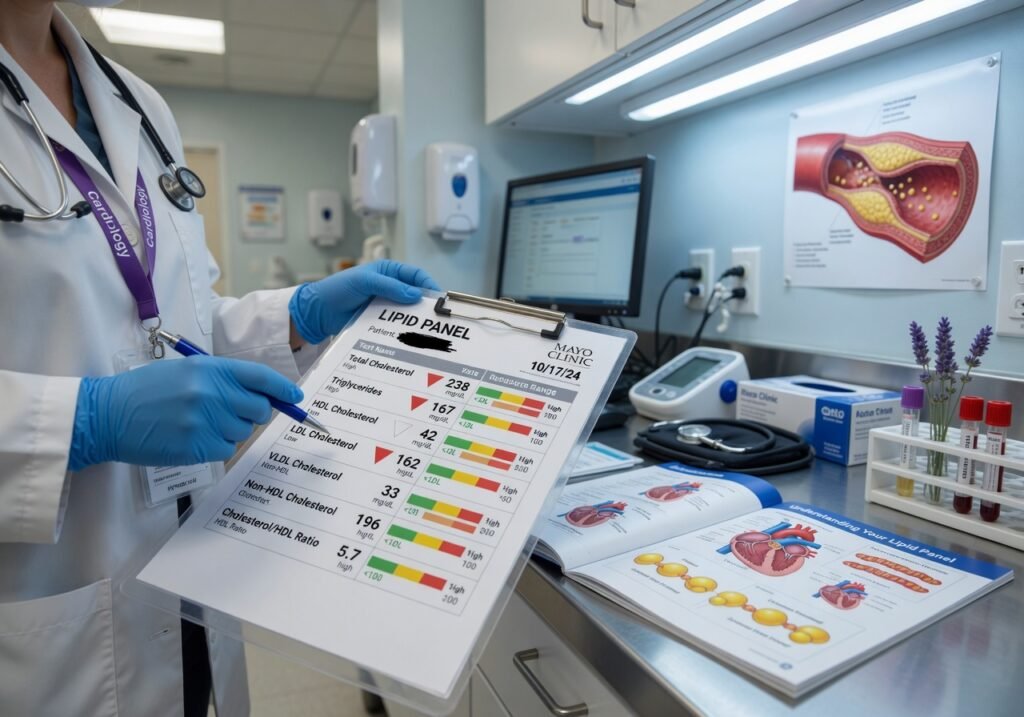
Your doctor interprets the results using these general cutoffs: total cholesterol under 200 mg/dL is desirable, 200-239 is borderline high, and 240 or higher is high. LDL cholesterol under 100 mg/dL is optimal, though targets depend on your cardiovascular risk. For someone who’s had a heart attack, LDL should be under 70 mg/dL. For low-risk people, under 100 is reasonable. HDL should be 60 mg/dL or higher for protection against heart disease. Triglycerides under 150 mg/dL are normal; 150-199 is borderline; 200 and higher is high.
The diagnosis isn’t just about numbers, though. Your doctor will calculate your 10-year cardiovascular risk using tools like the Framingham Risk Score or the pooled cohort equations from the American College of Cardiology. This considers your age, sex, race, blood pressure, diabetes status, smoking history, and lipid values together. A 35-year-old with mildly elevated LDL but no other risk factors might need only lifestyle changes. A 55-year-old smoker with the same LDL needs medication. Context matters.
Some doctors order advanced testing: lipoprotein(a), which measures a genetic risk factor for heart disease, or apolipoprotein B, which counts the actual number of atherogenic particles. These aren’t routine but help refine decisions in confusing cases—someone with apparently normal LDL but elevated apoB might need more aggressive treatment.
Treatment Options Available Now
Statins remain first-line therapy for elevated LDL cholesterol. Atorvastatin 10-80 mg daily is most commonly prescribed. Simvastatin, rosuvastatin, and pravastatin are alternatives. High-intensity statins (atorvastatin 40-80 mg or rosuvastatin 20-40 mg) lower LDL by 45-55%. Many patients tolerate these without issues, though 5-10% experience muscle pain, which usually resolves with dose reduction or switching agents.
For patients who can’t tolerate statins or need additional LDL reduction, ezetimibe blocks cholesterol absorption in the intestines, lowering LDL by approximately 20% when added to a statin. PCSK9 inhibitors—evolocumab, alirocumab, inclisiran—are monoclonal antibodies or antisense oligonucleotides that dramatically reduce LDL by 50-70%, useful for familial hypercholesterolemia or statin intolerance. These are expensive and typically reserved for high-risk patients.
For isolated triglyceride elevation, fibrates like fenofibrate lower triglycerides by 30-50% but have mild LDL-raising effects. Icosapent ethyl, a high-dose fish oil derivative, reduces triglycerides significantly in people already on statin therapy, and the REDUCE-IT trial showed it reduced cardiovascular events in select populations—those with triglycerides between 135-499 mg/dL despite statin use.
For low HDL, which is harder to treat pharmacologically, niacin was historically used but causes flushing and has fallen out of favor. Aerobic exercise remains your most effective HDL-raising intervention.
Bempedoic acid is newer, working through a different mechanism than statins, reducing both LDL and uric acid—useful for gout-prone patients. It doesn’t lower triglycerides or raise HDL, but it serves as add-on therapy.
Managing Your Lipids Daily
If you’re on statin therapy, consistency matters more than perfection. Taking atorvastatin 40 mg six days weekly is less effective than taking it seven days. Most people benefit from evening dosing since cholesterol synthesis peaks overnight.
For dietary intervention, the DASH diet—designed for hypertension but excellent for lipids—emphasizes fruits, vegetables, whole grains, lean protein, and low-fat dairy while restricting saturated fat and added sugars. Reducing saturated fat from 12% to 7% of calories lowers LDL by approximately 8-10%. Plant sterols—found in fortified foods, nuts, and seeds—lower LDL by 6-15%. Soluble fiber from oats, beans, and psyllium reduces LDL by 3-5%.
Triglycerides respond dramatically to refined carbohydrate reduction. Replacing white bread, sugary cereals, and processed snacks with whole grains, legumes, and vegetables can drop triglycerides by 20-40% within weeks.
Exercise works better than most people realize. Thirty minutes of moderate aerobic activity five days weekly raises HDL by 3-5 mg/dL and lowers triglycerides by 20-30% in many people. Resistance training adds modest benefits.
Alcohol moderation matters. One drink daily for women, two for