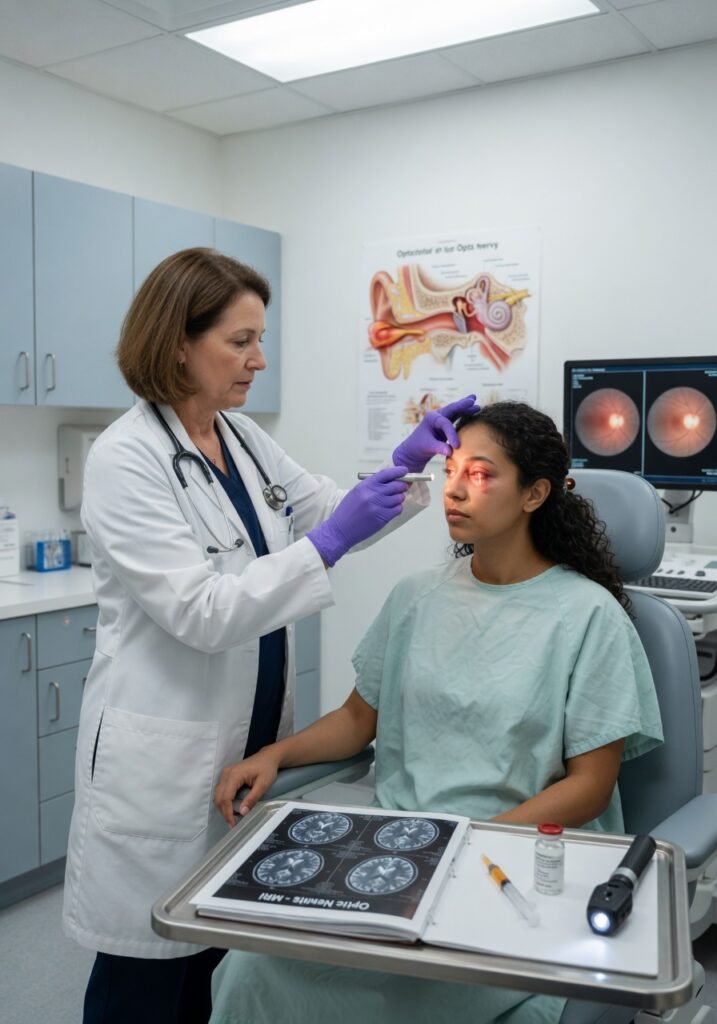
What Most People Get Wrong About Optic Neuritis
Sarah, a 34-year-old marketing manager, woke up one morning with blurred vision in her left eye and assumed she needed glasses. Three days later, when looking at her child’s face caused sharp pain behind that same eye, she finally scheduled an appointment. Her ophthalmologist didn’t look at her retina first—he asked about pain with eye movement, checked her color vision with a simple plate test, and ordered an MRI. Within hours, Sarah learned she had optic neuritis, inflammation of the nerve transmitting signals from her eye to her brain. Most people think optic neuritis is primarily a vision problem you can see developing gradually. In reality, it strikes suddenly, causes more pain than vision loss in many cases, and often signals that something neurological is happening elsewhere in the body that deserves investigation.
Key Facts About Optic Neuritis
- Optic neuritis affects approximately 5 out of 100,000 people annually in developed countries, with women comprising 65-75% of cases
- Pain with eye movement occurs in 90% of patients, yet many delay seeking care because vision loss seems minor initially
- Within one year, 50% of patients with optic neuritis will develop additional neurological symptoms suggesting multiple sclerosis (MS), according to the Optic Neuritis Treatment Trial published in JAMA
- Recovery of vision typically begins within 2-4 weeks even without treatment, but intravenous methylprednisolone accelerates this timeline by approximately 1-2 weeks
- Patients aged 18-45 account for 90% of optic neuritis cases, making it a disease of younger adults rather than elderly populations
Understanding How Optic Neuritis Damages the Nerve
Your optic nerve is essentially a fiber-optic cable made of roughly 1.2 million nerve fibers bundled together. Each fiber sends visual information from your retina directly to your brain. Now imagine inflammation surrounding and attacking the myelin sheath—the insulation coating these fibers—similar to damage to the rubber coating on electrical wiring. When myelin gets inflamed and damaged, signals travel slowly or get scrambled. The nerve swells. Suddenly, colors look washed out (especially reds appear pink or gray), moving your eye causes stabbing pain, and your central vision blurs. This isn’t about the lens or retina malfunctioning. This is about the communication highway itself being under attack.
What Actually Causes Optic Neuritis
Optic neuritis is almost always autoimmune—your own immune system mistakenly identifies the myelin coating as a threat and attacks it. But why does this happen? Multiple sclerosis is the most obvious connection. Among people with a first episode of optic neuritis, 26% already have brain lesions consistent with MS even if they haven’t experienced other neurological symptoms, according to research published in Neurology. Your risk skyrockets if you carry specific genetic markers and live in temperate climates—there’s a clear geographic gradient with higher prevalence in northern latitudes, suggesting vitamin D deficiency plays a role.
Beyond MS, several other autoimmune conditions trigger optic neuritis. Neuromyelitis optica spectrum disorder (NMOSD) causes more severe inflammation than typical optic neuritis and requires different long-term management. Myelin oligodendrocyte glycoprotein (MOG) antibody disease, discovered within the last decade, accounts for 5-10% of optic neuritis cases previously labeled “idiopathic.” Infections like Epstein-Barr virus (EBV) and COVID-19 can precede optic neuritis onset by weeks or months. Here’s the clinical insight most websites skip: systemic autoimmune diseases like systemic lupus erythematosus and sarcoidosis cause optic neuritis less commonly than MS, but when they do, the inflammation pattern looks different on MRI, requiring adjusted treatment duration.
How Optic Neuritis Actually Feels: Symptoms Beyond Blurred Vision
The hallmark symptom arrives without warning. Your vision in one eye becomes cloudy or dim—sometimes so subtle on day one that you might notice it only when closing your other eye. Within 24-72 hours, this progresses. Reds appear desaturated; a red apple looks brownish. Your central vision develops a blind spot or “scotoma.” Contrast sensitivity drops, making it harder to read small text.
Here’s what distinguishes optic neuritis from other causes of vision loss: the pain. Moving your eye left, right, up, or down triggers sharp, aching pain deep behind the eyeball. Some patients describe it as if someone is pushing a needle through the back of their eye. This pain is actually reliable—it’s present in roughly 90% of optic neuritis cases and largely absent in other acute vision problems. Photopsia (seeing flashing lights, especially in peripheral vision) happens occasionally. Temperature-dependent vision worsening—seeing worse when your body heats up from exercise or fever—occurs in roughly 20% of patients and relates to demyelinated fibers conducting heat-sensitive signals poorly.
Most patients overlook early warning signs. A week before obvious vision loss, you might notice slight difficulty with peripheral vision or persistent eye discomfort that feels like tiredness. Some experience color distortion affecting only blue wavelengths before red desaturation becomes obvious.
Diagnosing Optic Neuritis: Beyond the Eye Chart
Your eye chart (visual acuity) might appear almost normal initially—this surprises many patients. The inflammation often affects your central vision specifically, so peripheral vision remains sharp. This is why ophthalmologists run specific tests instead of relying on standard vision screening.
The Ishihara color plates or similar color vision tests reveal early disease. A patient with optic neuritis typically fails these tests dramatically (confusing reds with browns, seeing numbers as different colors). The relative afferent pupillary defect (RAPD) test shows delayed pupil response when light enters the affected eye—a finding that’s practically pathognomonic for optic neuritis. Visual field testing documents the pattern of vision loss; central scotomas are classic.
MRI with contrast is the definitive test. T2-weighted images show swelling within the nerve itself. Gadolinium enhancement demonstrates acute inflammation. Brain MRI simultaneously screens for demyelinating lesions elsewhere. Optical coherence tomography (OCT) measures thickness of your retinal nerve fiber layer—a permanently thinner layer persists after optic neuritis resolves, serving as objective evidence of past inflammation.
Cerebrospinal fluid analysis via lumbar puncture occasionally helps when diagnosis is unclear, revealing oligoclonal bands indicating CNS inflammation. Comprehensive blood testing screens for syphilis, Lyme disease, sarcoidosis, and other mimics, though most optic neuritis cases don’t require this workup if MRI and clinical presentation are typical.
Treating Optic Neuritis: What the Evidence Actually Shows
Here’s a legitimate surprise: optic neuritis typically improves on its own. Even untreated, roughly 70% of patients regain 20/20 vision within six months. This is why observation alone is legitimate management in some cases. But accelerating recovery matters to most working patients.
Intravenous methylprednisolone (1 gram daily for 3 days, followed by oral prednisone taper) speeds visual recovery by approximately 10-14 days compared to placebo. The Optic Neuritis Treatment Trial, published in JAMA in 1992 and still guiding practice today, demonstrated this benefit. Steroids don’t significantly improve final visual outcomes at one year—both treated and untreated groups reach similar endpoints—but they restore function faster. For patients with jobs requiring clear vision, this acceleration is clinically meaningful. Oral prednisone alone, without IV methylprednisolone, actually worsens outcomes compared to observation, so dosing matters.
Plasma exchange (plasmapheresis) helps when steroids don’t produce improvement within two weeks, particularly in severe cases. This mechanical removal of circulating antibodies benefits perhaps 5-10% of patients with especially aggressive inflammation.
Determining future MS risk guides long-term decisions. If your brain MRI shows no demyelinating lesions and you have no prior neurological events, your risk of developing MS within 15 years is approximately 25%. If your brain MRI reveals demyelinating lesions, that risk jumps to roughly 56%. Patients with high-risk MRI findings often begin disease-modifying therapy (interferon-beta, glatiramer acetate, fingolimod, or newer agents) even before MS diagnosis to prevent subsequent relapses.
Managing Optic Neuritis Day-to-Day: Practical Strategies
Light sensitivity typically dominates the first two weeks. Dark sunglasses—even indoors—aren’t weakness; they’re smart management. FL-41 tinted lenses (amber-tinted specifically) reduce photopsia and discomfort better than standard sunglasses because they filter blue wavelengths that demyelinated nerves conduct poorly.
Avoid sudden temperature changes when possible. Hot showers, saunas, and intense exercise can temporarily worsen vision for hours. This Uhthoff phenomenon (transient worsening with heat) disappears as inflammation resolves but feels alarming when first experienced. Plan rest days. This isn’t laziness—demyelinated fibers fatigue faster than normal ones.
Reading becomes challenging when central vision is affected. Audiobooks, voice-to-text features, and screen magnification aren’t forever—they’re bridge strategies for weeks, not months. Track your vision systematically. Test your color vision every few days using smartphone apps that display Ishihara plates. Note the date vision stops improving; this helps your neurologist identify whether you’re progressing toward MS or remaining monophasic.
Pain management during acute phases usually requires NSAIDs or acetaminophen. Occasionally, neuropathic pain requires gabapentin or pregabalin if standard analgesics fail, though this need is uncommon.
Can Optic Neuritis Be Prevented
True primary prevention (stopping the first episode from occurring) isn’t feasible because we can’t identify at-risk individuals before disease appears. However, secondary prevention—stopping recurrent episodes after diagnosis—is real.
Vitamin D sufficiency matters. Low vitamin D levels correlate with higher MS relapse rates. Maintaining serum 25-hydroxyvitamin D above 40 ng/mL is reasonable for patients with optic neuritis or MS, though this doesn’t prevent initial episodes.
Disease-modifying therapies (DMTs) reduce relapse risk by 30-50% depending on the agent. Patients diagnosed with MS following optic neuritis reduce their probability of additional relapses substantially with agents like ocrelizumab, natalizumab, or fingolimod compared to observation alone.
For patients with isolated optic neuritis and no brain lesions—those at lower MS risk—the evidence for starting DMTs is weaker. Shared decision-making with your neurologist should weigh your individual risk factors, MRI findings, and personal preferences.
Correcting a Major Misconception
Many patients assume optic neuritis always leads to blindness or permanent vision damage. This is false. Final visual outcomes are actually quite good: 85-90% of patients achieve 20/25 vision or better by one year regardless of treatment, though treated patients get there faster. Permanent vision loss significant enough to impair daily function occurs in maybe 5% of cases. The nerve inflammation resolves. The myelin partially repairs. You’re unlikely to go blind from optic neuritis alone.
Frequently Asked Questions About Optic Neuritis
Sources & Medical References
HealthTopics.com articles are based on peer-reviewed medical research and guidance from the NIH, CDC, and WHO. See our editorial policy for full sourcing standards.