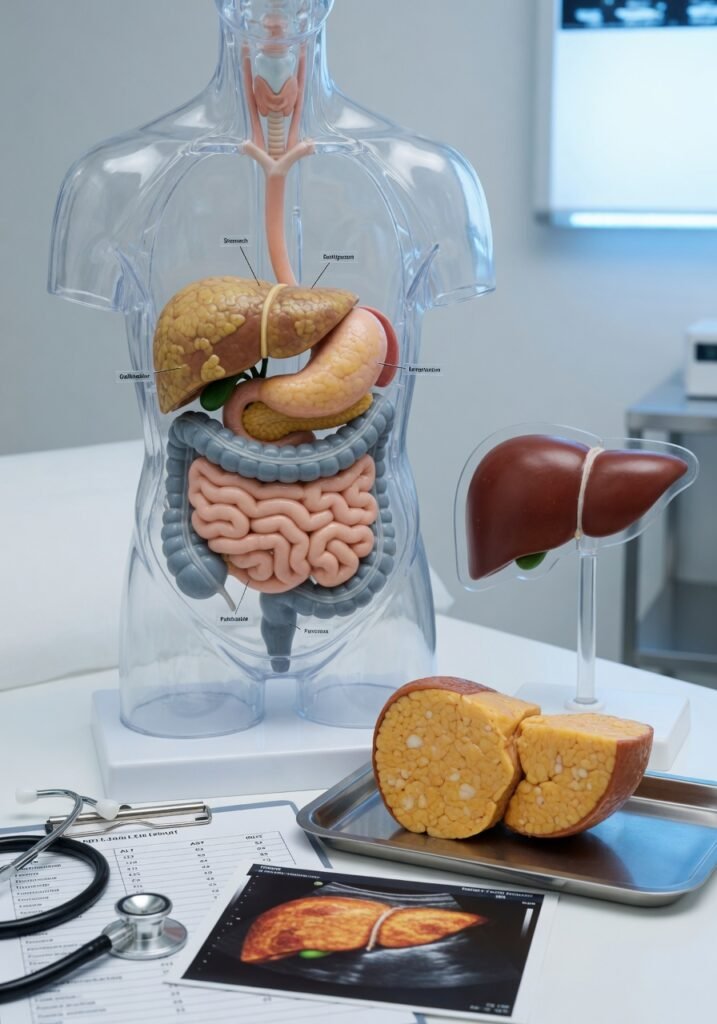

Fatty Liver Disease: What Your Doctor Knows That You Don’t
Most people assume fatty liver disease is something that happens to heavy drinkers or those who are clearly overweight. Sarah, a 42-year-old accountant with a BMI of 26 who exercised three times weekly, discovered she had advanced liver fibrosis during routine bloodwork. She’d consumed maybe two glasses of wine per week. Her liver was failing not because of alcohol or visible obesity, but because of metabolic dysfunction silently reshaping her organ from the inside.
Here’s what separates fact from fiction: fatty liver disease isn’t primarily about the amount of fat you carry visibly. It’s about cellular dysfunction—specifically, how your liver processes fat at the mitochondrial level. You can develop this condition while appearing metabolically healthy on paper. You can reverse significant portions of it without drastic weight loss. And the progression from simple fat accumulation to cirrhosis follows patterns that most articles simply don’t explain accurately.
Key Facts About Fatty Liver Disease
- NAFLD affects approximately 25-30% of the U.S. population, according to CDC epidemiological data, making it the most common chronic liver disease in America
- Up to 20% of NAFLD patients progress to NASH (nonalcoholic steatohepatitis) with active inflammation and liver cell injury
- The NHANES study published in Hepatology documented that metabolic syndrome increases NASH risk by 4.6-fold regardless of obesity status
- Liver fat content can increase by 5-10% per year in untreated cases, but can decrease by 20-30% annually with targeted intervention
- Only 3-5% of simple NAFLD cases progress to cirrhosis over 10 years if risk factors remain stable, but this rises to 15-20% in NASH cases
Understanding Fatty Liver Disease: The Mechanism Behind the Accumulation
Imagine your liver as a metabolic checkpoint where nutrients get processed and sorted. In healthy livers, excess carbohydrates and fats get packaged into lipoproteins and shipped out into your bloodstream for use or storage elsewhere. In fatty liver disease, something goes wrong at the cellular level—your hepatocytes (liver cells) start accumulating triglycerides they can’t efficiently export.
This happens through three main pathways. First, increased uptake of free fatty acids from your bloodstream because insulin resistance makes cells less responsive to satiety signals. Second, excessive de novo lipogenesis—your liver literally manufactures fat from carbohydrates, especially refined carbs and fructose, in a process driven by overactive sterol regulatory element-binding protein (SREBP). Third, impaired mitochondrial beta-oxidation means the fat-burning machinery inside liver cells works inefficiently.
When fat simply accumulates without inflammation, that’s NAFLD. When your immune system gets activated—usually triggered by lipotoxicity, endotoxins from gut bacteria, or oxidative stress—inflammatory cytokines like TNF-alpha and IL-6 start damaging liver cells. That’s when you cross into NASH territory. This distinction matters enormously because NASH carries real risk of progression to fibrosis and cirrhosis, while simple NAFLD usually doesn’t.
Causes and Risk Factors: Beyond the Obvious
Insulin resistance sits at the center of this disease for most patients. About 70% of NAFLD cases involve some degree of metabolic dysfunction syndrome. Type 2 diabetes increases your risk substantially, and pre-diabetic glucose levels matter too—you don’t need full-blown diabetes to develop advanced liver disease.
Obesity is a contributor but not the requirement everyone thinks it is. Body composition matters more than your scale reading. Visceral adiposity (fat surrounding your organs) drives liver inflammation far more aggressively than subcutaneous fat (the pinchable kind). A person with normal BMI but high visceral fat can develop NASH while someone with higher BMI but better fat distribution may only have simple steatosis.
Here’s the lesser-discussed risk factor that changes management: fructose consumption. Not just added sugars broadly, but specifically fructose—whether from high-fructose corn syrup, regular cane sugar, agave, or honey. The fructose pathway in your liver bypasses the normal regulatory step that glucose uses. High fructose consumption activates hepatic de novo lipogenesis more potently than equivalent calories from starch. Someone drinking three sodas daily has meaningfully different liver disease progression patterns than someone consuming equivalent calories from whole grains.
Other contributors include polycystic ovary syndrome (associated with insulin resistance), certain medications (valproic acid, amiodarone, methotrexate), rapid weight loss (paradoxically), and specific genetic polymorphisms in the PNPLA3 gene that increase susceptibility regardless of weight.
Signs and Symptoms: What Actually Happens Day to Day
Here’s the uncomfortable truth: most people with NAFLD have zero symptoms. Your liver doesn’t have pain receptors. You can have significant fibrosis without knowing it.
When symptoms do emerge, they’re often vague. Fatigue is common—not the sleepiness of poor sleep, but a grinding energy depletion that coffee doesn’t fix. Some patients describe difficulty concentrating or mental fog. Right upper quadrant discomfort (not pain exactly, but heaviness) occurs in about 15-20% of cases. Abdominal bloating happens frequently, often attributed incorrectly to irritable bowel syndrome.
Early warning signs that get overlooked: unexplained elevation in liver enzymes on routine bloodwork (ALT above 40 IU/L, AST above 35 IU/L), disproportionate fatigue after meals rich in fat or refined carbs, and worsening glucose control even in people without diabetes. Some patients notice spider angiomas (small red spider-like marks on skin) or palmar erythema (reddening of palms) only in advanced cases.
If jaundice develops or you experience easy bruising, that suggests cirrhosis—you need urgent evaluation. Ascites (fluid accumulation in the abdomen) is a late sign indicating liver decompensation.
Diagnosis: The Testing Process Explained
Your doctor likely starts with liver function tests (LFTs)—specifically ALT, AST, alkaline phosphatase, and bilirubin. In NAFLD, ALT typically elevates more than AST (the opposite pattern suggests alcoholic liver disease). Many people have normal LFTs with advanced fibrosis though, so negative bloodwork doesn’t exclude disease.
Platelet count matters. Progressive fibrosis reduces platelet production, so a declining platelet count correlates with advancing liver damage. The AST-to-platelet ratio index (APRI score) helps estimate fibrosis stage using just two blood values.
Ultrasound is the standard initial imaging. It detects fat accumulation easily but can’t reliably stage fibrosis. Your radiologist might note “echogenic liver” (bright appearance indicating fat) and measure liver echotexture.
Transient elastography (FibroScan) is the game-changer for fibrosis assessment. You lie flat, a probe vibrates against your side, and it measures liver stiffness in kilopascals. This non-invasive test correlates with fibrosis stage better than anything except biopsy. Values under 7.2 kPa suggest no significant fibrosis; values above 12 kPa suggest advanced fibrosis or cirrhosis.
Liver biopsy—inserting a needle to sample tissue—remains the only definitive diagnosis but carries small risk and sampling error. Most patients avoid it now with improved non-invasive testing available.
Treatment Options: What the Evidence Actually Shows Works
No FDA-approved medication specifically treats NAFLD yet, which surprises most patients. Treatment focuses on halting progression and reversing damage where possible.
Weight loss of 7-10% improves liver steatosis. Beyond 10% loss, you see improvements in inflammation and fibrosis markers. But here’s the clinical insight most articles miss: weight loss through caloric restriction alone doesn’t work as well as weight loss combined with specific dietary changes. The composition of your diet matters profoundly.
Pioglitazone, a diabetes medication in the thiazolidinedione class, reduces liver fat and improves ALT in NASH patients without diabetes. It works by improving insulin sensitivity and reducing oxidative stress. The catch: weight gain is common (3-4 kg average), and long-term safety for cirrhosis patients remains unclear.
Vitamin E supplementation (800 IU daily) improves histology in NASH without diabetes. It reduces oxidative stress but increases all-cause mortality slightly in some subgroups, so it’s not universal.
For advanced fibrosis or cirrhosis, antiviral therapy targeting hepatitis C (if present) and screening for hepatocellular carcinoma become critical. GLP-1 receptor agonists like semaglutide show promise in emerging trials for weight loss and liver inflammation reduction, though they’re not yet standard NAFLD therapy.
Dietary changes often outperform medications. Mediterranean-style eating patterns reduce NASH progression. Specifically, the combination of reduced refined carbohydrates, increased fiber, and olive oil intake produces measurable improvements in liver fat content within 12 weeks for many patients.
Practical Daily Management: Concrete Strategies
Replace liquid calories first. Every soda, juice, or sweetened beverage you eliminate has outsized impact on hepatic de novo lipogenesis. This single change often produces detectable ALT improvements within four weeks.
Target a fructose intake below 25 grams daily. That means reading labels—ketchup, salad dressing, yogurt, and “health” bars hide substantial fructose. Focus on whole foods: vegetables, legumes, fish, nuts, and whole grains.
Time your eating. Recent evidence shows that consuming carbohydrates later in the day (versus breakfast-heavy) improves metabolic markers in NAFLD patients. Space meals at least 12 hours apart overnight to allow hepatic fat mobilization during fasting.
Resistance training twice weekly produces more consistent liver enzyme improvements than aerobic exercise alone, likely through improved insulin sensitivity and mitochondrial function. Even bodyweight exercises matter—consistency exceeds intensity.
Monitor your markers. Request liver enzyme panel and platelet count every 6 months initially. If your ALT isn’t improving within 8-12 weeks of dietary changes, your approach needs adjustment. Ask your gastroenterologist about FibroScan annually to track fibrosis progression objectively.
Alcohol becomes genuinely important to eliminate entirely once NASH is diagnosed. The liver’s impaired detoxification makes alcohol metabolism particularly damaging. Even moderate drinking accelerates progression in NASH patients.
Prevention: Evidence-Based Approaches With Caveats
If you have metabolic risk factors but no liver disease yet, preventing progression is absolutely achievable. The threshold for lifestyle intervention is lower than you’d expect—even pre-diabetic glucose levels warrant dietary changes.
Mediterranean diet prevents NAFLD development in at-risk populations. The mechanism involves improved insulin sensitivity, reduced oxidative stress, and altered gut microbiota composition that decreases endotoxin translocation.
Regular physical activity—not necessarily intense exercise—reduces fatty infiltration. Moderate activity for 150 minutes weekly produces measurable benefit even without weight loss. Your liver responds to movement itself, not just weight change.
Coffee consumption shows protective effects. Three to four cups daily is associated with reduced fibrosis progression and lower NASH prevalence. The mechanism likely involves polyphenols and improved insulin sensitivity, though causation isn’t proven.
Here’s the caveat: prevention is easier than reversal. Advanced fibrosis with cirrhotic changes responds poorly to even intensive interventions. The window for reversibility appears to narrow as fibrosis progresses. Starting early matters enormously.
Sources & Medical References
HealthTopics.com articles are based on peer-reviewed medical research and guidance from the NIH, CDC, and WHO. See our editorial policy for full sourcing standards.