The Spicy Food Myth That Keeps People Suffering
Maria came to my clinic convinced she’d caused her own ulcer by eating too much salsa. She’d been popping antacids for months, avoiding her favorite foods, and feeling guilty about her eating habits. Here’s what surprised her: she had an H. pylori infection, not a lifestyle problem. The bacteria had been colonizing her stomach lining for years, probably since childhood. The spicy food didn’t cause it—and eliminating spicy food wouldn’t cure it. What Maria needed was a specific antibiotic regimen, not dietary penance. This is the disconnect I see constantly: peptic ulcers are primarily caused by bacterial infection or medication, not by foods you love or stress you can’t control.
Five Facts About Peptic Ulcer Disease
- H. pylori causes 90% of duodenal ulcers and 60-70% of gastric ulcers according to the CDC, with NSAIDs accounting for most of the remainder
- Approximately 4.5 million Americans have active peptic ulcer disease at any given time, though roughly 10% of the U.S. population has been infected with H. pylori
- Untreated H. pylori infection increases stomach cancer risk by 2.7-fold according to JAMA Oncology data
- Triple therapy (omeprazole, amoxicillin, clarithromycin) achieves cure rates of 85-90% when taken correctly for 10-14 days
- Silent ulcers—those causing minimal pain—account for up to 20% of cases and are often discovered only after perforation or severe bleeding occurs
How Your Stomach’s Protective Lining Actually Breaks Down
Think of your stomach lining like a fortress wall made of specialized cells called mucosal tissue. This wall secretes protective mucus and bicarbonate that neutralize stomach acid, keeping the acid confined to the interior chamber where it’s supposed to digest food. Healthy stomach tissue never touches raw acid—that’s the whole design.
When H. pylori bacteria burrow into this lining, they trigger chronic inflammation that weakens the fortress. The bacteria produce urease, an enzyme that creates an alkaline bubble around itself, allowing it to survive in an acidic environment. As your immune system fights back, inflammatory cells flood the area, eroding the protective mucus layer. Meanwhile, the infection disrupts the cells that produce bicarbonate. Within weeks or months, you’ve got a localized crater—an actual hole in the mucosa where stomach acid is directly contacting blood vessels and underlying tissue. That’s an ulcer.
NSAIDs like ibuprofen work differently. They block prostaglandins, chemicals that normally maintain the mucus layer and increase blood flow to stomach tissue. Take NSAIDs regularly, and you strip away this protection without needing an infection. The acid does the damage directly.
What Actually Causes Peptic Ulcers (And What Doesn’t)
The bacterial culprit is Helicobacter pylori, a spiral-shaped organism that’s been traveling with humans for millennia. You typically contract it through contaminated water or food, or from close contact with infected family members—not from anything you did wrong. Once it establishes itself, it stays unless you kill it with antibiotics. That’s worth emphasizing: this is an infection you can cure.
NSAIDs are the second major cause. This includes ibuprofen, naproxen, indomethacin, and celecoxib. The risk jumps if you’re over 65, take the medication daily, have a history of ulcers, or combine NSAIDs with corticosteroids or anticoagulants like warfarin. Aspirin at doses above 325mg daily carries similar risk, though low-dose aspirin (81mg for heart protection) is relatively safer.
Stress, contrary to old teaching, doesn’t directly cause ulcers. However, stress can worsen existing H. pylori infections by suppressing immune function, and it can trigger symptom flares in people who’ve had ulcers. Alcohol and caffeine don’t cause ulcers either, though they can irritate an existing ulcer and delay healing.
Here’s the clinical insight most sources skip: Zollinger-Ellison syndrome (gastrinoma) causes 1% of peptic ulcers but gets missed constantly. This rare tumor secretes excessive gastrin hormone, driving acid production to extreme levels. If someone has multiple ulcers, ulcers in unusual locations like the small bowel, or keeps getting ulcers despite proper H. pylori treatment and NSAID cessation, gastrinoma screening becomes essential. A fasting serum gastrin level above 1000 pg/mL is virtually diagnostic.
What Peptic Ulcers Actually Feel Like Day-to-Day
The classic symptom is burning epigastric pain—that region between your navel and lower ribs. Patients usually describe it as a gnawing or sharp sensation that comes and goes. For duodenal ulcers (in the small intestine), pain often emerges 2-3 hours after eating or wakes you at night. Gastric ulcers (in the stomach itself) tend to hurt right after eating or with large meals.
Beyond pain, you might experience bloating, early satiety (feeling full after minimal food), or nausea. Some people report occasional vomiting or notice black, tarry stools—which means bleeding into the GI tract. Others have no pain whatsoever until something goes badly wrong.
The overlooked early warning sign is persistent epigastric tenderness without obvious ulcer pain. You notice it when you press on your upper abdomen or when the weight of your seatbelt bothers you. This localized tenderness, even without classic burning pain, suggests mucosal inflammation and warrants investigation. Waiting for dramatic pain symptoms means you might miss the infection until it causes serious bleeding or perforation.
How We Actually Diagnose Peptic Ulcer
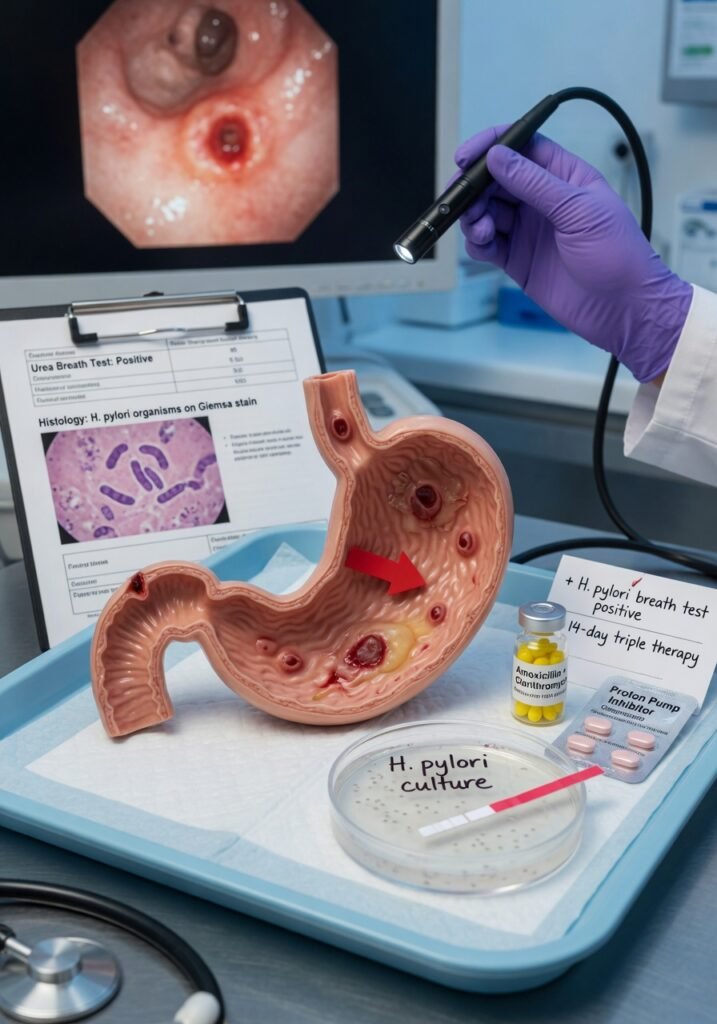
The gold standard is upper endoscopy—we thread a thin camera down your throat while you’re sedated. This lets us visualize the ulcer directly, measure it, and take biopsies to confirm it’s not cancer and to test for H. pylori using histology or rapid urease testing. If we find H. pylori, we’ve diagnosed both the ulcer and its cause in one procedure.
If endoscopy isn’t available or you decline it, we can test for H. pylori first using a urea breath test or stool antigen test. The stool antigen test is especially practical—you provide a sample, and we detect bacterial antigens. However, if the ulcer has already bled significantly or perforated, endoscopy becomes urgent rather than elective.
For NSAID-related ulcers, the diagnosis is often clinical: you’ve been taking ibuprofen or naproxen, and now you have epigastric pain. Endoscopy confirms it but isn’t always strictly necessary if H. pylori testing is negative and we can stop the NSAID.
Treatment That Actually Works
For H. pylori, we use triple therapy or quadruple therapy. The standard triple regimen combines a proton pump inhibitor (usually omeprazole 20mg twice daily), amoxicillin 1000mg twice daily, and clarithromycin 500mg twice daily for 10-14 days. This cures H. pylori in about 85-90% of cases. In clarithromycin-resistant areas or after prior treatment failure, we switch to quadruple therapy: omeprazole, amoxicillin, metronidazole, and bismuth subsalicylate.
Proton pump inhibitors reduce stomach acid production and allow ulcers to heal. Omeprazole, lansoprazole, pantoprazole, and esomeprazole all work similarly. For NSAID ulcers, we stop the NSAID (or switch to acetaminophen), then use a PPI for 4-8 weeks. If you must continue NSAIDs, adding a PPI or misoprostol for gastroprotection becomes necessary.
H2-receptor antagonists like famotidine are older, less potent than PPIs, and rarely used as monotherapy anymore. They’re helpful as adjuncts for breakthrough symptoms but shouldn’t be your primary ulcer treatment.
After treatment, H. pylori needs confirming eradication. We typically repeat testing with a urea breath test or stool antigen at least 4 weeks after completing antibiotics. Retesting too early gives false negatives. If eradication fails, we consider resistance patterns and switch antibiotics accordingly—perhaps moving to fluoroquinolone-based regimens like levofloxacin.
Living With and Managing Peptic Ulcer Day-to-Day
First and foremost, stop NSAIDs immediately unless absolutely medically necessary. If you have heart disease requiring aspirin, discuss this with your cardiologist—the cardiovascular benefit often outweighs ulcer risk once you’re on PPI protection. But recreational NSAID use for headaches? Switch to acetaminophen or ibuprofen-free alternatives.
Take your PPI consistently, usually 30 minutes before breakfast. Timing matters because the drug works best on an empty stomach. If your doctor prescribed bismuth or clarithromycin, follow the exact schedule—skipping doses allows resistant bacteria to emerge.
Regarding diet: no foods are universally forbidden. That said, if chocolate, coffee, or mint visibly worsen your symptoms, avoid them temporarily. Alcohol and very hot foods can irritate healing ulcers, so moderate or eliminate them during treatment. Small, frequent meals often feel better than three large ones.
Manage stress through exercise, sleep, and whatever relaxation works for you—meditation, reading, time outdoors. While stress doesn’t cause ulcers, it can suppress immune function and slow healing.
Prevention: What Actually Works
The best prevention is avoiding H. pylori in the first place. This means drinking clean water, practicing hand hygiene (especially important if you have infected family members), and not sharing toothbrushes or eating utensils with untested individuals. In areas with high H. pylori prevalence, some countries have implemented screening-and-treat programs for all adults; research shows this reduces gastric cancer incidence.
For H. pylori–negative individuals, preventing NSAID ulcers means using the lowest effective NSAID dose for the shortest duration possible. If you’re over 60, have cardiovascular disease, take anticoagulants, or have prior ulcer history, simply avoid NSAIDs altogether. Stick with acetaminophen. If NSAID use is unavoidable, concurrent PPI therapy (omeprazole 20mg daily or lansoprazole 15mg daily) reduces ulcer risk by 70-80%.
One nuance: COX-2 selective inhibitors like celecoxib were marketed as safer for the stomach, and they do carry lower GI bleeding risk than nonselective NSAIDs. However, they carry higher cardiovascular risk in some populations, so they’re not universally protective.
Frequently Asked Questions
Can peptic ulcers heal on their own without antibiotics?
Not reliably. If you have H. pylori, the bacteria won’t disappear without antibiotics—the infection persists and can lead to gastric cancer. If your ulcer is NSAID-related and you stop the medication and take PPIs, it can heal in 4-8 weeks. But once you have an active ulcer with H. pylori, eradication therapy is necessary.
How do I know if my ulcer has perforated?
Sources & Medical References
HealthTopics.com articles are based on peer-reviewed medical research and guidance from the NIH, CDC, and WHO. See our editorial policy for full sourcing standards.