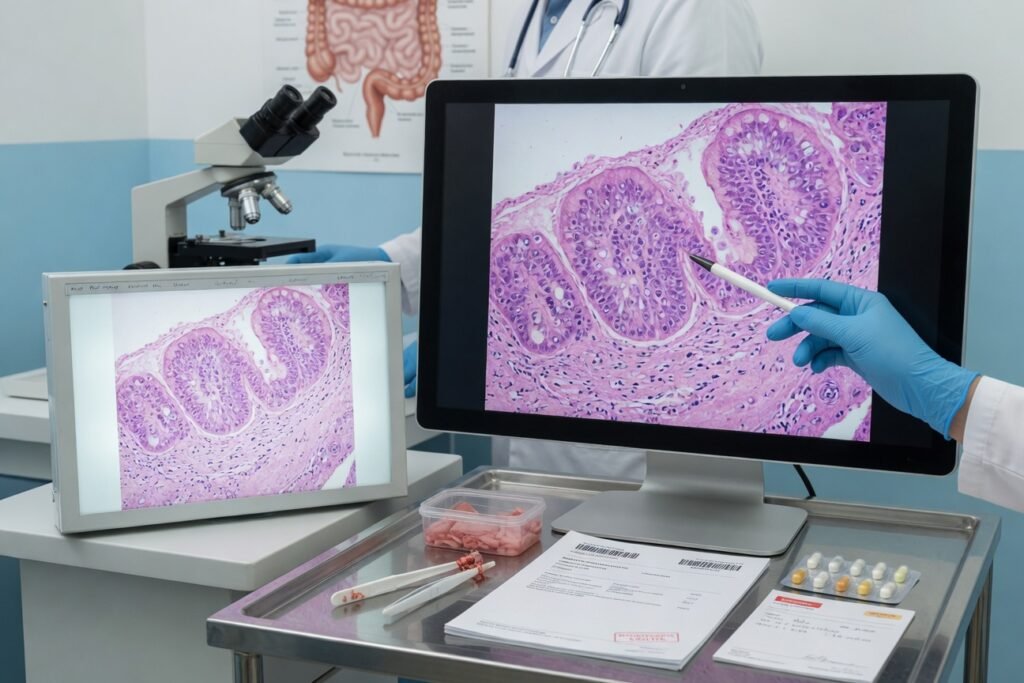
Sarah had been running to the bathroom six or seven times a day for months, frustrated that her primary care doctor kept attributing it to irritable bowel syndrome. The watery diarrhea persisted despite dietary changes, and her colonoscopy looked completely normal to the naked eye—yet the biopsies told a different story. She had microscopic colitis, a condition that literally requires a microscope to diagnose, which explained why her initial evaluations came back inconclusive.
Microscopic colitis is inflammation of your colon that you can’t see during a standard colonoscopy, but becomes obvious when tissue samples are examined under magnification. Unlike ulcerative colitis or Crohn’s disease, where the inflammation is visible as ulcers or eroded areas, microscopic colitis hides itself. The National Institutes of Health reports that microscopic colitis accounts for up to 15% of all chronic diarrhea cases in developed countries, yet many patients spend years getting misdiagnosed.
Key Facts About Microscopic Colitis
- Incidence has increased from 5-7 cases per 100,000 people in 2000 to approximately 20-30 cases per 100,000 annually, according to recent epidemiological studies
- Two distinct subtypes exist: collagenous colitis (thicker collagen bands beneath the surface) and lymphocytic colitis (increased immune cells without collagen changes)
- Women are affected more frequently than men, with peak diagnosis occurring between ages 50 and 70
- Certain medications, particularly NSAIDs and selective serotonin reuptake inhibitors (SSRIs), are implicated in 10-15% of cases
- Approximately 20-30% of patients achieve complete remission on dietary modifications alone, though most require pharmaceutical intervention
What Actually Happens Inside Your Colon
Think of your colon’s inner lining like a protective barrier made of closely packed cells. In microscopic colitis, immune cells called lymphocytes and plasma cells infiltrate this barrier, causing inflammation that disrupts fluid absorption. Your colon normally reabsorbs water from stool as it moves through—when that process gets compromised, you’re left with watery diarrhea that can be chronically debilitating.
The two subtypes differ in their microscopic appearance. Collagenous colitis involves abnormal thickening of the collagen layer beneath the intestinal lining, almost like scar tissue building up in areas it shouldn’t. Lymphocytic colitis shows increased white blood cells throughout the tissue without that collagen component. Both trigger the same symptoms, but some evidence suggests they may respond differently to certain treatments.
What makes this condition particularly frustrating is that standard colonoscopy magnification isn’t sufficient to spot the problem. You need actual histological examination—tissue under 40x magnification or higher—to see the inflammatory infiltrate that defines the disease.
Causes and Risk Factors Worth Knowing
Microscopic colitis isn’t triggered by infection like some diarrheal illnesses. Instead, your immune system essentially overreacts to something in your colon, though the exact trigger often remains unclear. Genetic predisposition plays a role—if close relatives have inflammatory bowel disease, your risk increases.
Several medication classes are well-documented culprits. Nonsteroidal anti-inflammatory drugs (NSAIDs) like ibuprofen and naproxen appear in roughly 10-15% of cases. SSRIs such as sertralose and paroxetine have been associated with microscopic colitis onset. Beta-blockers used for hypertension, particularly atenolol, have occasionally preceded diagnosis. Proton pump inhibitors used long-term for acid reflux may also increase risk, though this connection remains somewhat controversial.
Here’s what most articles overlook: bile acid malabsorption in the terminal ileum can perpetuate microscopic colitis symptoms even after initial inflammation resolves. Your small intestine normally absorbs bile acids for reuse; when this process fails, excess bile reaches your colon and triggers secretory diarrhea. This explains why some patients with microscopic colitis improve dramatically on cholestyramine, a bile acid sequestrant, even though their inflammation technically resolved.
Smoking paradoxically appears protective, which is why former smokers occasionally develop the disease after quitting. Stress and psychological factors may trigger flares, though this isn’t the primary cause.
Recognizing Symptoms Before Diagnosis
Chronic watery diarrhea is the hallmark, but the pattern matters clinically. You might experience 5-10 bowel movements daily, often with urgency that forces you to locate bathrooms constantly. Unlike infectious diarrhea, this typically persists for weeks to months, gradually wearing down quality of life.
Abdominal pain ranges from absent to moderate cramping—severe pain should prompt investigation for other conditions. Some patients report abdominal bloating and gas, though less prominently than in irritable bowel syndrome. Weight loss occurs in approximately 25% of patients, usually gradual rather than dramatic.
An overlooked early sign is nocturnal diarrhea. If you’re waking at night with bowel urgency, that’s worth mentioning to your physician specifically. Daytime-only diarrhea might suggest food intolerance or IBS, but nighttime symptoms suggest organic inflammation.
Fatigue often accompanies the condition, partly from fluid loss and partly from chronic inflammation itself. You might notice your symptoms wax and wane unpredictably—a good week followed by a difficult flare without obvious triggers.
How Diagnosis Actually Works
Your physician will start with a thorough history and basic laboratory work: complete blood count, comprehensive metabolic panel, and inflammatory markers like C-reactive protein. Many patients with microscopic colitis have normal inflammatory markers, which is why they weren’t identified initially.
Colonoscopy is mandatory. The procedure lets your gastroenterologist visualize your entire colon and retrieve multiple biopsies from different regions. This is critical—you need samples from the right colon (cecum and ascending colon) and left colon, because inflammation can be patchy. A colonoscopy that looks visually normal but includes adequate biopsies is far more valuable than one that looks inflamed without biopsies.
The pathologist examines tissue under a microscope, looking for increased intraepithelial lymphocytes (more than 20 per 100 epithelial cells in lymphocytic colitis) or the thickened subepithelial collagen layer exceeding 10 micrometers in collagenous colitis. Sometimes diagnosis requires immunohistochemical staining to properly count immune cell subtypes.
Expect your gastroenterologist to also screen for celiac disease with serological testing, as the conditions can coexist. They’ll likely check vitamin B12 and folate levels given the chronic diarrhea.
Treatment: What Actually Works
Mild cases often respond to dietary modification alone. A low-fat diet and reduced lactose intake help many patients. Soluble fiber from psyllium husk or methylcellulose can paradoxically help by absorbing excess water, though insoluble fiber sometimes worsens symptoms.
For moderate to severe disease, budesonide is the first-line pharmaceutical choice. This inhaled corticosteroid is absorbed systemically and concentrates in the colon, reducing inflammation with fewer systemic side effects than oral prednisone. The typical dose is 9 mg daily for 8 weeks, then tapered. Budesonide induces remission in 70-80% of patients, though relapse occurs in 30-40% when discontinued.
Mesalamine compounds (5-aminosalicylic acid derivatives) like mesalamine 1.2 grams three times daily provide benefit for some patients, particularly those with milder disease. These work better for ulcerative colitis than microscopic colitis, but aren’t without utility here.
For budesonide-refractory or frequently relapsing disease, immunosuppressant medications become relevant. Azathioprine at doses of 1-2 mg per kilogram body weight, or its metabolite 6-mercaptopurine, can maintain remission in patients who repeatedly flare when steroids taper. These require baseline thiopurine methyltransferase (TPMT) testing to avoid toxicity.
Antidiarrheals like loperamide provide symptomatic relief, though caution is warranted in actively inflamed disease. Cholestyramine or colesevelam may help if bile acid malabsorption contributes to diarrhea.
Biologic therapies targeting TNF-alpha or other cytokines show promise in small studies but aren’t yet standard care. Your gastroenterologist may consider these in refractory cases.
Living Day-to-Day With Microscopic Colitis
Track your triggers in a symptom diary. While many patients can’t identify obvious precipitants, some notice flares after stress, specific foods, or medication changes. Dairy, high-fat foods, and caffeine are common culprits worth testing individually.
Plan your schedule around bathroom access. This sounds simple, but it matters—knowing you have quick access to facilities reduces anxiety, which can itself trigger symptoms. Avoid back-to-back meetings or situations where leaving isn’t feasible.
Maintain hydration deliberately. Your colon isn’t reabsorbing water effectively, so you need higher fluid intake than average. Electrolyte replacement with coconut water or sports drinks during flares prevents dehydration.
Work with a dietitian experienced in inflammatory bowel disease. Generic dietary advice doesn’t account for the specific pathophysiology of microscopic colitis. An elimination diet, removing potential triggers for 2-4 weeks then reintroducing systematically, helps identify your personal triggers.
Monitor medication interactions carefully. If you’re on SSRIs or NSAIDs and develop chronic diarrhea, ask your prescriber whether alternatives exist. Sometimes switching from ibuprofen to acetaminophen for pain management makes a difference.
Prevention and Prognosis
You can’t prevent microscopic colitis if genetic susceptibility exists, but you can minimize triggers. Avoid unnecessary NSAIDs. If you need chronic pain management, work with your physician on safer alternatives.
The condition rarely progresses to fulminant colitis or perforation, which is genuinely reassuring. Unlike ulcerative colitis or Crohn’s, microscopic colitis carries minimal risk of colorectal cancer. Remission rates are favorable—most patients achieve periods of symptom freedom on appropriate therapy.
Long-term prognosis involves managing flares rather than cure. About 20-30% of patients maintain remission long-term after initial treatment. Others experience intermittent flares requiring periodic medication adjustments. Complete resolution of symptoms should be the goal, not merely “management.”
Frequently Asked Questions
Sources & Medical References
HealthTopics.com articles are based on peer-reviewed medical research and guidance from the NIH, CDC, and WHO. See our editorial policy for full sourcing standards.