
“`html
GERD: What You Actually Need to Know About Long-Term Acid Reflux Management
Sarah, a 42-year-old marketing executive, thought her nightly heartburn was just something to manage with antacids before bed. She’d heard GERD was mostly about avoiding spicy foods and staying upright after meals. Six months later, an upper endoscopy revealed Barrett’s esophagus—a precancerous change—because her acid exposure had been far more severe than her occasional symptoms suggested. This is the gap between what patients assume about GERD and what physicians know: many people with significant disease feel almost nothing, while others with mild symptoms convince themselves they have a crisis. The difference lies in understanding not just when you feel heartburn, but what’s actually happening to your esophagus when you don’t.
Key Facts About GERD
- Approximately 20% of Americans experience GERD symptoms at least weekly, according to the American Gastroenterological Association, yet only about half seek medical evaluation
- The lower esophageal sphincter (LES) pressure drops by an average of 40% in GERD patients compared to healthy controls—a measurable physiologic change
- Proton pump inhibitors (PPIs) like omeprazole reduce gastric acid production by 90% or more, making them far more potent than H2 blockers like famotidine
- Barrett’s esophagus develops in approximately 10-15% of GERD patients with chronic symptoms, and progresses to esophageal adenocarcinoma at a rate of roughly 0.5% per year
- Silent reflux—acid exposure without the sensation of heartburn—accounts for up to 60% of reflux events in some patients, making pH monitoring essential for diagnosis confirmation
Understanding the Mechanics of GERD
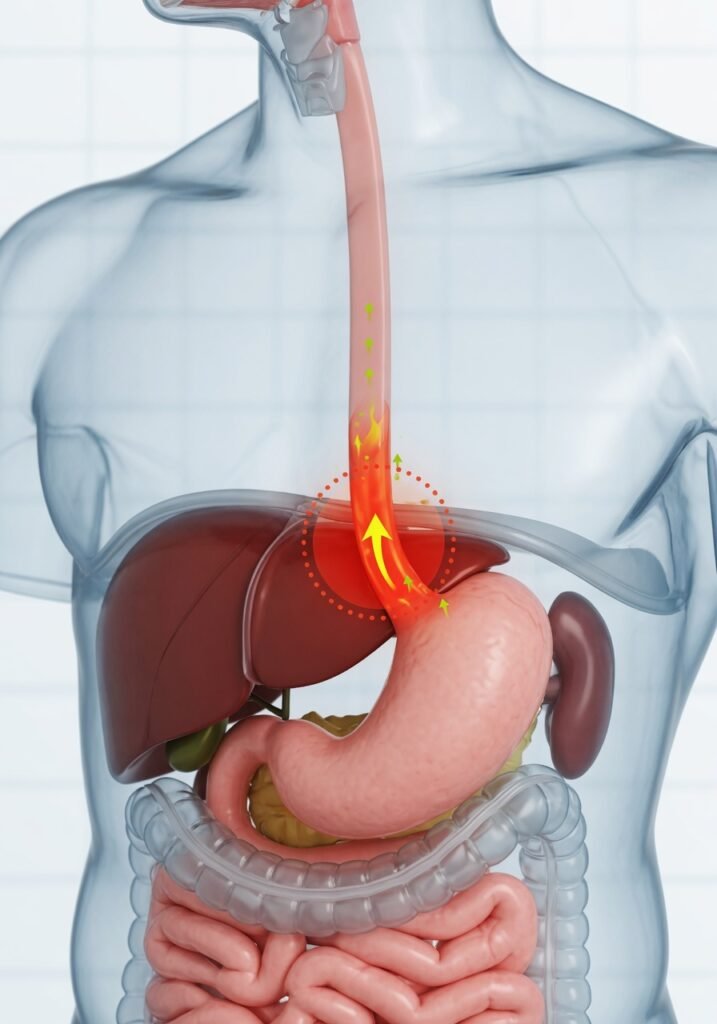
Think of your esophagus as a one-way slide. There’s a muscular door at the bottom—the lower esophageal sphincter—that’s supposed to open only when food travels down, then snap shut immediately. In GERD, this door either opens when it shouldn’t, stays partially open too long, or closes weakly. Stomach acid (hydrochloric acid at a pH around 2) then sloshes backward into the esophagus, which is lined with delicate tissue designed for food passage, not acid exposure.
What complicates this picture is that reflux isn’t binary. You’re not either refluxing or not. Instead, healthy people have occasional brief reflux events—maybe a dozen per day—that cause no damage because they’re brief and the LES recovers quickly. In GERD, you might have 40, 50, or 80 reflux events daily, some lasting several minutes. The tissue starts to erode. The body responds with inflammation. Over years, chronic inflammation can trigger cellular changes that lead to Barrett’s esophagus or, in the worst cases, cancer.
Here’s what most articles skip: your swallowing mechanics and saliva matter enormously. Saliva contains bicarbonate, which neutralizes acid. People who swallow frequently clear acid faster. Lying flat or bending forward after eating prevents gravity from helping drain acid back to the stomach. This is why a 60-year-old who lies on the couch after dinner can have far more dangerous reflux than a 35-year-old who eats the same meal but stays upright and swallows frequently.
Causes and Risk Factors: Which Ones Actually Drive Disease
The usual culprits—spicy food, citrus, chocolate—matter less than most people think. A NIH study found that individual food triggers vary dramatically by person, and blanket dietary restrictions help only about 30% of GERD patients noticeably. What’s far more predictive is your anatomy and how your stomach empties.
Obesity increases GERD risk substantially, particularly visceral fat (the kind around your organs). The extra abdominal pressure literally squeezes the stomach and forces acid upward. Smoking directly weakens the LES, reducing its pressure within minutes of inhaling. Alcohol does the same thing—it’s not about the type of alcohol but the fact that alcohol relaxes that crucial sphincter.
Pregnancy causes GERD in up to 80% of women during the third trimester, partly because the hormone progesterone relaxes smooth muscle (including the LES) and partly because the enlarging uterus increases abdominal pressure. Most of this resolves after delivery, though some women develop persistent GERD.
Here’s the overlooked factor: medications. Anticholinergics (used for allergies, incontinence, depression), calcium channel blockers (blood pressure drugs like diltiazem), nitrates (for angina), and even some osteoporosis medications like alendronate directly relax the LES or delay gastric emptying. If your GERD worsened after starting a new medication, this might be why. Aspirin and NSAIDs like ibuprofen also increase acid secretion and irritate the esophageal lining directly.
Recognizing Symptoms and Early Warning Signs
Heartburn—a burning sensation behind the breastbone, usually worse after meals or when lying down—is the classic symptom. But patients often experience patterns they don’t connect to reflux. Chronic hoarseness, especially worse in the morning. Throat clearing that won’t stop. Sensation of a lump in the throat. A persistent dry cough that your primary care doctor attributes to “probably post-nasal drip” when actually it’s acid vapor irritating your larynx. Dental erosion, particularly on the back surfaces of your upper teeth, happens because stomach acid reaches your mouth during sleep reflux.
One subtle early warning many people miss: difficulty swallowing (dysphagia) or the sensation that food is getting stuck. This suggests the reflux has caused enough inflammation or scarring to narrow your esophagus—a sign you need evaluation soon, not eventually.
Nocturnal symptoms deserve special attention. If you wake up with acid in your mouth or find yourself coughing at 3 a.m., your reflux is more aggressive than someone who only feels symptoms after large dinners. Supine reflux is harder on your esophagus because gravity isn’t helping, and you’re not swallowing to clear the acid.
Here’s a distinction many patients miss: not all chest discomfort from reflux feels like classic heartburn. Some people describe it as a heavy pressure, which understandably makes them worry about their heart first. If you’re uncertain whether your chest discomfort is reflux or cardiac, seek evaluation—your physician can help differentiate based on the pattern, your risk factors, and potentially an EKG.
How GERD Gets Diagnosed
Your primary care doctor usually starts with your history. When does it happen? What makes it better or worse? How often? But symptoms alone aren’t reliable. Remember Sarah—her minimal symptoms masked significant disease.
An upper endoscopy (esophagogastroduodenoscopy or EGD) lets your gastroenterologist directly visualize your esophagus, stomach, and upper small intestine using a thin flexible camera. They can spot erosion, Barrett’s esophagus, or other complications. The procedure takes 10-15 minutes, and you’re sedated, so you won’t remember it. If findings are normal but you have symptoms, that rules out structural damage but doesn’t mean your reflux isn’t damaging you silently.
Ambulatory pH monitoring is the most accurate test. You swallow a small catheter with a sensor (or wear a clip attached to the esophageal wall) that measures pH for 24-48 hours. A pH below 4 indicates acid exposure. Your doctor calculates what percentage of time your esophagus was exposed to acid and correlates it with your symptoms via a diary you keep. Many patients are shocked to learn they have way more acid exposure than their symptoms suggest.
Esophageal manometry measures the pressure and contractions of your esophagus and LES. It’s useful when surgery is being considered or when your reflux pattern is unusual.
Treatment Options That Actually Work
Proton pump inhibitors (omeprazole, lansoprazole, pantoprazole, esomeprazole) are first-line therapy for moderate to severe GERD or when complications are present. They work by blocking the proton pump—the mechanism that produces stomach acid—and achieve their full effect after 3-5 days of consistent use. They’re remarkably effective; most patients on an appropriate PPI dose have 90%+ reduction in acid secretion.
H2 receptor blockers (famotidine, ranitidine) are weaker—they reduce acid by about 70%—and work faster (within an hour) but have a shorter duration. They’re reasonable for occasional heartburn but inadequate for frequent symptoms or complications.
Antacids (calcium carbonate, magnesium hydroxide) neutralize acid already present but don’t prevent new acid production. They work within minutes and last 30 minutes to a few hours. They’re fine for occasional use but not for chronic GERD management.
For patients who don’t tolerate PPIs or want alternatives, H2 blockers at higher doses or the potassium-competitive acid blocker vonoprazan (newer, not yet widely available in the US) are options. Some patients benefit from adding a prokinetic agent like metoclopramide if their stomach empties slowly, though metoclopramide carries a black box warning for long-term use due to tardive dyskinesia risk.
Surgical intervention—fundoplication, where the surgeon wraps part of the stomach around the LES to strengthen it—works well for carefully selected patients, particularly those with severe symptoms despite medication, those intolerant to PPIs, or those with large hiatal hernias. Success rates are around 80-90% for symptom relief in the short term, though some patients develop dysphagia (difficulty swallowing) or bloating afterward. The newer LINX procedure, a magnetic ring implanted around the LES, is less invasive but less data exist on long-term outcomes.
Daily Management: Concrete Strategies That Work
If you’re on a PPI, take it 30-60 minutes before your largest meal of the day. The drug needs time to activate the proton pumps, and those pumps work hardest during digestion. Taking it with breakfast but then eating a large dinner is less effective than timing it to your eating pattern.
Elevation matters more than you’d think. If you have nighttime reflux, raise the head of your bed 6-8 inches using blocks under the bedframe—not just extra pillows, which can bend your torso and increase abdominal pressure. A wedge pillow specifically designed for reflux is another option.
Eat smaller meals more frequently rather than three large meals. Large meals stretch your stomach and increase LES relaxation. Finish eating 3-4 hours before lying down, giving your stomach time to empty.
Identify your personal triggers through a symptom diary. One patient’s trigger is coffee; another’s is chocolate. Generic lists don’t work. After you’ve taken medication for a week and baseline symptoms are controlled, try eliminating one suspected trigger food for a week and see if symptoms worsen when you reintroduce it.
Lose weight if you’re overweight, but gradually. Rapid weight loss can transiently worsen reflux. A 5-10% reduction in body weight often improves GERD significantly.
Don’t wear tight clothing around your abdomen. Tight belts, tight jeans, or compression garments increase intra-abdominal pressure.
Chew sugar-free gum after meals. It stimulates saliva production and swallowing, accelerating acid clearance.
Prevention: What Actually Stops GERD From Developing
Most GERD develops over years, not suddenly. The best prevention is avoiding or correcting modifiable risk factors before reflux becomes chronic. Stop smoking—this is one of the most impactful changes. Avoid alcohol, particularly in the evening. Maintain a healthy weight. These aren’t guaranteed to prevent G