Why does my gut sometimes feel like it’s fighting itself? Understanding inflammatory bowel disease
Sarah, a 34-year-old project manager, woke up at 3 AM with urgent abdominal pain and bloody diarrhea for the third time that week. She’d already missed two client meetings due to bathroom emergencies. Her gastroenterologist eventually diagnosed ulcerative colitis, but what struck Sarah most was realizing her immune system had been attacking her own intestinal lining for months without her knowing the difference between this and Crohn’s disease—two conditions that look similar but demand completely different treatment strategies.
The fundamental question patients wrestle with is straightforward: why does inflammatory bowel disease happen, and what separates Crohn’s from ulcerative colitis? The answer matters because these are not minor variations of the same illness. They require different medications, carry different surgical implications, and progress differently over a lifetime.
Key Facts About Inflammatory Bowel Disease
- The CDC reports that approximately 3.1 million U.S. adults have been diagnosed with inflammatory bowel disease, with incidence rising 19% between 1999 and 2019
- Crohn’s disease can affect any part of the digestive tract from mouth to anus, while ulcerative colitis is confined exclusively to the colon and rectum
- Patients with Crohn’s have a 15-30% lifetime risk of requiring surgery, compared to 20-30% for ulcerative colitis, but the types of surgery differ fundamentally
- Disease onset typically occurs between ages 15-35, though a second peak appears between 50-70 years old
- Approximately 25% of patients have a first-degree relative with inflammatory bowel disease, indicating significant genetic predisposition
The Actual Inflammatory Process: What’s Happening Inside
Think of your intestinal lining as a gatekeeping system. It’s supposed to let nutrients through while keeping harmful bacteria and large molecules out. In inflammatory bowel disease, your immune system develops a faulty identification system—it mistakes your own intestinal cells for invaders and launches a sustained attack.
In Crohn’s disease, this inflammatory assault penetrates through all layers of the bowel wall, creating deep ulcers and potentially causing fistulas (abnormal tunnels between intestines or between intestines and skin). In ulcerative colitis, the inflammation stays confined to the inner lining and submucosa, creating continuous inflammation along the colon’s length without those penetrating ulcers.
The inflammation itself produces cytokines—chemical messengers that recruit more immune cells to the area. This creates a self-perpetuating cycle: more inflammation, more damage, more inflammation. This is why anti-inflammatory medications and immune-suppressing biologics work—they interrupt this cascade.
What Actually Causes This: Known and Overlooked Risk Factors
Genetics loads the gun, but environment pulls the trigger. The JAMA Psychiatry journal has documented that patients with inflammatory bowel disease have higher rates of depression and anxiety preceding diagnosis, which complicates the picture—are stress and mental health triggers, or consequences of undiagnosed disease?
The established risk factors include family history, smoking (which dramatically worsens Crohn’s but paradoxically slightly protects against ulcerative colitis—a phenomenon we still don’t fully understand), and certain infections early in life. Appendectomy before age 20 actually appears protective against ulcerative colitis.
Here’s what most articles gloss over: the Western dietary pattern featuring high omega-6 polyunsaturated fats and low fiber appears to shift gut microbiota composition in ways that increase inflammatory bowel disease risk. Additionally, long-term use of oral contraceptives shows a modest increased risk, particularly for Crohn’s disease, a connection rarely discussed in patient education materials.
Recognizing the Red Flags: Symptoms Most Patients Miss Early
Persistent diarrhea lasting more than four weeks is the most common presentation, but patients often dismiss it or self-treat with over-the-counter medications for months before seeking help. Blood in stool is alarming enough to bring people to doctors, but the less dramatic early warnings get ignored: unexplained weight loss, chronic fatigue disproportionate to activity level, and recurrent mouth sores.
Crohn’s disease frequently announces itself through anal fissures or perirectal abscesses (painful collections of pus near the rectum) that keep getting misdiagnosed as simple hemorrhoids. Patients make multiple trips to the ER before someone orders the right imaging.
Joint pain affecting knees, ankles, and wrists can precede bowel symptoms by months. Some patients develop uveitis (inflammation inside the eye causing blurred vision and light sensitivity) or erythema nodosum (tender red bumps on the shins) before any gastrointestinal complaint brings them to a doctor.
Getting the Diagnosis: What the Testing Actually Involves
Your doctor will start with basic labs—complete blood count looking for anemia, comprehensive metabolic panel checking kidney and liver function, and C-reactive protein or fecal calprotectin measuring inflammation markers. Calprotectin matters because it correlates with actual bowel inflammation better than symptoms alone.
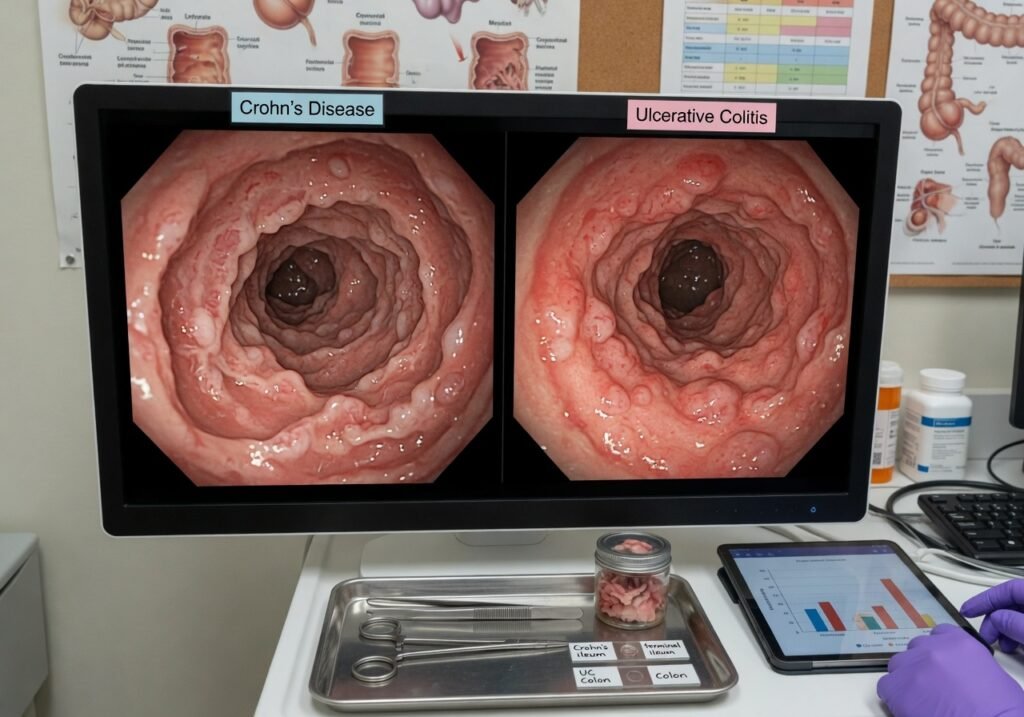
Colonoscopy with biopsy is the gold standard for diagnosis. Your gastroenterologist will inspect the entire colon and take tissue samples from multiple sites. Ulcerative colitis shows continuous inflammation starting at the rectum and extending proximally, whereas Crohn’s shows skip lesions (patches of inflammation with normal-appearing tissue between them). Under the microscope, pathologists look for cryptitis and crypt distortion patterns.
Crohn’s patients typically need CT enterography or MR enterography to visualize the small bowel, since colonoscopy cannot reach past the ileocecal valve. This is where fistulas or strictures (dangerous narrowings) might lurk undetected.
Treatment: Specific Medications That Actually Work
Mild disease often responds to 5-aminosalicylates (5-ASAs) like mesalamine or sulfasalazine, which reduce inflammation locally in the colon. These work reasonably well for ulcerative colitis but are less effective for Crohn’s disease affecting the small bowel.
Moderate to severe disease requires corticosteroids like prednisone or budesonide (which has fewer systemic side effects). Budesonide is particularly useful for Crohn’s because it targets the terminal ileum preferentially. These are induction therapy—you use them to control flares, not long-term maintenance.
Immunosuppressants like azathioprine (Imuran) or methotrexate help maintain remission, but they take 6-12 weeks to work. The real game-changer came with biologic therapies: TNF-alpha inhibitors like infliximab (Remicade) or adalimumab (Humira), IL-12/23 inhibitors like ustekinumab (Stelara), and integrin antagonists like vedolizumab (Entyvio). These target specific parts of the immune cascade and work faster—sometimes within weeks.
Which drug you receive depends on disease location, severity, prior treatments, and whether you have extraintestinal manifestations like arthritis or skin disease. There’s no universal answer—your gastroenterologist will sequence therapies based on your specific presentation.
Practical Daily Management: Strategies That Matter
During flares, a temporary low-residue diet (avoiding raw vegetables, whole grains, high-fiber foods) reduces stool volume and urgency. This isn’t a permanent diet—it’s tactical management during active disease. Keep a food diary; individual triggers vary wildly between patients. Dairy triggers diarrhea for some people due to lactose intolerance exacerbating disease, while others tolerate it fine.
Stress management directly impacts disease activity. Patients who practice regular meditation or cognitive behavioral therapy show measurably reduced symptom severity in some studies. This isn’t placebo—stress activates mast cells in the gut and increases intestinal permeability through mechanisms involving the vagal nerve.
Adherence to maintenance medications even during remission prevents 70% of disease reactivation. Many patients make the mistake of stopping medications once they feel well, which virtually guarantees relapse within months. Sulfasalazine or mesalamine for ulcerative colitis, or continued biologic therapy for Crohn’s, keeps the immune system suppressed enough to prevent attacks.
Prevention: What the Evidence Actually Shows
Primary prevention is difficult because genetic susceptibility is largely fixed. Secondary prevention—preventing relapses in diagnosed patients—works through medication adherence and lifestyle optimization. Some evidence suggests prolonged breastfeeding in infants of affected mothers reduces inflammatory bowel disease risk, possibly through transfer of protective antibodies and microbiota.
Smoking cessation is non-negotiable for Crohn’s patients—it accelerates disease progression and increases surgery risk. For ulcerative colitis patients, smoking weirdly offers modest protection, though quitting is still advised for overall health.
Antibiotic use in childhood has shown association with increased inflammatory bowel disease risk, supporting the hygiene hypothesis. Probiotics have disappointing evidence despite widespread marketing—they haven’t proven to prevent disease or maintain remission in rigorous trials.
Frequently Asked Questions About Inflammatory Bowel Disease
Medical Disclaimer
This article is educational and does not replace professional medical advice. Inflammatory bowel disease diagnosis and management require individualized assessment by a board-certified gastroenterologist. The information presented reflects
Sources & Medical References
HealthTopics.com articles are based on peer-reviewed medical research and guidance from the NIH, CDC, and WHO. See our editorial policy for full sourcing standards.