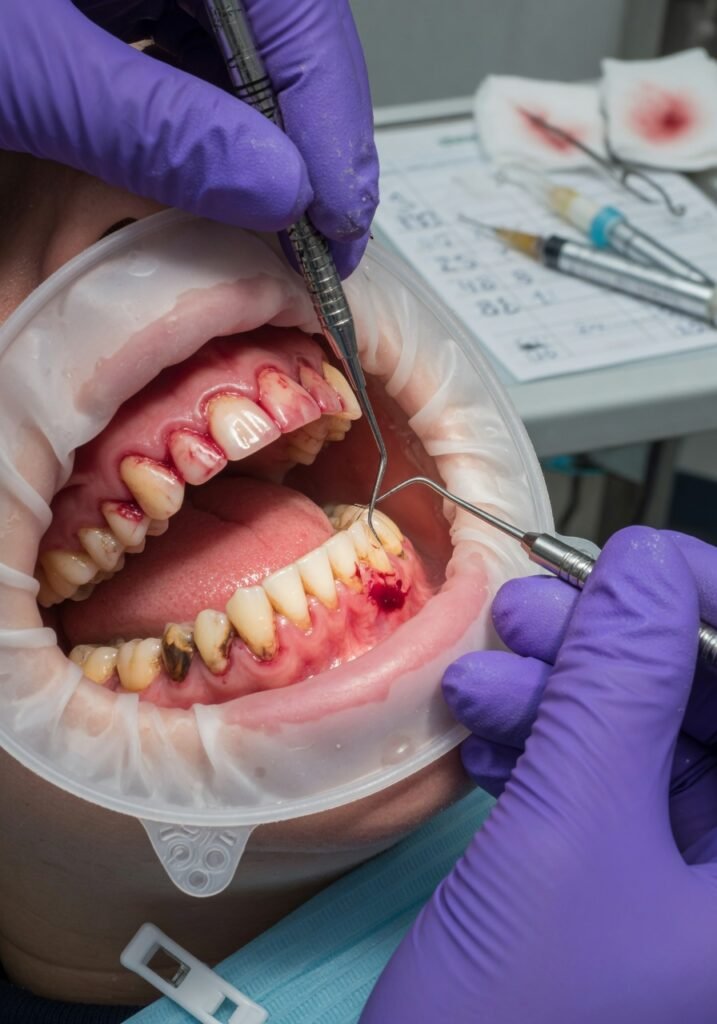
Sarah, a 42-year-old marketing director, noticed her toothbrush bristles were tinged pink during her morning routine. She’d been brushing harder lately, figuring that would help with the slight swelling she’d seen in her lower gums over the past few weeks. What she didn’t realize was that aggressive brushing was making things worse—and that the bleeding itself was her mouth’s way of signaling an infection she couldn’t see yet. Her dentist would later tell her that she’d caught gingivitis at exactly the right moment, before it progressed to the bone-destroying version called periodontitis.
Gum disease affects roughly half of American adults over 30, according to the CDC, yet most people don’t understand the difference between the reversible early stage and the permanent damage that comes later. Here’s what you actually need to know about treating your gums—and why the timing of that treatment matters more than most dentists emphasize.
Key Facts About Gum Disease
- The CDC reports that 47.2% of adults aged 30 and older have some form of periodontitis, with severe periodontitis affecting nearly 9% of the population
- Gingivitis (early-stage gum disease) is completely reversible if caught before bone loss occurs, but once periodontitis develops, the damage to supporting bone and ligaments is permanent
- Patients with untreated periodontitis lose an average of 0.1 to 0.2 millimeters of bone per year, though aggressive cases can progress much faster
- Non-surgical scaling and root planing (deep cleaning) reduces probing depths by an average of 1.4 millimeters, comparable in some cases to surgical intervention
- Smokers have 3 to 6 times higher risk of developing periodontitis than non-smokers, partly because smoking impairs the immune response in gum tissue
Understanding What Happens in Your Gums
Think of your gum tissue as a seal around your teeth. Under that seal is a shallow groove—normally just 1 to 3 millimeters deep—where your gum attaches to the tooth and the underlying bone. Bacteria live in everyone’s mouth, but in gum disease, certain pathogenic strains trigger your immune system to mount an inflammatory response. That inflammation is actually your body fighting back, which sounds good until you realize it’s also destroying the very tissues you’re trying to protect.
The progression works like this: bacteria accumulate in plaque. Your immune cells rush to the area, causing redness and swelling. If the plaque isn’t removed, it hardens into tartar (calculus), which traps more bacteria. At this stage, you have gingivitis. The inflammation is confined to the gums themselves, and your body hasn’t yet started destroying bone. But if the inflammation continues unchecked, your immune response begins attacking the periodontal ligament—the connective tissue holding your tooth to its socket—and the alveolar bone beneath it. Now you have periodontitis, and the damage is irreversible.
What makes this particularly sneaky is that the early destruction often happens painlessly. You can have significant bone loss without feeling anything, which is why routine screening matters so much.
Causes and Risk Factors: Beyond Just Poor Brushing
The most obvious culprit is inadequate oral hygiene. But before you blame yourself entirely, understand that susceptibility to gum disease is heavily genetic. The JAMA study on periodontal disease noted that some people with mediocre brushing habits never develop periodontitis, while others with excellent hygiene still struggle. Your immune system’s response to the bacterial challenge matters at least as much as the bacteria themselves.
Diabetes dramatically increases your risk. High blood glucose impairs neutrophil function (the white blood cells that fight oral bacteria) and makes gum tissue more prone to infection. Conversely, untreated periodontitis worsens glycemic control—it’s a vicious cycle.
Smoking and vaping are major players, disrupting both immune function and blood flow to gum tissue. Hormonal shifts matter too; pregnancy gingivitis affects up to 40% of pregnant women because increased progesterone changes how gums respond to plaque. Medications that cause dry mouth (antihistamines, antidepressants, antihypertensives) indirectly worsen gum disease since saliva protects against bacterial overgrowth.
Here’s what most articles miss: chronic stress suppresses your immune response to oral pathogens. If you’re under sustained stress, your gums become more vulnerable to infection even with the same bacterial load. This isn’t a minor factor—it’s a documented mechanism.
Other contributors include poor nutrition (especially vitamin C deficiency), misaligned bite creating excessive pressure on certain teeth, and family history of early tooth loss.
Signs and Symptoms: What You’ll Actually Notice
The earliest warning sign most people miss is a change in the way their gums feel. Before visible bleeding, you might notice your gums feel slightly tender when you eat hard foods, or a strange looseness when you floss. Some patients describe a “different texture” to their gums—slightly puffy or squishy instead of firm.
Bleeding during brushing or flossing is obvious, but its absence doesn’t reassure you. Some patients with aggressive periodontitis have minimal bleeding; others bleed easily but haven’t progressed far. The symptom is meaningful only in context.
You might notice your teeth looking longer. This isn’t actually new tooth growth—your gums are receding, exposing root surface. Root exposure causes another symptom: tooth sensitivity to cold. That sharp pain when you drink ice water often brings patients to the dentist, even though it’s actually a sign of advanced gum disease.
Bad breath (halitosis) that doesn’t improve with mouthwash suggests bacterial overgrowth beneath the gum line. Advanced periodontitis can cause a metallic or distinctly foul taste. Some patients notice their bite has changed slightly, or that teeth feel a bit loose or shifted—these are red flags for bone loss.
Diagnosis: How Your Dentist Determines Severity
Visual inspection is just the starting point. Your dentist or hygienist uses a periodontal probe—a thin, graduated ruler—to measure the depth of the space between your tooth and gum at multiple sites around each tooth. Healthy probing depths are 1 to 3 millimeters. Depths of 4 to 5 millimeters suggest gingivitis or early periodontitis. Anything deeper than 6 millimeters indicates more advanced destruction.
They’re also noting whether your gums bleed when probed (which suggests inflammation) and whether the interdental papilla (the gum between your teeth) is intact or “cratered” (another sign of periodontitis). They may ask about tooth mobility—does any tooth wiggle slightly when they push on it?
X-rays reveal bone loss patterns. Horizontal bone loss (where the bone level drops uniformly) looks different from vertical or angular bone loss (where the bone appears to have a “crater” beside the tooth root). The pattern sometimes hints at the severity and how aggressive the disease is.
Some practices use additional tools like gum recession measurements or microbiological testing (analyzing which specific bacteria are present), though these are less standard.
Treatment Options: Current Evidence and Specifics
For gingivitis, the answer is often simpler than you’d expect: professional removal of tartar followed by improved home care. Your hygienist or dentist performs scaling and polishing, removing the hardened buildup that brushing alone cannot touch. Most gingivitis reverses completely within 2 to 3 weeks if you then maintain excellent daily hygiene.
When periodontitis is present, non-surgical treatment begins with scaling and root planing (SRP), also called a “deep cleaning.” This involves removing tartar below the gum line and smoothing the root surface so bacteria have fewer places to attach. Local anesthesia is usually given because probing deeper than 5 or 6 millimeters causes genuine discomfort. Research published in the NIH database shows that SRP typically reduces pocket depths by about 1 to 2 millimeters on average, though response varies significantly between patients.
Antimicrobial rinses like chlorhexidine (Peridex) or cetylpyridinium chloride reduce bacterial counts, but they’re adjuncts, not replacements for mechanical cleaning. Some dentists prescribe oral antibiotics (minocycline or doxycycline) for aggressive periodontitis, though overuse of systemic antibiotics is concerning for resistance. Localized antibiotic delivery systems—like doxycycline hyclate microspheres (Arestin) injected directly into deep pockets—target bacteria at the source.
If non-surgical treatment doesn’t achieve adequate pocket depth reduction after 4 to 8 weeks, your dentist may recommend periodontal surgery. Common procedures include flap surgery (lifting gum tissue to access and clean root surfaces and remove diseased tissue) or bone grafting (for localized bone defects). Newer regenerative techniques like guided tissue regeneration use membranes to encourage bone regrowth in some situations.
The most important truth about treatment: catching periodontitis early, before extensive bone loss, makes all the difference. Once bone is gone, no treatment can restore it.
Practical Daily Management: Concrete Strategies That Work
First, upgrade your technique. Brush with a soft-bristled toothbrush (hard bristles traumatize receded gums) using gentle, circular motions. Angle the brush at 45 degrees toward the gum line. Spend at least 2 minutes brushing. Electric toothbrushes with pressure sensors (like Oral-B models with SmartGuide) help prevent excessive force.
Floss daily. Interdental brush cleaners (small conical brushes) work better than string floss for people with significant bone loss and spacing between teeth. Water flossers (like Waterpik) are effective if used correctly, though they don’t remove plaque mechanically the way string floss does—they’re complementary, not substitutes.
If you smoke or vape, these habits directly impair healing after treatment. Quitting gives your immune system a fighting chance. Even reducing from 1 pack to half a pack daily improves outcomes measurably.
For dry mouth (whether from medications or other causes), ask your dentist about saliva substitutes or stimulants like xylitol lozenges or pilocarpine. Staying hydrated helps, but it won’t fully compensate for medication-induced xerostomia.
Keep sugar intake low, especially sticky sugars. Bacteria ferment simple carbohydrates into acids that worsen inflammation. This matters more for gum disease than general dental health.
Schedule professional cleanings every 3 to 4 months if you have a history of periodontitis, rather than the standard 6 months. More frequent cleanings prevent tartar buildup that fuels the disease.
Prevention: What Evidence Actually Shows Works
The foundational prevention strategy is consistent daily mechanical cleaning—brushing and interdental cleaning—combined with professional cleanings. This prevents gingivitis in most people. But preventing progression from gingivitis to periodontitis is trickier because individual immune response matters so much.
For people with genetic susceptibility, aggressive plaque control and frequent professional cleanings can hold the line but won’t guarantee prevention. If you have a family history of early tooth loss or periodontitis, be especially vigilant.
Managing systemic conditions matters tremendously. Diabetic patients with well-controlled blood glucose have significantly less gum disease. Stress management—through exercise, meditation, or counseling—has measurable effects on periodontal health, though it’s not a primary prevention tool.
Antimicrobial rinses like chlorhexidine can prevent gingivitis when combined with mechanical cleaning, but long-term daily use causes staining and taste alteration. Short-term use (1 to 2 weeks) after treatment makes sense; indefinite use doesn’t.
Vitamin C deficiency worsens gum disease, but supplementing with meg