
“`html
Gum Disease: Why Your Mouth’s Silent Infection Could Be Damaging Your Heart
Sarah, a 47-year-old accountant, noticed her gums bled slightly when she flossed. She assumed it was nothing serious—maybe she was brushing too hard. Six months later, her dentist diagnosed moderate periodontitis. What caught her off-guard wasn’t just the diagnosis itself, but what her cardiologist said next: patients with untreated periodontitis have a 2.6 times higher risk of cardiovascular events compared to those with healthy gums, according to research published in JAMA Cardiology. That statistic changed how she understood her oral health entirely.
Key Facts About Gum Disease
- Approximately 47.2% of American adults aged 30 and older have some form of periodontal disease, according to CDC data from the National Health and Nutrition Examination Survey
- Gingivitis (early stage) affects roughly 90% of the global population at some point, yet only about 15% progress to severe periodontitis if treated early
- Untreated periodontitis can lead to loss of 2-4 teeth per decade after age 40, making it the leading cause of tooth loss in adults
- The bacteria in periodontal pockets can enter the bloodstream during routine chewing, potentially triggering systemic inflammation
- Professional scaling and root planing reduces pocket depth by an average of 1.6mm after 8 weeks of healing
Understanding Gum Disease: The Progressive Breakdown
Your gums aren’t just decorative tissue holding your teeth in place. They’re a protective barrier—think of them as the rubber seal around a window. When that seal fails, water gets inside and causes damage to the frame. In your mouth, the “water” is bacterial biofilm, and the “frame” is the bone supporting your teeth.
Here’s what actually happens: Bacteria colonize the space where your tooth meets your gum. If you don’t remove this biofilm daily through brushing and flossing, it hardens into tartar (calculus), which your toothbrush can’t touch. Your immune system responds by sending white blood cells to fight the infection. This inflammatory response causes the redness and swelling you see in gingivitis. The problem? If inflammation continues unchecked, it doesn’t just stay in your gums—it migrates downward, destroying the periodontal ligament (the fibers anchoring your tooth) and the alveolar bone beneath it.
This is where gingivitis becomes periodontitis. The gum pulls away from the tooth, creating a periodontal pocket—a space where bacteria multiply without oxygen. In shallow pockets, they’re somewhat controlled. But in deep pockets (4mm or deeper), anaerobic bacteria thrive and release toxic byproducts directly into your bloodstream through the inflamed tissue. This isn’t just a mouth problem anymore.
Causes and Risk Factors: What Actually Starts the Problem
The primary culprit is poor oral hygiene, but “poor” doesn’t always mean “negligent.” Some people brush twice daily and still develop periodontitis because they’re missing the spaces between teeth—the interproximal areas where 80% of periodontal disease starts. Flossing or using interdental brushes directly addresses this blind spot that standard toothbrushing misses.
Smoking is the second-most modifiable risk factor, and it’s brutal: smokers are 4-6 times more likely to develop severe periodontitis than non-smokers. Why? Smoking reduces blood flow to the gums, suppresses immune function, and creates an environment where aggressive pathogens thrive. Quitting even temporarily improves outcomes, though full benefits take months.
Diabetes dramatically accelerates gum disease. The connection is bidirectional: high blood glucose impairs immune response, and the chronic inflammation from periodontitis worsens glycemic control. NIH research shows diabetic patients with poor glycemic control have 3-4 times the risk of periodontitis compared to non-diabetics.
Stress hormones like cortisol suppress immune function, making your gums more susceptible to bacterial colonization. This is an underappreciated factor most articles skip. Chronic stress literally weakens your mouth’s defenses.
Other contributors include: genetic predisposition (some people’s immune systems are less effective at fighting periodontal bacteria), hormonal fluctuations (pregnancy-related gingivitis affects 30-50% of pregnant women), certain medications that reduce saliva flow (antidepressants, antihistamines, blood pressure medications), and aggressive brushing—which damages the gum margin and creates recession.
Signs and Symptoms: What You Actually Feel
Early gingivitis is often symptomless, which is the dangerous part. You might notice your gums bleed when you floss or brush, but many people ignore this as normal. It isn’t. Healthy gums don’t bleed. That bleeding indicates inflammation and compromised tissue integrity.
As disease progresses, you’ll notice persistent bad breath that mouthwash doesn’t fix (it’s caused by volatile sulfur compounds from anaerobic bacteria), gum swelling that makes your teeth look longer, teeth that feel slightly loose, or a persistent bad taste in your mouth even after brushing. Some patients describe a “dull aching” in their jaws, particularly when chewing hard foods.
One overlooked warning sign: gum recession. Your gums actually shrink as the underlying bone dissolves. If you’ve noticed your teeth look longer than they used to, that’s your gum line retreating—and it’s often painless. By the time you feel discomfort, significant bone loss has usually occurred.
Suppuration (pus drainage) from the gum indicates advanced periodontitis. If you ever see yellowish fluid between your tooth and gum, that requires urgent evaluation.
Diagnosis: What Your Dentist Is Actually Measuring
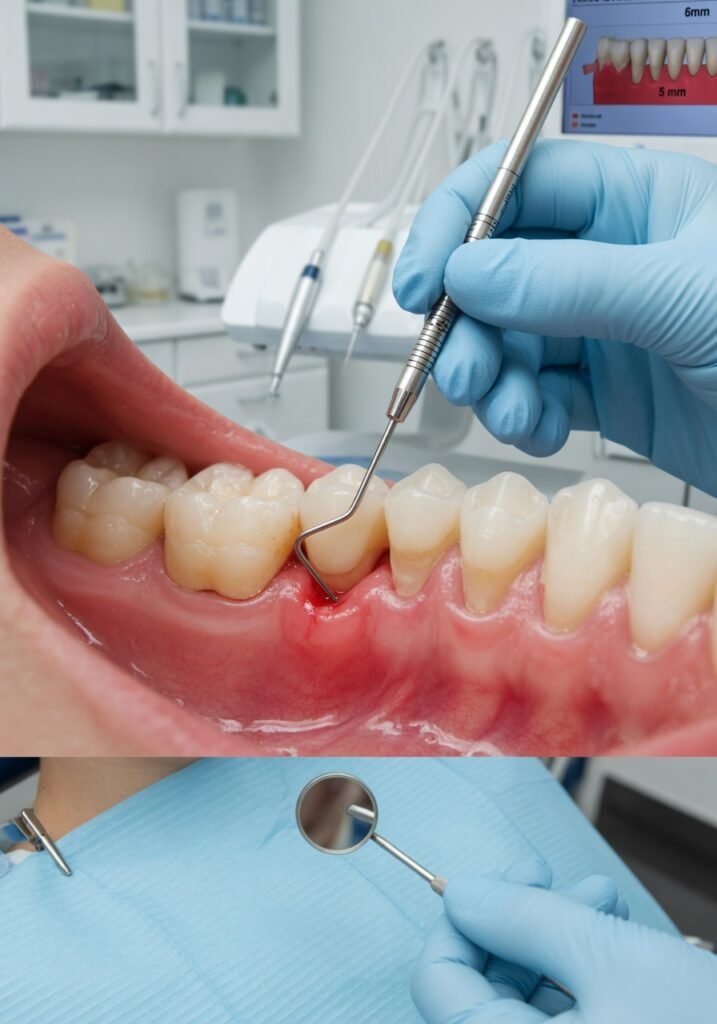
Your dentist won’t just look at your gums. They’ll perform a periodontal probing, which means gently inserting a thin ruler called a periodontal probe into the space between your tooth and gum. Healthy probing depth is 1-3mm. Anything 4mm or deeper suggests bone loss. The probe doesn’t hurt, but if your gums are inflamed, you might feel mild sensitivity.
They’ll also document which teeth have pockets, how many sites are affected, and whether you have bleeding on probing (BOP). A patient with generalized bleeding at multiple sites has more extensive disease than someone with isolated pockets around a few teeth.
Most dentists will take a full-mouth radiograph (X-rays) to assess bone level. You can actually see bone loss on these images—the space between the tooth root and surrounding bone decreases. This visual evidence determines disease severity and helps guide treatment planning.
Some offices perform advanced diagnostics like electronic periodontal charts or bacterial DNA testing, but these aren’t standard in most practices and aren’t always necessary for diagnosis.
Treatment Options: What Modern Dentistry Can Actually Do
Treatment depends entirely on disease stage and severity.
For gingivitis: The good news—it’s reversible. Professional cleaning plus improved home care usually resolves inflammation within 2-3 weeks. No medication needed. Your own daily effort is the treatment.
For mild to moderate periodontitis: Scaling and root planing (SRP), also called non-surgical periodontal therapy, is the first-line treatment. Your hygienist removes tartar and biofilm from below the gum line and smooths the root surface so bacteria have fewer places to attach. This typically requires 4-6 visits, with each quadrant of your mouth treated separately. Local anesthesia is used, so you feel pressure but not pain. Studies show SRP reduces pocket depths by an average of 1.6mm, though results vary based on your home care afterward.
Antimicrobial agents are sometimes used adjunctively. Chlorhexidine rinses reduce bacterial load, and some dentists place minocycline microspheres directly into deep pockets to deliver antibiotics locally. However, systemic antibiotics (like amoxicillin-clavulanate) for periodontitis lack strong evidence and are typically reserved for aggressive periodontitis cases or immunocompromised patients.
For advanced periodontitis: If pockets remain 5mm or deeper after SRP with good home care, you’ll likely need periodontal surgery. Flap surgery allows the periodontist to access root surfaces deeper in the pocket and sometimes regenerate lost bone using bone grafts or guided tissue regeneration membranes. These procedures have real success in selected cases but require a specialist and significant healing time (2-3 months before full function).
Laser therapy is marketed heavily but lacks sufficient evidence from rigorous trials. It may complement traditional SRP but shouldn’t replace it.
Practical Daily Management: Concrete Strategies That Actually Work
Interdental cleaning is non-negotiable. Toothbrushes only clean about 65% of tooth surface. You need floss, water flossers, or interdental brushes (which are easier for many people). Pick one method and use it daily—consistency matters more than which tool you choose. If traditional floss frustrates you, try GUM Soft-Picks or Waterpik; they’re easier to use correctly.
Technique matters more than aggression. Brush gently at a 45-degree angle to your gum line, using small circular motions. Vigorous, horizontal scrubbing damages the gum margin and causes recession. Electric toothbrushes often prevent this problem because they oscillate automatically at safer speeds.
Use antimicrobial rinses strategically. Chlorhexidine 0.12% rinses (like Peridex) reduce bacterial counts, but they’re not for daily indefinite use—they can cause staining and tartar buildup with prolonged use. Your dentist might recommend them for 2-3 weeks after SRP, then switch to regular rinsing.
Address underlying contributors. If you smoke, each cigarette you avoid improves your periodontal prognosis. If you’re diabetic, tight glucose control directly improves gum healing. If you’re stressed, sleep and meditation genuinely affect your immune response to oral bacteria.
Attend maintenance appointments religiously. After initial treatment, you need professional cleanings every 3-4 months, not the standard 6 months. Your dentist will monitor probing depths and assess healing. Skipping these appointments is how treated periodontitis progresses again.
Prevention: What the Evidence Actually Shows
You can’t “prevent” gum disease entirely if you’re genetically susceptible, but you can prevent it from developing or progressing. The evidence is straightforward: daily interdental cleaning plus twice-daily brushing reduces gingivitis incidence by 30-40% compared to brushing alone. That’s not magical—it’s mechanical removal of biofilm from areas your brush can’t reach.
Professional cleanings don’t “prevent” periodontitis, but they remove tartar buildup and allow your immune system to control bacteria more effectively. Whether you need them every 6 months or every 3 months depends on your individual risk factors and previous disease severity.
Here’s the nuance most articles miss: prevention only works if you sustain the behavior. One week of perfect oral hygiene followed by months of neglect is worse than modest, consistent effort. The patients who maintain stable periodontitis long-term are those who floss regularly and see their hygienist without skipping appointments.
Frequently Asked Questions
Sources & Medical References
HealthTopics.com articles are based on peer-reviewed medical research and guidance from the NIH, CDC, and WHO. See our editorial policy for full sourcing standards.