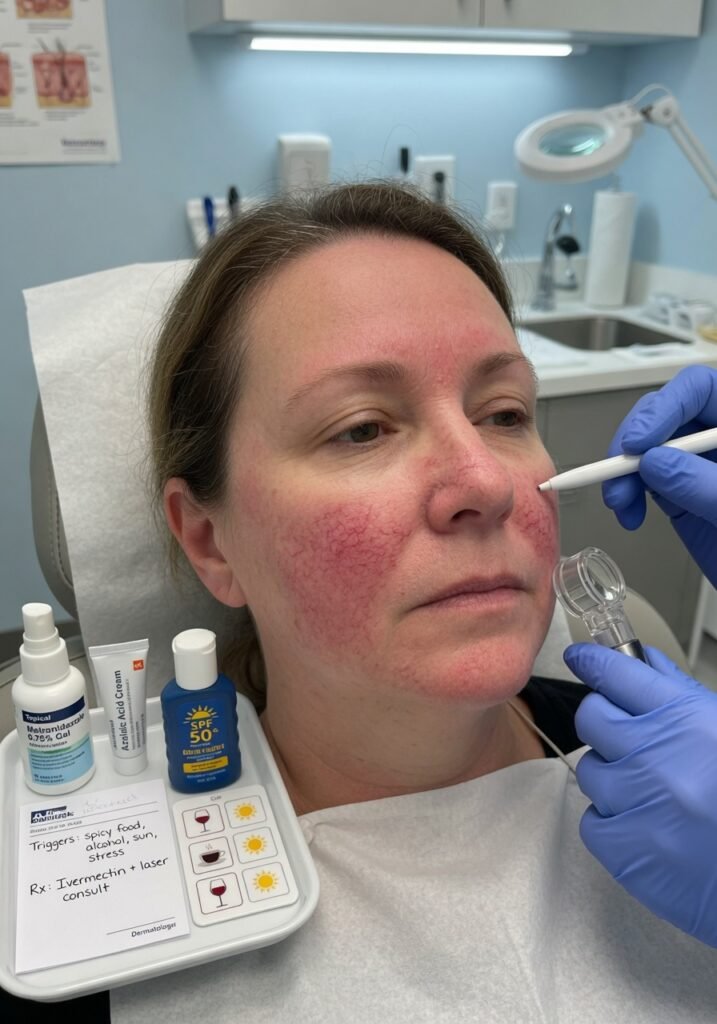
Rosacea: Why Your Face Keeps Flushing and What Actually Works
Maria, a 42-year-old marketing director, had spent three years attributing her persistent facial flushing to hot flashes. Then her dermatologist pointed out something she’d missed: the redness was concentrated on her cheeks and nose, her skin felt perpetually sandpapery, and she occasionally noticed tiny bumps that looked almost like acne. She had rosacea—and she wasn’t alone. Research shows that approximately 1 in 20 Americans has rosacea, yet nearly 70% of patients remain undiagnosed because they mistake the condition for acne, sunburn, or simple sensitivity. What makes rosacea particularly frustrating is that it doesn’t follow predictable patterns. The same stimulus that triggers a flare on Monday might leave your skin clear on Wednesday, making it feel deeply personal and impossible to control.
Key Facts About Rosacea
- Rosacea affects approximately 16 million Americans, with women accounting for 70–80% of diagnosed cases, though men often have more severe presentations
- The condition typically begins between ages 30 and 50, though onset can occur as early as the teens and as late as the 60s
- Research published in JAMA Dermatology found that rosacea patients have a three-fold increased risk of cardiovascular disease, suggesting systemic involvement beyond skin manifestations
- Four distinct subtypes exist (erythematotelangiectatic, papulopustular, phymatous, and ocular), with many patients experiencing overlapping features from multiple categories
- Untreated rosacea progresses through predictable stages, from occasional flushing to persistent redness to thickened skin texture, with progression occurring over months to years
Understanding What’s Actually Happening in Your Skin
Rosacea isn’t simply inflammation. Think of it as your skin’s alarm system misfiring. In people with rosacea, the blood vessels that should dilate during exercise or heat exposure instead become hypersensitive and over-reactive. They dilate excessively in response to normal stimuli that wouldn’t bother other people’s skin. Over time, these repeated episodes of vascular instability seem to trigger an innate immune response—specifically, increased activation of cathelicidin, an antimicrobial peptide that your skin produces to fight infection. The catch? In rosacea patients, cathelicidin levels are abnormally elevated, which paradoxically causes inflammation rather than protection.
This cascade also involves a protein called TRPV1, essentially a heat and irritant sensor in nerve fibers beneath your skin. In rosacea, TRPV1 becomes hypersensitive, firing at the slightest provocation. Your nervous system and vascular system are essentially having a conversation that goes awry. That’s why your face feels burning hot sometimes even when room temperature is normal. Your skin’s barrier function also becomes compromised—the lipids that normally seal in moisture deteriorate, leaving your skin drier and more reactive. This isn’t your imagination or poor skincare choices. It’s measurable dysfunction.
Causes and Risk Factors You Should Know About
Genetics load the gun, environment pulls the trigger. If both parents have rosacea, your risk jumps to roughly 40–50%. Fair skin and Celtic or Northern European ancestry carry higher predisposition, though rosacea absolutely occurs in people with darker skin tones—it’s just often missed in initial diagnosis.
The obvious triggers include extreme temperatures (heat and cold both cause problems), spicy foods, alcohol (particularly red wine and spirits), caffeine, and emotional stress. But here’s what most articles gloss over: the contribution of the skin microbiome. Specifically, overgrowth of the Demodex mite—a microscopic organism that lives on everyone’s skin—has been found in dramatically higher numbers on rosacea-affected skin. The CDC’s dermatological investigations note that whether this represents cause or consequence remains unclear, but antimicrobial treatments targeting this organism do improve symptoms in many patients. That’s worth knowing because it means some flares might be partly addressable through specific skincare rather than systemic medication.
Other risk factors include estrogen fluctuations (menopause accelerates onset), chronic sun exposure without protection, chronic corticosteroid use on the face, and interestingly, undiagnosed autoimmune conditions like systemic lupus or celiac disease, which share inflammatory pathways with rosacea. People with digestive dysfunction or small intestinal bacterial overgrowth (SIBO) report higher rosacea flare frequency, possibly through shared immune activation.
What Rosacea Actually Feels Like Day to Day
The visual presentation—persistent facial redness predominantly on cheeks, nose, chin, and forehead—is what people notice. But patients report that the sensation is equally important. Many describe a burning or stinging quality, almost like sunburn pain without the sun exposure. Some feel intense heat radiating from their face while their core body temperature is normal. Others report tightness, roughness, or a sensation of sandpaper when they touch their cheeks.
Early warning signs that signal an impending flare include slight flushing that appears and disappears within minutes, mild itching or tingling, and increased skin sensitivity to normally tolerable skincare products. These prodromal symptoms might precede visible redness by hours, giving you a window to intervene with trigger avoidance or topical interventions. Many patients also report that their triggers cluster during certain life phases—high-stress periods, hormonal cycles, or seasons with extreme temperatures—rather than remaining static year-round.
Ocular rosacea, affecting the eyes and eyelids, occurs in about 50% of people with skin rosacea and is frequently missed. Patients describe dry, gritty eyes, excessive tearing, light sensitivity, and redness of the eyelids. Some develop chalazion (blocked oil glands) or experience recurrent styes.
How Diagnosis Actually Works
There is no blood test for rosacea. Diagnosis relies entirely on clinical presentation—your doctor’s visual assessment and your history of symptoms. The National Rosacea Society established diagnostic criteria: you typically need flushing or persistent redness plus one of the following: visible blood vessels (telangiectasia), bumps and pustules, or skin thickening.
Your dermatologist will likely ask detailed questions about triggers, duration of symptoms, and whether family members are affected. They might ask about gastrointestinal symptoms, since the rosacea-IBS connection is well-documented. Importantly, they’ll examine your eyes specifically, since ocular involvement changes management priorities. Some dermatologists use dermoscopy—magnification to visualize vascular patterns—but standard clinical examination suffices for diagnosis.
The diagnostic challenge often isn’t confirming rosacea but distinguishing it from acne vulgaris, seborrheic dermatitis, systemic lupus, or contact dermatitis. That’s why providing your doctor with detailed trigger history matters enormously.
Treatment Options That Actually Have Evidence
Topical metronidazole (MetroGel or MetroLotion) has been a first-line treatment for decades, though its mechanism in rosacea remains unclear—it probably works through antimicrobial and anti-inflammatory pathways. You apply it twice daily, and improvement typically appears over 4–8 weeks. Azelaic acid (Finacea or The Ordinary Azelaic Acid Suspension) is increasingly preferred because it simultaneously addresses the Demodex overgrowth, reduces inflammation, and improves skin barrier function. Concentration matters: dermatology-grade 15–20% formulations work better than the 10% concentration in some cosmetic products.
Topical retinoids, particularly tretinoin (Retin-A) and adapalene (Differin), improve rosacea through anti-inflammatory mechanisms and increased cell turnover. Start low and go slow—your skin will be sensitive initially, but many patients achieve excellent control with retinoids. Sulfacetamide-sulfur combinations (Sulfacleanse, Sumaxin) work for some patients, though the smell is noticeable.
For moderate to severe rosacea, oral antibiotics at subantimicrobial doses work primarily through anti-inflammatory effects, not infection fighting. Low-dose doxycycline (20 mg twice daily, marketed as Oracea) demonstrates clear efficacy in clinical trials. Minocycline is an alternative. These typically require 12 weeks for full benefit. Oral ivermectin (Soolantra), taken as a single dose monthly, targets Demodex overgrowth and shows effectiveness comparable to metronidazole for papulopustular rosacea.
Procedural options include laser and light therapies. Intense pulsed light (IPL) and laser treatments targeting hemoglobin in blood vessels reduce visible redness and flushing episodes effectively. Results typically last 6–12 months before repeat sessions become necessary. Laser options are expensive but offer sustained improvement that topicals alone might not achieve.
Practical Daily Management Strategies
Identify your specific triggers through systematic tracking. Keep a simple log: what did you eat, your stress level, temperature exposure, and skin response. Patterns emerge over 2–3 weeks. Don’t assume all rosacea triggers are universal—your main triggers might be completely different from someone else’s.
Skincare becomes medical management. Use a gentle, non-foaming cleanser (CeraVe Hydrating Cleanser or Vanicream work well) with lukewarm—never hot—water. Pat dry rather than rubbing. Apply prescribed treatments to clean skin. Layer a ceramide-rich moisturizer over topical medications to reduce irritation and reinforce barrier function. Use mineral sunscreen (zinc oxide or titanium dioxide) daily at SPF 30 minimum, reapplying after two hours in sun.
Temperature control matters more than people realize. Use lukewarm water for showers and face washing. Avoid extreme cold—if you exercise outdoors in winter, protect your face with a scarf. Don’t drink beverages at extreme temperatures. In summer, use a lightweight long-sleeved shirt and wide-brimmed hat rather than relying solely on sunscreen.
Stress management has actual physiological effects. Rosacea flares correlate with elevated cortisol. Practices that reduce sympathetic activation—deep breathing, yoga, meditation—genuinely reduce flare frequency. This isn’t placebo.
If you suspect ocular involvement, see an eye care specialist. Warm compresses applied to eyelids daily, eyelid hygiene with gentle cleansing, and artificial tears all help. Severe cases need topical antibiotic ointment prescribed by an ophthalmologist.
Prevention: What the Evidence Actually Shows
You cannot prevent rosacea if you carry genetic predisposition, but you can substantially reduce flare frequency and severity through trigger management. Consistent sun protection deserves special emphasis—UV exposure doesn’t just trigger acute rosacea, it also accelerates long-term progression toward thickened skin and permanent vascular changes.
Avoiding your identified trigger foods and beverages works. If spicy foods flare your rosacea, this isn’t psychological. Capsaicin directly activates TRPV1 receptors. Simply avoiding them prevents flares. Similarly, if you notice alcohol triggers symptoms within hours, abstaining prevents that cascade.
Starting treatment early prevents progression. Stage 1 rosacea (occasional flushing) is substantially easier to manage than Stage 3 (phymatous changes with thickened, bulbous nose). Once your skin develops these structural changes, they’re difficult to reverse even with aggressive treatment.
Some patients report that antimicrobial skincare ingredients like sulfur or azelaic acid used preventively reduce flare frequency even between treatment courses. The evidence for this is mixed but worth experimenting with in your own care.
Frequently Asked Questions
Sources & Medical References
HealthTopics.com articles are based on peer-reviewed medical research and guidance from the NIH, CDC, and WHO. See our editorial policy for full sourcing standards.