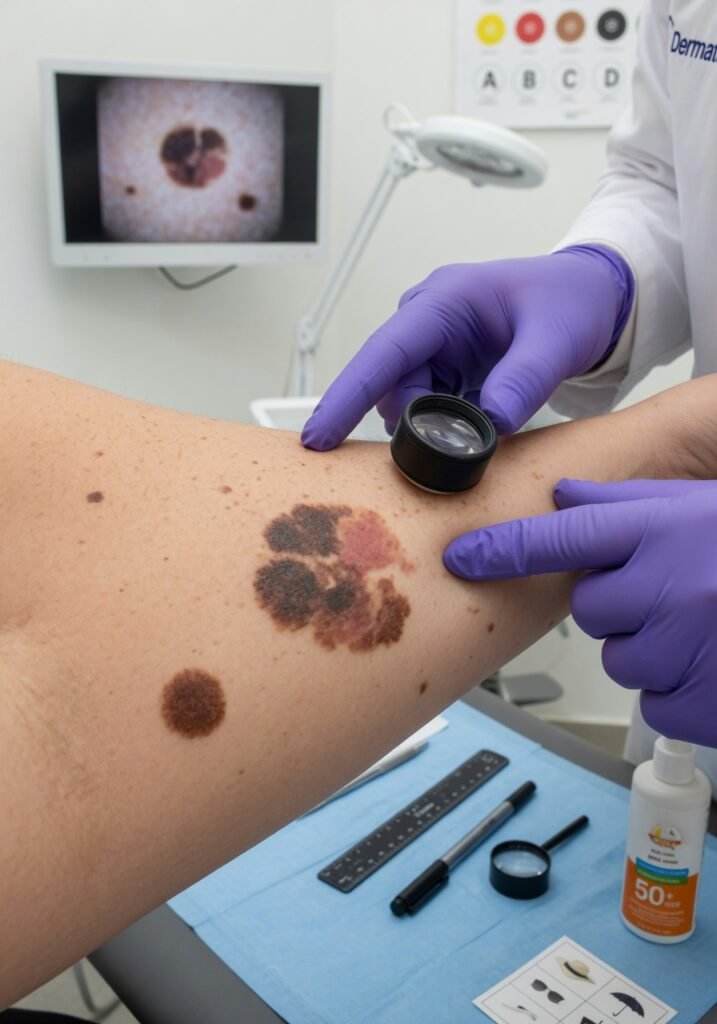
Sarah, 34, found a slightly raised brown spot on her shoulder during a routine shower. It looked identical to the dozen other moles scattered across her back—nothing special, nothing alarming. She assumed melanoma meant a large, dark, obviously ugly mark. Six months later, when that “nothing special” spot had grown a quarter inch and developed uneven coloring, her dermatologist removed it immediately. The pathology report came back: melanoma, 0.8mm thick, caught early. Here’s what Sarah—and most patients—get wrong: melanoma doesn’t announce itself with obvious disfigurement. It whispers. It tricks you into thinking unchanged things are harmless, when the real danger lies in the ones that do change, even subtly.
Key Facts About Melanoma
- The CDC reports that melanoma incidence increased by approximately 1-2% annually over the past two decades, making it one of the fastest-rising cancer types in the United States.
- Approximately 99,780 new cases of melanoma were projected for 2022 in the U.S., with roughly 7,650 deaths annually according to the American Cancer Society.
- When melanoma is detected at Stage 0 or 1 (localized disease), five-year survival rates exceed 95%; once it spreads to distant organs, survival drops to 27-29%.
- Melanoma accounts for only about 1% of all skin cancers but causes roughly 75% of skin cancer deaths because of its aggressive potential.
- People with a family history of melanoma have a 5-10 times higher lifetime risk compared to those without family history, according to the National Institutes of Health.
Understanding Melanoma: What’s Actually Happening
Your skin manufactures color through cells called melanocytes. These cells sit in your epidermis like workers in a factory, normally producing melanin at a steady, regulated rate. Melanoma occurs when these workers lose their quality control instructions entirely. The DNA inside melanocytes gets damaged—usually from ultraviolet radiation, but sometimes from genetics, chronic inflammation, or pure bad luck—and they begin dividing uncontrollably. Unlike basal cell carcinoma or squamous cell carcinoma, which grow slowly and mostly stay local, melanoma cells are aggressive travelers. They grow downward through skin layers and outward toward surrounding tissue. More troubling, they have an unsettling ability to hitch rides through lymphatic vessels and bloodstreams, reaching distant organs before you even notice the original spot changed.
Think of it this way: a basal cell carcinoma is a worker who shows up late and wastes time at his station. Melanoma is a worker who abandons his post, recruits other workers to abandon theirs, and spreads throughout the entire facility.
Causes & Risk Factors: Which Ones Actually Matter
Ultraviolet radiation—both UVA and UVB—remains the dominant culprit. But here’s the nuance most articles skip: it’s not just total lifetime sun exposure. Intense, intermittent burns appear more dangerous than gradual tanning. People who get severe sunburns, especially during childhood, carry substantially higher risk. The NIH notes that even one blistering sunburn in childhood doubles melanoma risk later in life.
Fair skin, red or blonde hair, and light eyes increase susceptibility because you produce less protective melanin. But melanoma does occur in darker-skinned populations, and when it does, it’s often diagnosed later because both patients and providers wrongly assume they’re protected. That’s a critical blind spot.
Family history matters tremendously. Inherited mutations in genes like CDKN2A (also called p16) predispose certain families to melanoma. If both your parents had melanoma, your lifetime risk approaches 50%. Atypical mole syndrome—where someone has many irregular moles plus family history—escalates risk further.
Here’s the overlooked factor: melanoma risk increases with age, yet younger people often ignore it. A 25-year-old with a changing mole might dismiss it as youthful skin variation. Meanwhile, older patients assume new spots are simply senescence. Both groups underestimate risk. Additionally, immunosuppression—whether from HIV infection, organ transplant medications like tacrolimus, or chronic corticosteroid use—substantially increases melanoma incidence. Transplant patients on long-term immunosuppression have roughly 20-40 times higher risk than the general population.
Signs & Symptoms: What Patients Actually Notice
The ABCDE rule exists for good reason, but patients often apply it mechanically without understanding the underlying principle: any change is suspicious. Let’s break it down through what you’ll actually observe:
- Asymmetry: One half of the mole doesn’t match the other. Draw an imaginary line down the center. If the shape differs significantly between sides, that’s abnormal.
- Border irregularity: The edge looks scalloped, notched, or blurred rather than smoothly demarcated. Think of a map’s coastline versus a perfect circle.
- Color variation: Multiple colors within one spot—browns, blacks, tans, reds, even white or blue areas. Uniform coloring is reassuring; a rainbow within one mole is not.
- Diameter: Larger than a pencil eraser (roughly 6mm) raises concern, though some melanomas start smaller.
- Evolving: Any change over weeks or months. Growing larger, darkening, developing new symptoms like itching or bleeding.
What often gets missed: the evolution component matters more than any single feature. A benign mole can have asymmetry and irregular borders naturally. But if that mole changed shape last month, started itching, or developed a new darker patch, those changes themselves are the red flag. Itching and bleeding should never be dismissed as “just irritation”—they warrant immediate evaluation.
Diagnosis: The Clinical Process
Your dermatologist performs a visual inspection, often using a dermatoscope—a handheld magnifying device that reveals subsurface patterns invisible to the naked eye. If anything looks questionable, biopsy is the only definitive test. This means removing all or part of the suspicious lesion and sending it to pathology for microscopic examination. The pathologist assesses how deeply the melanoma penetrates (thickness in millimeters, called Breslow thickness) and whether it shows high-risk features like ulceration or high mitotic rate.
If melanoma is confirmed, staging follows. This involves imaging (CT or PET scans depending on thickness) and sometimes sentinel lymph node biopsy, where surgeons identify the first lymph node(s) the cancer would theoretically reach and test them for spread. Early-stage melanoma (Stage 1-2) may need only the initial lesion removal with appropriate margins. Advanced disease requires systemic therapy.
Treatment Options: What Currently Works
For localized melanoma (Stages 1-2), surgical excision with adequate margins remains the foundation. The margin width depends on tumor thickness—thinner tumors need smaller margins; thicker ones need wider clearance.
For advanced melanoma (Stage 3-4), immunotherapy has transformed outcomes. Checkpoint inhibitors like pembrolizumab (Keytruda) and nivolumab (Opdivo) unleash the immune system against melanoma cells. These monoclonal antibodies block PD-1, a protein that cancer cells exploit to hide from immunity. Response rates are substantial, though not universal—about 40-50% of patients achieve significant responses.
Targeted therapy with BRAF inhibitors like vemurafenib (Zelboraf) or dabrafenib (Tafinlar) works specifically for melanomas carrying BRAF mutations, which occur in roughly 50% of cases. When paired with MEK inhibitors like trametinib (Mekinist), outcomes improve further. However, resistance often develops within months to years.
Combination approaches—checkpoint inhibitor plus targeted therapy, or dual checkpoint inhibition—are increasingly used for advanced disease. Radiation therapy addresses brain metastases or other difficult-to-treat sites. Chemotherapy like dacarbazine plays a limited modern role given immunotherapy’s superiority.
Practical Daily Management
After treatment, surveillance is relentless but manageable. Schedule dermatology exams every 3-6 months for the first 2-3 years if you had Stage 2 or higher disease. Self-examination matters—every month, spend 15 minutes with a mirror and body map photographing your moles. These photos become baseline comparisons; any new spot or changed spot gets flagged immediately rather than waiting for your next appointment.
Sun protection isn’t optional. Use broad-spectrum SPF 30+ sunscreen daily, reapplying every two hours during outdoor activity. Wear UPF-protective clothing and wide-brimmed hats during peak sun hours (10 AM to 4 PM). Avoid tanning beds entirely—they increase melanoma risk by 59% according to research presented in JAMA Dermatology.
If you’re on immunotherapy, expect side effects: fatigue, rash, joint pain, gastrointestinal upset, and rarely, serious autoimmune complications like myocarditis. Report anything new to your oncologist promptly rather than assuming it’s unrelated.
Prevention: What Evidence Actually Shows
Sunscreen works, but only if used correctly. Studies show people apply one-quarter to one-half the recommended amount. One ounce (shot glass full) per application is the standard. Reapply after sweating, swimming, or toweling off.
Protective clothing, hats, and shade work better than sunscreen alone because they don’t rely on user compliance. Peak sun avoidance during childhood is particularly critical—a single severe burn during childhood raises lifetime melanoma risk more than cumulative adult sun exposure.
Vitamin D status matters. Some early evidence suggests vitamin D deficiency increases melanoma risk, though debate continues about optimal levels. Rather than pursuing aggressive sun exposure to boost vitamin D, supplementation is safer—ask your doctor about your level.
There’s no strong evidence that antioxidant supplements or specific foods prevent melanoma. Avoid this rabbit hole.
Common Misconception: “I Have Dark Skin, So I Don’t Need to Worry About Melanoma”
Wrong. While lighter skin increases risk, melanoma occurs across all skin tones. In Black and Latino populations, melanoma is often diagnosed at later stages because both patients and providers miss it on darker skin. Melanoma on darker skin often appears on the palms, soles, or nail beds—areas less frequently examined. If you have dark skin and notice any pigmented lesion changing shape, color, or size, seek evaluation immediately. Earlier detection in higher-risk populations could save thousands of lives.
Frequently Asked Questions
Sources & Medical References
HealthTopics.com articles are based on peer-reviewed medical research and guidance from the NIH, CDC, and WHO. See our editorial policy for full sourcing standards.