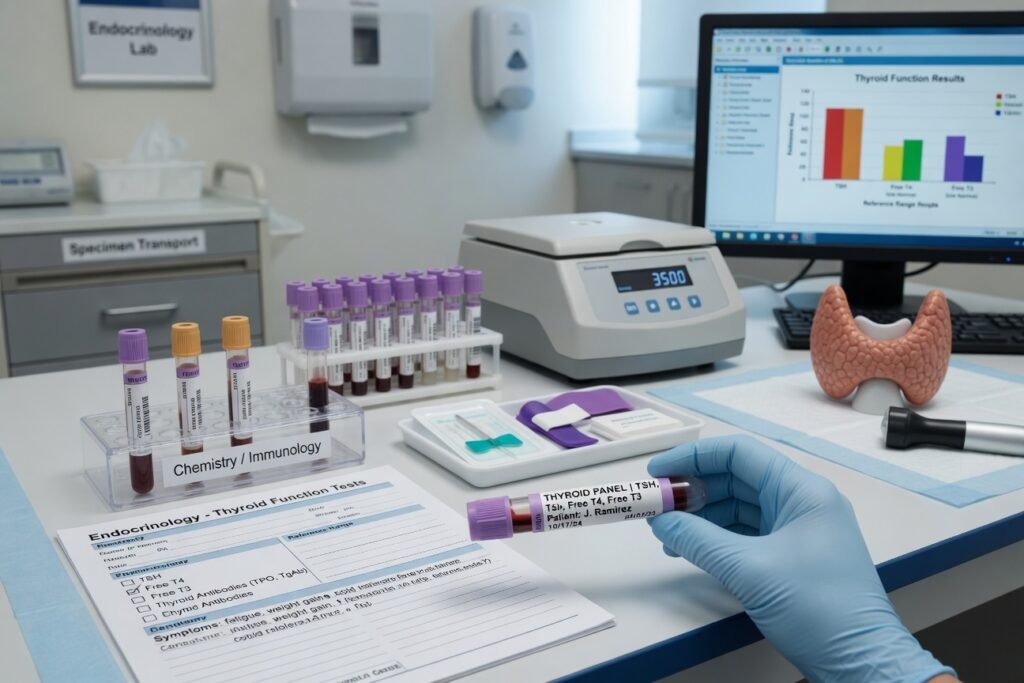

Why Did My Doctor Order a TSH Test When I Feel Fine? Understanding What Your Numbers Really Mean
Sarah, a 42-year-old accountant, came to her annual appointment feeling completely normal. Her doctor ordered routine bloodwork anyway and called three days later: her TSH was 8.5. “But I have no symptoms,” Sarah said, confused. That conversation illustrates a fundamental disconnect in thyroid medicine—your lab numbers don’t always match how you feel, and catching problems early through screening prevents months or years of suffering that hasn’t happened yet.
This matters because thyroid dysfunction affects roughly 12% of the U.S. population at some point in their lifetime, according to the American Thyroid Association, and roughly half of those cases go undiagnosed. Your thyroid is essentially your body’s metabolic control center, regulated by a feedback loop involving your pituitary gland and the hormones TSH, free T4, and T3. Understanding what these three tests actually measure—and how they interact—changes everything about how you interpret those confusing lab results your doctor hands you.
Key Facts About Thyroid Function Tests
- The CDC estimates that approximately 1 in 8 Americans will develop thyroid disease during their lifetime, yet only about half receive a diagnosis.
- TSH (thyroid-stimulating hormone) typically ranges from 0.4 to 4.0 mIU/L in standard labs, though some experts argue the upper limit should be 2.5 mIU/L for optimal health.
- Free T4 and Free T3 tests measure the active, unbound hormones; total T4 and T3 tests include bound hormones and are less clinically useful for most patients.
- Women are 5 to 8 times more likely to develop hypothyroidism than men, with risk increasing sharply after age 50.
- TSH can take 6 to 8 weeks to stabilize after a dose adjustment of levothyroxine, which is why your doctor won’t retest immediately after medication changes.
How Thyroid Tests Actually Work: The Three-Part Communication System
Think of your thyroid as a factory, your pituitary gland as the manager, and TSH as the radio communication between them. Your pituitary releases TSH as a signal that says, “Hey thyroid, we need more hormone output.” The thyroid responds by releasing T4 (thyroxine) and T3 (triiodothyronine), which circulate throughout your bloodstream telling your cells to speed up their metabolism. When enough thyroid hormone reaches the pituitary, it sends less TSH—a perfect negative feedback loop, until something breaks it.
Here’s the clinical insight most websites gloss over: TSH is an indirect measurement. A single TSH number doesn’t tell you definitively whether your thyroid is working properly. A high TSH usually means your pituitary is desperately signaling a sluggish thyroid (primary hypothyroidism). But a “normal” TSH with low free T4 might mean your pituitary itself isn’t working (secondary hypothyroidism), which requires different treatment. This is why ordering TSH alone, without free T4, can miss real problems.
Free T4 and free T3 are the actual thyroid hormones doing the work. Free means they’re circulating unbound and available to cells, not stuck to proteins. Total T4 is less useful because it includes bound hormone that isn’t immediately active—though some doctors still order it out of habit. When you check free T4, you’re measuring what’s actually available to speed up your metabolism, regulate temperature, and control your heart rate.
Why Thyroid Tests Get Ordered: Risk Factors and Who Actually Needs Screening
Your doctor should order thyroid tests if you have obvious symptoms, but the real question is: who needs screening without symptoms? Women over 50 should have at least one TSH check, according to American College of Physicians guidelines. Anyone with a family history of autoimmune thyroid disease or other autoimmune conditions has elevated risk—your immune system’s tendency to attack itself often runs in families. Similarly, if you have type 1 diabetes, celiac disease, or rheumatoid arthritis, your risk of developing thyroid disease climbs significantly.
The overlooked risk factor: medication-induced thyroid dysfunction. Lithium (used for bipolar disorder), amiodarone (for arrhythmias), and even some immunotherapy drugs for cancer directly damage thyroid function. If you take any of these, your doctor should check TSH periodically, not just once. Iodine deficiency is rare in the U.S. due to iodized salt, but people following strict low-sodium diets or vegan diets without seaweed supplementation can develop problems. Pregnancy is another critical time—thyroid hormone requirements increase 20 to 30%, which is why every pregnant patient should be screened.
Postpartum thyroiditis affects 5 to 10% of women in the first year after delivery. You feel fine during pregnancy, deliver, and then suddenly at 3 months postpartum you’re exhausted, anxious, and your heart races. Many women assume it’s postpartum depression or normal adjustment when actually their thyroid is flaring due to immune rebound after pregnancy’s immune-tolerant state. This is specifically why postpartum screening catches something important.
What Patients Actually Experience: Symptoms That Make You Question Your Sanity
Early hypothyroidism feels subtle. You notice your coffee doesn’t wake you up anymore. You gain five pounds despite eating the same. Your hair sheds slightly more in the shower. Your nails break easier. These are the whispers before the screams. As the condition worsens, fatigue becomes undeniable—the kind where you sleep 10 hours and wake unrefreshed. Your brain feels foggy. Concentration at work becomes an exhausting effort. Your skin dries out. Constipation develops. Women often report worsening PMS or heavier periods.
Hyperthyroidism, by contrast, makes you feel wired. Your heart races at rest. You’re anxious or irritable without obvious reason. You lose weight despite eating more. Heat bothers you intensely. Some patients describe trembling hands or insomnia that feels almost manic. The emotional component confuses people—they think they’re developing anxiety disorder when actually their thyroid is pouring out too much hormone.
The overlooked early warning sign: intolerance to temperature changes. Before full-blown symptoms, many patients report suddenly hating cold air or sweating excessively in mild temperatures. This reflects your thyroid’s control over metabolic rate and thermoregulation. If you’re dressing differently than you used to and can’t explain why, mention it to your doctor alongside your labs.
How Doctors Actually Diagnose Thyroid Disease: What the Process Looks Like
Your doctor starts with TSH. If it’s normal (between 0.4 and 4.0 mIU/L in most labs), many practices stop there and call you healthy. But this misses approximately 5 to 10% of people with subclinical hypothyroidism—TSH in the upper-normal range with free T4 already declining. If your TSH is abnormal, they order free T4 to confirm primary thyroid disease. If TSH is suppressed (low) with high free T4, you have hyperthyroidism or Graves’ disease. If TSH is elevated with low free T4, you have hypothyroidism, likely autoimmune (Hashimoto’s thyroiditis).
At that point, most doctors order thyroid peroxidase (TPO) and thyroglobulin antibodies to confirm autoimmune thyroiditis. This doesn’t change treatment—you’ll still take levothyroxine—but it explains why your immune system is attacking your own thyroid and helps predict the disease course. Some patients ask about free T3 testing. Your doctor might initially decline because T3 can be expensive and less standardized, but if you’re on thyroid replacement and still feel terrible, pushing for T3 testing is reasonable because a minority of patients need T3 supplementation alongside T4.
The actual experience: you give blood in the morning (after fasting makes results more consistent), wait 24 to 48 hours, and your doctor calls with numbers. Don’t compare your numbers to your friend’s numbers—lab reference ranges vary between companies. What matters is whether your results are normal or abnormal for your specific lab, and how you feel.
Treatment: What Actually Works and Why Different People Need Different Approaches
For hypothyroidism, levothyroxine (brand names Synthroid, Levoxyl, Unithroid) is first-line. It’s synthetic T4 that your body converts to T3 as needed. The typical starting dose is 25 to 50 micrograms daily, increased every 6 to 8 weeks based on TSH response. Most people stabilize on 75 to 150 micrograms daily, though some need higher doses. Take it on an empty stomach, 30 to 60 minutes before breakfast, because food and supplements interfere with absorption.
Some patients do well on levothyroxine alone. Others—perhaps 10 to 15% based on clinical observation—feel better when desiccated thyroid extract (brand name Armour Thyroid) or combination levothyroxine plus liothyronine (synthetic T3) is used. This isn’t standard practice and insurance often won’t cover it, but if you’re on levothyroxine, TSH is normal, and you still feel hypothyroid symptoms, discussing T3 supplementation is appropriate. Your doctor might dismiss this as unproven, and they’re technically correct by strict evidence standards, but quality-of-life improvement in specific patients is measurable.
For hyperthyroidism from Graves’ disease or toxic nodules, you have three real options: antithyroid drugs (propylthiouracil or methimazole), radioactive iodine ablation, or thyroidectomy. Methimazole is preferred for most people—it blocks thyroid hormone synthesis without destroying the gland, allowing remission possibility. Propylthiouracil is reserved for pregnancy or severe disease because of rare liver complications. Radioactive iodine (I-131) destroys thyroid tissue permanently; you become hypothyroid requiring lifelong levothyroxine, but it’s curative. Surgery is an option for patients who refuse radioactive iodine or have contraindications.
Managing Your Thyroid: Practical Strategies Beyond Just Taking Pills
Consistency matters more than most people realize. Take levothyroxine at the exact same time every morning. Your gut absorption varies slightly day-to-day, but consistent timing reduces that variability. Don’t stop taking it because you feel better—your symptoms improve because the medication is working. Stopping it causes symptoms to return within weeks as your thyroid can’t compensate.
Nutrient status directly impacts thyroid function. Selenium (Brazil nuts, fish) and zinc (oysters, beef, pumpkin seeds) are cofactors for the enzymes that convert T4 to T3. Iron deficiency worsens hypothyroidism symptoms even when TSH is normal, because your cells can’t respond properly to thyroid hormone. If you have fatigue despite normal TSH, ask your doctor to check iron studies (serum ferritin, iron, TIBC). Iodine intake should be moderate—avoid both deficiency (use iodized salt) and excess (don’t overuse seaweed supplements or kelp pills, which can contain 1000+ times normal daily needs).
Stress management has real effects. Chronic stress elevates cortisol, which impairs TSH secretion and T4 to T3 conversion. You can’t eliminate stress, but evidence shows that 20 to 30 minutes of regular aerobic exercise or meditation three times weekly measurably improves thyroid hormone metabolism. Sleep deprivation worsens hypothyroidism symptoms—your TSH rhythm is tied to circadian cycles, and poor sleep disrupts that pattern.
Prevention: What Actually Reduces Risk Before Problems Develop
True prevention of autoimmune thyroid disease isn’t possible because genetics determine your susceptibility. However, infection and stress trigger disease development in genetically vulnerable