
“`html
Do cataracts really make everything look yellowish, or is that just what people say happens?
That’s actually one of the most common patient questions I get, and the answer is: it depends on where the cataract is forming in your lens. A nuclear cataract—the type that develops in the center of your lens—does tend to create that brownish or amber tint because it changes how light refracts through the denser clouded area. But a cortical cataract, which forms in the outer layers like spokes on a wheel, typically causes glare and halos around lights instead. Most people assume cataracts are this single thing that affects everyone the same way, but the visual experience varies dramatically based on the cataract’s location, density, and how fast it’s progressing.
I’m writing this because I’ve watched patients delay surgery for years because they’re confused about what they’re actually experiencing, or they’ve read something online that doesn’t match their own symptoms. Let me walk you through what’s really happening in your eye, what your actual options are, and what recovery looks like after you decide to have surgery.
Key Facts About Cataracts
- More than 24 million Americans age 40 and older have cataracts in at least one eye, according to the National Eye Institute (NEI). By age 75, about half of all Americans have a cataract or have had cataract surgery.
- Cataracts progress at different rates—some stay stable for years while others progress from mild to vision-impairing within 12-18 months. There is no eye drop or medication that reverses cataract formation once it begins.
- Phacoemulsification with intraocular lens (IOL) implantation is the gold standard surgical approach, accounting for roughly 95% of cataract surgeries in developed countries, with success rates exceeding 98% for uncomplicated cases.
- Post-operative refractive error (needing glasses after surgery) occurs in about 10-15% of patients, which is why surgeons now use optical biometry and toric IOLs to correct astigmatism during the procedure itself.
- The economic burden of untreated cataracts in the United States exceeds $6 billion annually in lost productivity and increased healthcare costs, making early diagnosis genuinely important for quality of life.
Understanding How Cataracts Actually Develop
Your eye’s lens is made of proteins arranged in a precise, organized pattern. Think of it like a perfectly stacked pile of glass blocks—light passes straight through without scattering. A cataract forms when those proteins begin to clump together and denature, sort of like what happens when you cook egg whites and they turn from clear to opaque. The clouding doesn’t happen overnight in most cases. It’s a gradual process where proteins accumulate oxidative damage, aggregate, and disrupt the light pathways.
Here’s what most articles miss: the lens never stops growing. New lens cells are produced throughout your life, but they’re added to the outer surface. The older cells in the center get compressed and denser. This is partly why age itself is such a significant risk factor—your lens cells have simply had more time to accumulate damage. The proteins in the center of your lens from when you were born are still there, getting progressively more damaged by free radicals and metabolic stress.
Causes and Risk Factors—What Actually Matters
Age remains the strongest predictor. The Baltimore Eye Survey data showed that cataract prevalence doubled roughly every decade after age 40. But beyond age, ultraviolet (UV) radiation exposure plays a concrete role. Studies have linked cumulative UVB exposure to cataract formation, which is why protecting your eyes outdoors genuinely matters, not just for marketing purposes.
Diabetes accelerates cataract development significantly. Hyperglycemia causes sorbitol to accumulate in the lens through the aldose reductase pathway, drawing water in and causing swelling and protein denaturation. This is why diabetic patients sometimes develop cataracts in their 40s or even 30s—it’s not coincidence. Hypertension, smoking, and steroid medications (particularly inhaled or systemic corticosteroids used for asthma, COPD, or autoimmune conditions) all increase risk.
Here’s the factor most health websites skim over: previous eye trauma or inflammation. Anterior uveitis, even if resolved years ago, can trigger posterior subcapsular cataracts. I’ve seen patients who had an eye injury decades prior suddenly develop vision problems in that same eye because the cataract was germinating from the inflammation site all along. Ask about your injury history, even if you think it healed completely.
Signs and Symptoms—What You’ll Actually Notice
Early cataracts often produce no symptoms whatsoever. You might have one on your eye exam and feel completely fine. That’s why regular dilated eye exams matter, especially over age 50.
When symptoms do develop, the earliest complaint is usually blurred or dimmed vision that doesn’t improve with new glasses. Patients often describe it as looking through a dirty windshield or frosted glass. You might notice colors appear less vivid—blues and purples look muted, while yellows become more prominent. This color shift happens because the cataract filters shorter wavelengths of light.
Glare and halos around lights, especially while driving at night, are classic symptoms of cortical cataracts. Street lamps might have starburst patterns around them. Some patients experience monovision-like effects where one eye sees fine while the other is noticeably hazier. Reading becomes harder because you need more light to see clearly, and the printed words seem less sharp even with your reading glasses.
One overlooked early sign is frequent changes in your eyeglass prescription. When a nuclear cataract forms in the center of your lens, it can actually increase the lens’s refractive power temporarily, making you more myopic. Some patients notice they can suddenly read without reading glasses for a few months before vision deteriorates overall. This is called “second sight,” and it’s actually a red flag that a cataract is developing.
How Cataracts Are Actually Diagnosed
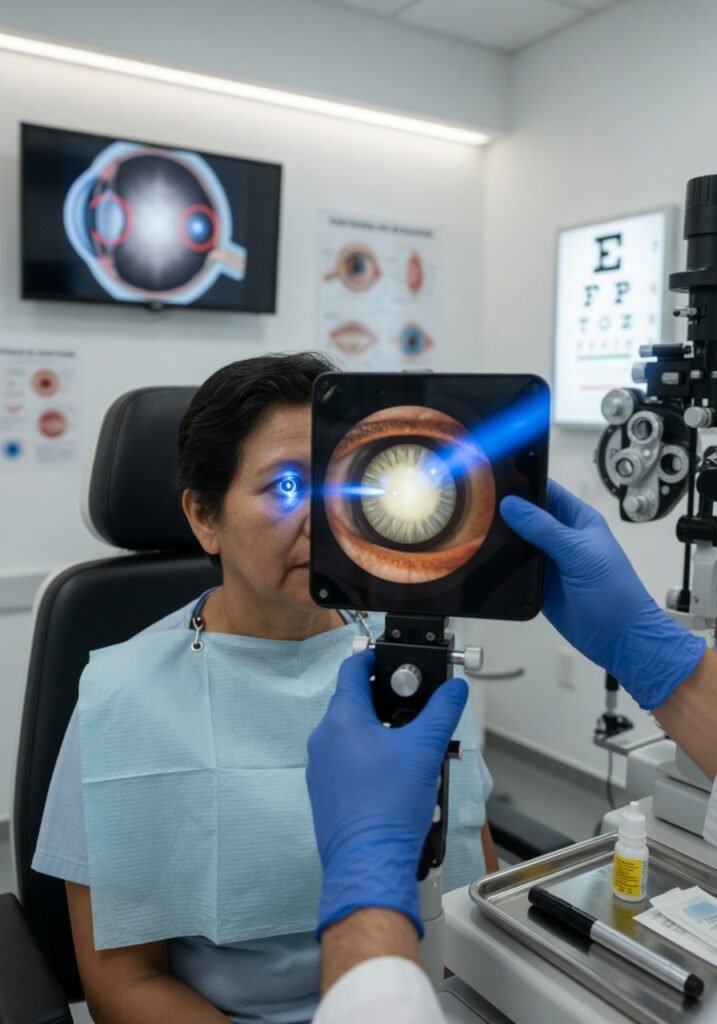
Your eye doctor will dilate your pupils and examine the lens directly with a slit lamp microscope. This is the only way to definitively see the cataract and grade its severity. The Lens Opacities Classification System (LOCS) is the standard—it grades cataracts on a scale, with higher grades indicating more advanced clouding.
Beyond visual inspection, your doctor will measure visual acuity and perform visual field testing to determine how much the cataract is actually affecting your function. Here’s something important: a cataract visible on an eye exam doesn’t automatically mean you need surgery. The decision hinges on whether your symptoms match the clinical findings and whether surgery would meaningfully improve your life.
Optical coherence tomography (OCT) can help rule out other causes of vision loss, like age-related macular degeneration or diabetic retinopathy, that might coexist with the cataract. If you’re a surgical candidate, your doctor will perform optical biometry (usually with IOLMaster or similar devices) to measure your eye’s dimensions and calculate the correct power of the intraocular lens you’ll receive.
Treatment Options and What Works Best
There is no medication, supplement, or eye drop that stops or reverses cataracts. If you see marketing claims about N-acetylcarnitine drops or other compounds preventing cataracts, those are not supported by rigorous clinical evidence. Some studies suggest antioxidant vitamins like lutein, zeaxanthin, and vitamin C might slow progression, but they won’t reverse existing opacity.
Surgery is the only definitive treatment. Phacoemulsification is the standard approach—your surgeon makes a small incision, uses ultrasonic waves to break up the clouded lens into tiny fragments, and vacuums those pieces out. Then an intraocular lens (IOL) is implanted to replace your natural lens’s focusing power.
IOL options have expanded significantly. Standard monofocal lenses correct distance vision, and you’ll likely need reading glasses afterward. Premium IOLs include multifocal lenses (Tecnis Multifocal, ReSTOR, Symfony) that allow functional vision at multiple distances, and toric IOLs (Alcon Toric, Bausch + Lomb Enlight Toric) that correct astigmatism simultaneously. These premium lenses cost more out-of-pocket but reduce dependence on glasses post-operatively.
Laser-assisted cataract surgery (LACS) uses a femtosecond laser for some surgical steps, but studies in JAMA Ophthalmology have not demonstrated superior visual outcomes compared to manual phacoemulsification for routine cases. For complex eyes (dense cataracts, small pupils, previous corneal surgery), it may offer advantages.
Practical Daily Management Before Surgery
While you’re deciding whether to have surgery or waiting for your procedure date, here are concrete strategies that actually help. Increase lighting in your home—use higher-wattage bulbs or add task lighting for reading and detail work. Position lights behind you when reading so they illuminate the page rather than creating glare in your eyes.
Wear quality sunglasses with UV protection outdoors, even on cloudy days. UV penetrates cloud cover, and reducing glare makes driving and outdoor activities more comfortable. Anti-glare or polarized lenses reduce halos around lights.
Update your eyeglass prescription if your vision has shifted, but understand that frequent changes might indicate cataract progression rather than refractive error. If you’re experiencing significant monovision effects, covering or closing the affected eye while doing detail work can improve clarity temporarily.
For driving, consider shifting to daytime-only driving if night vision has become hazardous. Most states don’t require specific visual acuity for licensing, but you’re legally and ethically responsible for safe driving. If you’re uncertain, ask your eye doctor specifically whether your vision meets safe driving thresholds.
What to Expect From Cataract Surgery Recovery
Most cataract surgeries take 10-15 minutes per eye under topical anesthesia. You’re awake the entire time, aware of light and movement but not feeling pain. Many patients report it’s less stressful than anticipated.
Vision improves rapidly in the first week. By day one or two, you’ll likely notice clearer vision, though it may be slightly blurry initially due to swelling and the antibiotic/anti-inflammatory drops your doctor prescribes (typically ofloxacin or moxifloxacin drops combined with prednisolone acetate). By two weeks, most patients achieve near-final visual acuity, though it can continue improving for 4-6 weeks as swelling fully resolves.
You’ll use medicated eye drops for about a month—anti-inflammatory drops usually three times daily, tapering to twice daily by week three. Your eye will feel scratchy, sensitive to light, and potentially itch as the cornea heals. This is completely normal and improves daily.
Restrictions include avoiding heavy lifting (over 25 pounds), strenuous exercise, and eye rubbing for at least two weeks. Water exposure during shower is fine after 48 hours if you’re careful, but no swimming or water aerobics for two weeks due to infection risk. Most people return to normal activities within a few weeks.
Prevention: What the Evidence Actually Shows
UV protection is genuinely preventive. Long-term sunglasses use reduces cataract risk, so this isn’t marketing hype. Wear sunglasses outdoors, especially if you live in sunny climates or spend significant time outside.
Smoking cessation matters substantially. Smokers develop cataracts 10-20 years earlier than non-smokers on average, according to prospective cohort data. Oxidative stress from cigarette smoke accelerates lens protein damage.
Tight glycemic control in diabetic patients slows cataract progression. This