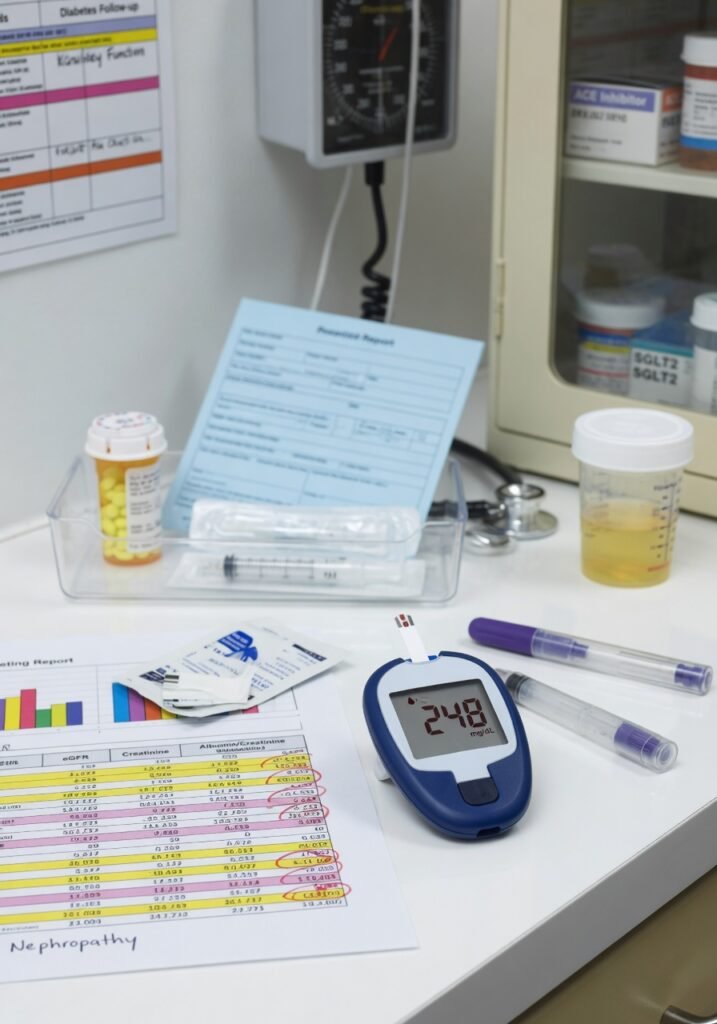
Why does my doctor keep checking my urine at every visit, even though my blood sugar feels “fine”? That question, which I hear from diabetic patients at least twice a week in clinic, reveals a critical blind spot. Most people with diabetes focus entirely on blood glucose numbers while ignoring the silent damage happening in their kidneys right now. Diabetic nephropathy—kidney disease caused by high blood sugar—affects roughly 30% of people with type 1 diabetes and 25% of those with type 2 diabetes, yet many don’t discover it until their kidneys are already badly scarred. Unlike high blood sugar, which you might feel, kidney damage produces almost no early symptoms. You feel completely normal while your filtering units, called nephrons, are being systematically destroyed.
Key Facts About Diabetes and Kidney Disease
- According to the CDC, diabetes is the leading cause of kidney failure in the United States, accounting for approximately 35% of all dialysis patients
- The NIH reports that approximately 1 in 3 adults with diabetes have chronic kidney disease, often without knowing it
- Albuminuria (protein leakage into urine) can begin appearing 5-10 years after diabetes onset, sometimes even earlier in type 1 diabetes
- African American and Hispanic populations develop diabetic nephropathy at 2-3 times the rate of non-Hispanic white populations, regardless of blood sugar control
- Early intervention can slow kidney disease progression by 30-50%, which is why screening matters even when you feel perfectly well
Understanding How Diabetes Damages the Kidneys
Your kidneys are essentially biological water treatment plants. About 180 liters of fluid pass through them daily, and a network of delicate blood vessels called glomeruli filters out waste while keeping proteins and blood cells inside your bloodstream. When blood sugar stays elevated for years, glucose molecules stick to the structural proteins in these tiny filtering units and damage their walls.
Think of it like repeated acid burns on exposed skin. One burn might heal. Hundreds of burns over a decade create scarring that never fully repairs. In diabetes, this process happens inside microscopic structures you can’t see or feel. The glomeruli thicken, their walls become rigid, and their filtering ability deteriorates. Proteins start leaking into your urine—first in amounts your doctor can only detect with a simple test, later in amounts you might notice as foaming urine or swollen ankles.
What makes this particularly insidious is the timing. Most people develop kidney damage 10-15 years after their diabetes begins. By that point, they’ve already accumulated significant permanent scarring. Catching it early, when only microscopic protein is leaking, means your treatment decisions can actually prevent progression.
Causes and Risk Factors You Need to Know
Obviously, chronically high blood sugar is the primary culprit. But blood sugar alone doesn’t explain why some people with mediocre glucose control never develop kidney disease while others with excellent control sometimes do. The missing pieces are worth understanding.
Hypertension is arguably as important as blood sugar for kidney health. High blood pressure directly damages glomerular blood vessels, accelerating the scarring process. Someone with a hemoglobin A1c of 7.5% but a blood pressure of 160/100 faces higher kidney disease risk than someone with an A1c of 8.2% and well-controlled pressure at 120/75. Yet patients often accept “I just have to watch my blood sugar” while neglecting blood pressure.
Genetics matter significantly. If your parents or siblings developed diabetic kidney disease, your risk increases substantially even with identical blood sugar levels. This genetic predisposition isn’t destiny—it’s a reason to be more aggressive with preventive treatments—but it’s rarely mentioned in standard discussions.
An often-overlooked risk factor is sodium sensitivity, which varies by ethnicity and genetic background. Some people’s kidneys are exquisitely sensitive to dietary salt, meaning a high-sodium diet accelerates kidney disease development independent of blood sugar or blood pressure numbers. Your doctor might recommend a low-sodium diet generically, but for certain genetic groups (particularly African Americans), this becomes medically essential rather than optional.
Duration of diabetes matters—someone with 20-year diabetes faces higher risk than someone at year 3, all else equal. Smoking accelerates kidney disease progression by about 50% compared to nonsmokers. Certain medications, particularly NSAIDs like ibuprofen, can trigger kidney damage in diabetics more easily than in non-diabetics.
Signs and Symptoms: What You Actually Experience
Here’s the clinical reality: early diabetic nephropathy produces zero symptoms. Your kidneys don’t have pain receptors. You won’t feel anything wrong. This is why screening catches it, not symptoms.
As kidney disease progresses to moderate stages, you might notice subtle changes. Swelling in your ankles or around your eyes, particularly in the morning. Increased nighttime urination—needing the bathroom 4-5 times after bedtime instead of once. Unusual fatigue that doesn’t match your sleep or exercise. These symptoms develop slowly enough that you might attribute them to aging or stress.
By the time someone develops obvious symptoms—difficulty concentrating, persistent nausea, loss of appetite—their kidney function has usually declined to less than 30% of normal. They’ve crossed the line into advanced chronic kidney disease where damage is largely irreversible.
The truly frustrating part? That patient usually asks, “Why didn’t my doctor catch this earlier?” The answer is often that blood pressure and urine protein checks weren’t done consistently enough, not that the disease couldn’t have been detected.
How Diagnosis Actually Works
Your doctor should perform three tests annually if you have diabetes: fasting blood glucose or A1c (which you probably already get), blood pressure (which gets checked but often not recorded as carefully as it should be), and urine albumin-to-creatinine ratio. That last one is the one that screens specifically for kidney damage.
The urine test is straightforward. You provide a random urine sample, and the lab measures how much albumin (a protein) is present relative to creatinine (a waste product your muscles produce at a constant rate). Normal is less than 30 mg/g. Microalbuminuria is 30-300 mg/g. Macroalbuminuria is greater than 300 mg/g. That numerical progression tells your doctor how far the kidney damage has progressed.
If albumin appears, your doctor orders a serum creatinine test, which measures kidney function more directly. The actual glomerular filtration rate (GFR) calculated from this blood test tells you how many milliliters of waste your kidneys filter per minute. Normal is 90 or higher. Stage 3a chronic kidney disease is 45-59. Stage 4 is 15-29. Stage 5 is below 15, meaning dialysis becomes necessary.
Some doctors might order an ultrasound or, rarely, a kidney biopsy if the findings are confusing. But usually, the diagnosis comes from these simple blood and urine tests done during routine care.
Treatment Options That Actually Slow Progression
Two drug classes have strong evidence for slowing diabetic kidney disease: ACE inhibitors and ARB medications. Lisinopril, enalapril, ramipril (ACE inhibitors) or losartan, valsartan, irbesartan (ARBs) reduce intraglomerular pressure—they lower the damaging hydraulic force inside the kidney’s filtering units. Studies show these drugs can slow progression by 20-30% beyond what blood pressure control alone achieves. Most diabetics with any sign of kidney disease should be on one of these medications.
A newer class called SGLT2 inhibitors (empagliflozin, dapagliflozin, canagliflozin) has shown remarkable kidney protective effects in recent trials. These were originally developed for blood sugar control, but they work through a completely different mechanism for kidney protection. The JAMA published the Dapagliflozin and Prevention of Adverse Outcomes in Chronic Kidney Disease trial showing these drugs reduce kidney disease progression by 39% even in non-diabetics. For diabetic patients, they’re increasingly considered first-line therapy.
GLP-1 receptor agonists like semaglutide and dulaglutide provide additional benefit, particularly for patients who need weight loss and blood sugar control.
Blood pressure targets for diabetics with kidney disease are stricter than for the general population. Most guidelines recommend a target of 130/80 or lower, sometimes lower if tolerated. This typically requires two or three antihypertensive medications working together.
Controlling blood sugar remains important—an A1c target of 7.0-7.5% offers kidney protection without excessive hypoglycemia risk. Some doctors argue for slightly looser control (A1c to 8.0%) in advanced kidney disease to reduce hypoglycemia risk, since kidneys also regulate glucose metabolism.
Daily Management Strategies That Matter
Beyond medications, concrete daily actions affect kidney health significantly. Sodium intake should stay below 2,300 mg daily, and for maximum kidney protection, aim for under 2,000 mg. This means reading every label on packaged foods—processed foods hide enormous salt loads. Restaurant meals often contain 1,500 mg in a single entree.
Protein intake needs adjustment once kidney disease develops. People often think “eat more protein to stay healthy,” but excess protein forces kidneys to work harder. Once albumin appears in urine, many nephrologists recommend limiting protein to 0.8 grams per kilogram of body weight daily. For a 180-pound person, that’s roughly 65 grams daily—about what you get from two 3-ounce chicken breasts, not the 150+ grams many Americans consume.
Hydration requires nuance. Unlike the “drink eight glasses daily” generic advice, someone with diabetic kidney disease should drink enough to maintain pale urine color but not excessive amounts. Overhydration stresses damaged kidneys.
Regular, moderate exercise—150 minutes weekly of walking, swimming, or cycling—directly improves kidney outcomes beyond its effects on blood sugar and weight. The mechanism isn’t entirely understood, but the evidence is solid.
Avoid NSAIDs for pain. Ibuprofen, naproxen, and similar drugs can accelerate kidney disease. Acetaminophen or prescription opioids become safer choices if pain develops, though obviously opioids carry their own risks.
Prevention: What the Evidence Actually Shows
The strongest prevention evidence points to tight blood pressure control before kidney disease begins. Maintaining blood pressure below 130/80 even in early diabetes reduces kidney disease development by roughly 35-40% compared to less stringent control.
Avoiding weight gain or losing weight if overweight provides substantial benefit. Each kilogram of weight loss improves kidney health, probably through multiple mechanisms—reduced inflammation, improved blood pressure, better insulin sensitivity.
Controlling blood sugar, while necessary, isn’t sufficient alone. Many people achieve excellent A1c values but develop kidney disease anyway if their blood pressure isn’t controlled. The combination matters more than perfecting any single metric.
Early identification of microalbuminuria creates a critical window for prevention. Someone detected with 50 mg/g albumin at year 10 of diabetes can often be brought back to normal urine protein within 12-24 months with aggressive ACE inhibitor or ARB therapy, plus strict blood pressure control. Wait until macroalbuminuria develops, and that window closes.
Frequently Asked Questions About Diabetes and Kidney Disease
Not entirely, but early-stage disease with significant proteinuria can improve with aggressive treatment. Studies show that intensive blood pressure control, ACE inhibitors, and SGLT2 inhibitors can reduce protein leakage by 50-60% in microalbuminuria. Once scarring becomes extensive (stage 4-5 kidney disease), reversal isn’t possible, though progression can still be slowed substantially
Sources & Medical References
HealthTopics.com articles are based on peer-reviewed medical research and guidance from the NIH, CDC, and WHO. See our editorial policy for full sourcing standards.