Sunburn Isn’t Just a Surface Problem—And That’s What Most People Get Wrong
Maria, a 34-year-old accountant, spent a Saturday at the beach last July without reapplying sunscreen. By evening, her shoulders and chest were visibly red. She figured she’d ice it, take some ibuprofen, and be fine in a week. What she didn’t know was that the DNA damage in her skin cells had already begun a cascade of inflammation that would continue for months—and that her risk of melanoma had just increased, regardless of whether the burn ever fully healed.
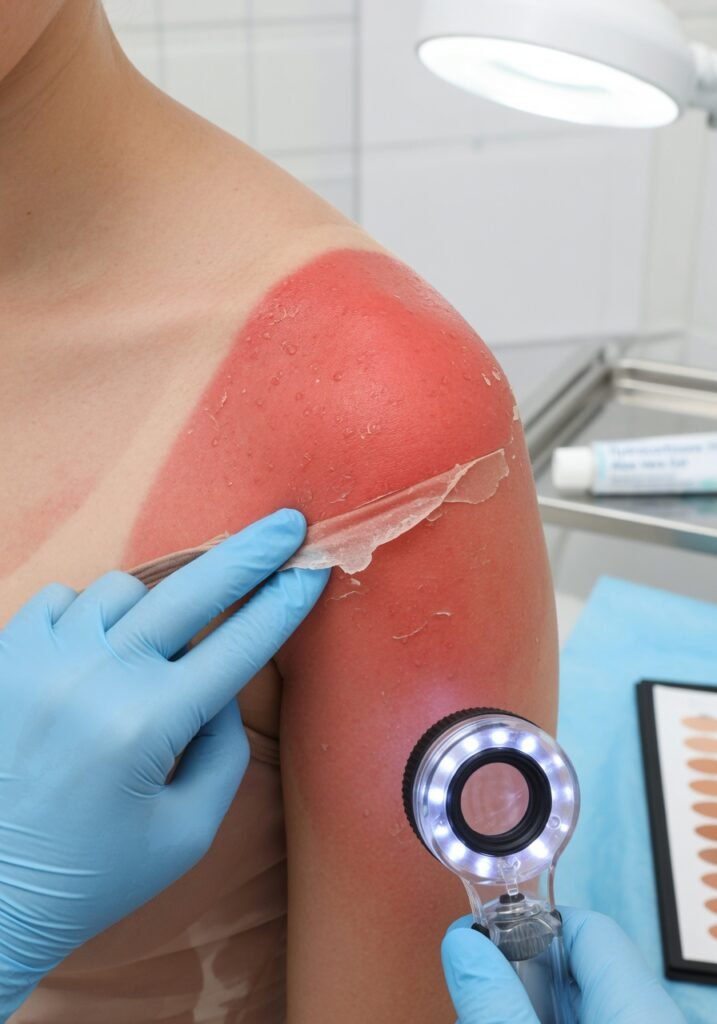
Most people think of sunburn as purely cosmetic—a red, painful nuisance that fades. The truth is uglier. Sunburn represents actual cellular injury. The redness you see is your body’s inflammatory response to thousands of sun-damaged skin cells. Some of those cells have sustained mutations in their DNA. Once that damage occurs, it doesn’t simply vanish when the burn fades. It accumulates.
Key Facts About Sunburn
- According to the CDC, more than one-third of American adults report getting sunburned at least once in the previous year—meaning roughly 80 million adults experience this injury annually.
- Sunburns that cause blistering represent a second-degree thermal injury equivalent to a minor burn from a stove or flame, not merely surface irritation.
- Peak UV exposure occurs between 10 AM and 4 PM, but 40% of daily UV radiation still reaches Earth during morning and late-afternoon hours, catching people off guard.
- A single severe sunburn during childhood increases lifetime melanoma risk by approximately 20%, and five or more serious burns increases risk by 80% according to NIH data.
- UVA radiation penetrates deeper into the dermis than UVB and doesn’t cause immediate redness—you can suffer significant UVA damage and feel nothing until hours later.
Understanding What Actually Happens During Sunburn
Your skin contains melanocytes—specialized cells that produce melanin as a protective pigment. But melanin isn’t a sunscreen. It’s more like a fire extinguisher that works after the fire has already started. When ultraviolet radiation hits your skin, it damages the DNA inside nearly every exposed cell, whether that cell is a melanocyte or not.
The immediate redness you see appears because your immune system recognizes this cellular damage and floods the area with inflammatory mediators. Your blood vessels dilate. Immune cells arrive. This is your body essentially saying: “Something is very wrong here.” The pain comes from nerve endings responding to both the heat and the chemical messengers of inflammation.
But here’s the critical part most articles skip: some of the cells with DNA damage don’t die immediately. They survive, but they’re mutated. Over years and decades, some of these mutated cells can multiply out of control—that’s how skin cancer develops. It’s not that one sunburn automatically causes cancer. It’s that each sunburn adds to the accumulated damage burden your skin carries.
Who Gets Burned and Why Some People Face Greater Risk
Skin type matters, but not in the way casual conversation often presents it. People with darker skin contain more baseline melanin and absorb UV radiation differently. A person with very dark skin might not develop visible erythema (the medical term for redness) from the same UV exposure that would badly burn someone with very fair skin. But don’t mistake this for immunity. Darker skin can still sustain DNA damage; it simply doesn’t display the inflammatory response as visibly. In fact, dermatologists often find that people with darker skin sometimes neglect sun protection precisely because they don’t see the red warning sign, leading to higher melanoma mortality rates in some populations.
Age is another underappreciated factor. Children absorb more UV radiation per unit of skin surface than adults because their skin is thinner and their protective mechanisms aren’t fully developed. A 7-year-old receives proportionally more UV penetration than a 37-year-old from identical sun exposure. This is why childhood sunburns carry such outsized risk.
Certain medications amplify sunburn risk by triggering photosensitivity—a chemical reaction between the drug and UV light. Tetracyclines (like doxycycline, commonly prescribed for acne), thiazide diuretics for blood pressure, nonsteroidal anti-inflammatories like naproxen, and some antibiotics in the fluoroquinolone class all increase burn risk. Many people don’t know their medication carries this risk until they burn badly after minimal sun exposure.
High altitude increases UV intensity by roughly 10% for every 1,000 meters of elevation. Someone hiking at 8,000 feet receives substantially more UV than someone at sea level on the same sunny day.
What Sunburn Actually Feels Like—And Early Warning Signs Most People Miss
The first sign often comes hours after sun exposure ends. You might feel a slight warmth or tenderness on your shoulders, but think nothing of it because the color hasn’t developed yet. This is the inflammatory cascade beginning, but many people ignore it. By evening, the redness becomes undeniable. By the next morning, the affected skin often feels hot to the touch, and any pressure—even from your shirt—causes sharp discomfort.
Severe sunburns bring systemic symptoms: chills, fever, nausea, headache. These indicate your body is mounting a whole-body inflammatory response to extensive skin damage. Some people develop fluid-filled blisters. This isn’t just painful irritation—this is second-degree burn territory, and it demands different treatment than simple erythema.
An overlooked early warning is when you notice your skin feels tight and unusually warm several hours after coming indoors. That sensation, before visible redness peaks, represents peak inflammation. This is your cue that damage has occurred, even if the cosmetic appearance hasn’t fully developed.
How Sunburn Gets Diagnosed
Sunburn diagnosis is primarily clinical. Your doctor or dermatologist will look at the affected area and ask when the exposure occurred. They’ll assess the depth and distribution of erythema. They’ll touch the skin to check for pain, warmth, and blanching (whether the redness fades briefly when pressed). They’ll ask whether you have blisters, because blistering moves the injury from first-degree to second-degree classification.
There’s no blood test for sunburn, no imaging study. The diagnosis is visual and tactile. What your doctor is really assessing is the severity—is this superficial thermal injury, or has it penetrated deeper?—because that determines treatment intensity.
If you have extensive burns affecting more than 20% of your body surface, fever, chills, or blistering, you should be evaluated. This isn’t just for reassurance; systemic symptoms can indicate heat injury progressing to heat exhaustion or heat stroke, which require different intervention.
Treatment That Actually Works
First, understand that no treatment reverses DNA damage. Nothing will undo the mutation in those cells. Treatment manages pain, reduces inflammation, and supports healing of the damaged tissue layer.
NSAIDs taken early make a measurable difference. Ibuprofen (Advil, Motrin) or naproxen (Aleve) reduce inflammation if started within the first few hours after sun exposure, before peak inflammation develops. The evidence supports taking these regularly for the first 24-48 hours, not just on-demand. Acetaminophen (Tylenol) helps with pain but doesn’t address inflammation as effectively.
Cool (not cold) compresses reduce pain and slow inflammation. Water at room temperature applied for 15-20 minutes multiple times daily is more effective than ice, which can damage already-compromised skin further. Some people find relief in cool baths, but avoid the temptation to soak for hours—excessive water exposure can dry skin further once you leave the bath.
Topical corticosteroids like hydrocortisone 1% cream reduce inflammation, particularly in the first 24-48 hours. Stronger prescription-strength steroids (triamcinolone or clobetasol) help significantly with severe burns, though they carry risks with prolonged use.
Aloe vera gets frequent mention but deserves skepticism. Some formulations help due to their cooling and moisturizing properties, but pure aloe (particularly ones with added lidocaine, which can cause contact dermatitis on damaged skin) isn’t clearly superior to plain moisturizers. Cetaphil or CeraVe applied to damp skin works reasonably well.
Blistering burns need different attention. Don’t pop blisters—they protect deeper tissue underneath. If a blister ruptures naturally, cleanse with gentle soap and apply an antibiotic ointment like Neomycin or Bacitracin, then loosely cover it. If blisters are extensive, prescription-strength topical antibiotics might be warranted to prevent infection.
Managing Sunburn Day-to-Day
Wear loose clothing that won’t stick to or rub burned areas. Cotton is better than synthetics. Avoid anything tight across your shoulders if that’s where the burn is worst.
Stay hydrated. Sunburn draws fluid to the skin surface as part of the inflammatory response, leaving less available for the rest of your body. Drink water consistently—not just when thirsty.
Avoid further sun exposure completely while burned. The damaged skin has compromised barrier function; additional UV exposure compounds the injury.
Expect peeling and itching as the skin heals. This usually begins 3-5 days after the burn. Resist the urge to pick or scratch. Use unscented moisturizer and keep nails trimmed. Some itching is inevitable as dead skin cells are shed, but gentle moisturizing minimizes severity.
Don’t use products containing petroleum jelly (Vaseline) on extensive burns—these create an occlusive seal that can trap heat. Light moisturizers work better.
Prevention—What Actually Works
Broad-spectrum sunscreen with SPF 30 or higher blocks most UVB and some UVA. The word “broad-spectrum” matters because it addresses both types. SPF 30 filters approximately 97% of UVB rays; SPF 50 filters about 98%. The difference isn’t proportional—higher SPF numbers offer diminishing returns.
Amount applied matters far more than product choice. Most people apply roughly one-quarter the recommended quantity. A teaspoon for your face, a shot glass-worth for your entire body. Most sunscreens lose effectiveness after water exposure or about 80 minutes on dry skin—the “water-resistant” label means 40 or 80 minutes, depending on the product. Reapply after swimming or sweating significantly.
Physical (mineral) sunscreens using zinc oxide or titanium dioxide sit on top of skin and reflect UV rays. Chemical sunscreens like oxybenzone or avobenzone absorb UV energy and convert it to heat. Both work; physical sunscreens feel heavier, while chemical sunscreens may cause irritation in sensitive skin. Neither is inherently superior.
Timing matters—reapply sunscreen every two hours, earlier if you’re in water or sweating. Sunscreen on day one of a beach vacation is useless if you don’t reapply on day two.
Seek shade during peak intensity hours (10 AM to 4 PM). UV index exceeds 6 during these hours in most of the US during summer months, requiring more aggressive protection.
Frequently Asked Questions
Does vitamin D deficiency develop if I avoid sun to prevent sunburn?
Not from reasonable sun protection. Your skin produces vitamin D from just 10-30 minutes of midday sun exposure several times per week—far less than the duration needed for recreational sun exposure that causes burns. If you’re concerned, supplementation with vitamin D3 (1000-2000 IU daily) is simpler and safer than relying on unprotected sun exposure for vitamin D synthesis.
Sources & Medical References
HealthTopics.com articles are based on peer-reviewed medical research and guidance from the NIH, CDC, and WHO. See our editorial policy for full sourcing standards.